The first thing SHADOW made was a mistake. Lisette Sand-Freedman and Brad Zeifman had left established publicity jobs in 2007 with a handful of promising clients, an office in Sand-Freedman’s apartment and a name: ZSF Media. They carried it into a meeting with Armani Exchange. The response was immediate. It sounded, the marketing team told them, like a sneeze. Come back with something else.
This is the sort of moment that business histories usually sand down. SHADOW kept it. Sand-Freedman walked around her apartment asking what the company was actually for. The answer was hiding in the relationship between agency and client. The agency would stand beside the brand, present but not preening, helping the client catch the light. SHADOW was a name, a correction and an operating principle at once.
The funny part is that the quiet name now belongs to a conspicuously busy company. SHADOW does public relations, but also creative strategy, scripts, films, photography, social programming, influencer and celebrity relations, pop-ups and events. It works mainly for consumer brands in beauty, fashion, retail, hospitality, spirits, technology and packaged goods. The client list has included e.l.f. Beauty, American Eagle and Aerie, Google Shopping, Estée Lauder, K18, Sony, Pottery Barn, 1 Hotels and Cadillac. Its product is not a press clipping. It is a connected sequence of attention.
The $7 million exam
In early 2024, e.l.f. Cosmetics had a hard brief. The beauty company wanted a national Super Bowl commercial that would exceed its regional debut from the year before. A 30-second slot in that game cost about $7 million, before production. There is no hiding on a stage that expensive. SHADOW’s idea began in a 3 a.m. text.
The team had noticed three things. Courtroom entertainment was everywhere: Suits had returned to popular culture, Jury Duty had become a meme factory, and Judge Judy Sheindlin still occupied a category of her own. E.l.f. had a product proposition centered on quality and accessibility. And the brand’s community already enjoyed treating beauty conventions as things worth cross-examining. Put the pieces together and you get Judge Beauty - a camp courtroom presided over by Sheindlin, populated by actors, reality personalities and creators, with overpriced cosmetics on trial.
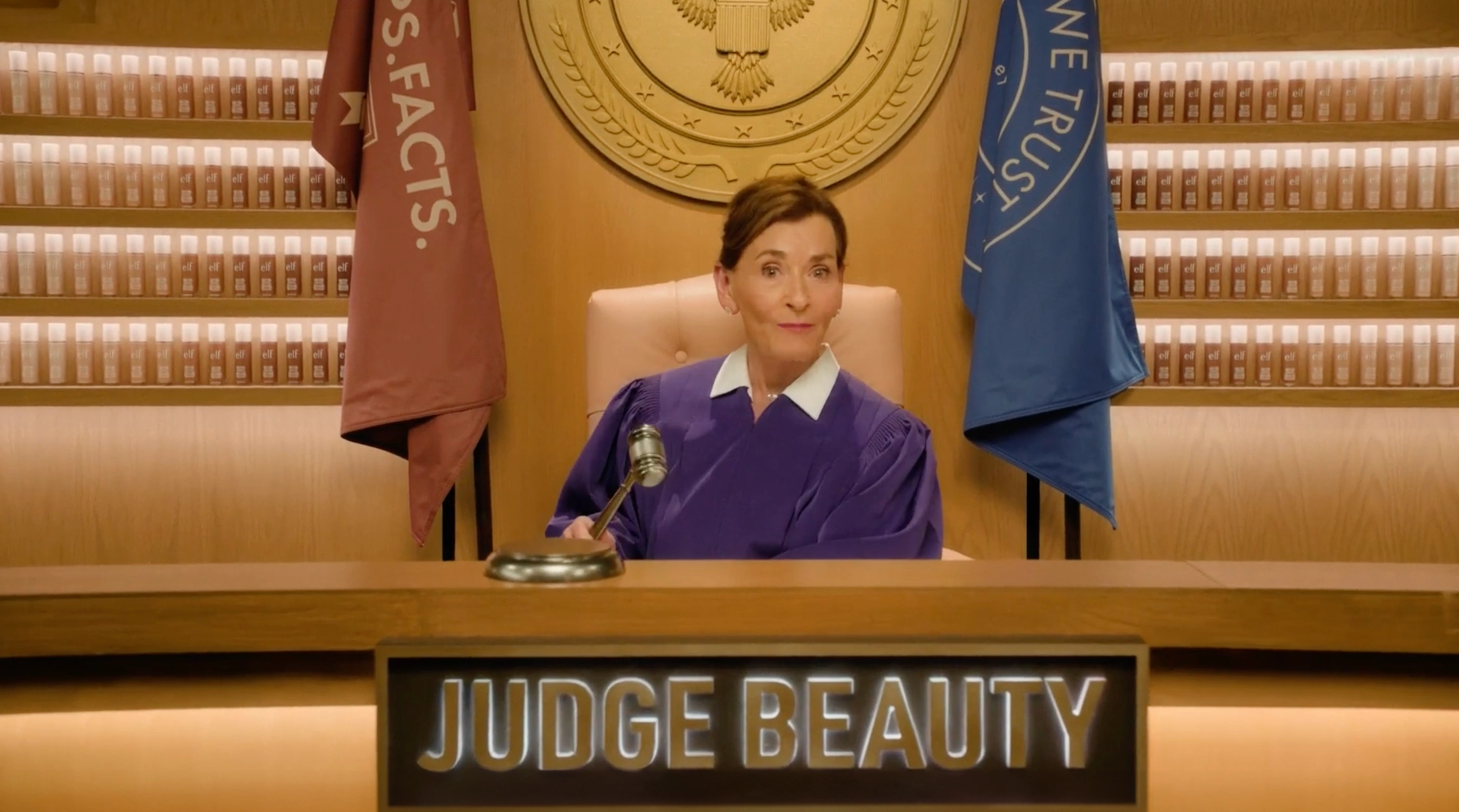
The commercial was only the ignition. SHADOW made a hero film, a longer cut, short versions, outdoor placements and digital material. It arranged the public-relations rollout in four pulses, teased cast members and kept creator content moving for a month after the game. The agency reports more than 100 billion earned-media impressions, 94 percent net-positive sentiment among notable beauty brands and a 118 percent increase in total site users. The spot later won a Webby.
The product is the plot
A year earlier, e.l.f. had given SHADOW an even stranger constraint: make the brand’s first commercial, for the Super Bowl, in three weeks. The featured Power Grip Primer had become famous online for its stickiness. SHADOW did not bury that benefit under an abstract manifesto. It exaggerated it until Jennifer Coolidge’s face stuck to her phone and a shower door. The product demonstration became the joke.
That decision is easy to copy and surprisingly rare. Begin with the physical or emotional fact a customer understands fastest. Then ask what would happen if that fact became absurdly powerful. SHADOW paired the primer’s grip with Coolidge just after The White Lotus, folded in her then-viral wish to play a dolphin, and moved before the references went stale. The agency reports 10 billion earned impressions in the first 24 hours and 57 billion over time. The work won a Webby People’s Voice award.
The same machinery appears at different scales. For Aerie, the useful fact was not a garment but a community position. SHADOW curated small New York brands into a one-day Hidden Gems Marketplace in the Meatpacking District, added fittings, donations and playful booths, and made an event that worked as shopping, content and press. It drew more than 800 people and, by the agency’s count, 2.7 billion impressions. For Google Shopping and Pat McGrath Labs, a virtual makeup try-on tool became a real pop-up: 3,500-plus attendees, 850,000 engagements and 3.4 million impressions. Technology became easier to understand once people could play with it.
A PR firm after PR fragmented
Traditional public relations assumed a relatively tidy route: a company told its story to a publicist, the publicist told an editor, and the editor told everyone else. SHADOW was born near the end of that arrangement. By 2016, the founders had removed “PR” from the company name because the work had already escaped it. Editors still mattered, but so did creators, feeds, brand channels, search interfaces, talent, live audiences and the camera phones inside every event.
SHADOW’s answer was not to choose one lane. It built the lanes into the same engagement. A brand can hire the agency for communications, social, creative, influence, content or experience - and long relationships let those disciplines accumulate context. American Eagle has worked with the firm for well over a decade. Observer reported in 2025 that 40 percent of SHADOW’s accounts had lasted more than seven years. In agency economics, where retainers and projects pay the bills, that continuity is both a moat and a creative advantage. The team remembers what the brand has already said.

The culture mirrors the name. Employees call themselves “shadows.” Early hires Michelle Sokoloff and Liza Suloti grew into co-founders in the current leadership structure; other long-serving executives became partners. The founders have described these leaders as their factual counterweight. That matters because SHADOW’s origin mythology is full of gut decisions - opening a West Coast office only five months after launch, pursuing work that supplied energy rather than merely paying bills, and treating a blunt no as information.
Speed has a cover charge
The attractive lesson is “move at the speed of culture.” The less attractive detail is that speed requires prepared people, decisive clients and money already allocated. SHADOW could make e.l.f.’s first Super Bowl spot in three weeks because the brand already understood its voice, the agency already understood the audience and both sides could approve unusual work quickly. A committee still debating its personality cannot borrow this method at the last minute.
Nor does a famous face rescue a weak product idea. Coolidge worked because stickiness was the joke. Judge Judy worked because judgment was the structure. Simone Biles worked for K18 because the campaign connected inner strength to repair and performance. Remove that fit and celebrity becomes decoration - expensive, briefly visible decoration.
Steal the sequence, not the spectacle
- Write the simplest true sentence about the product.
- Find a current behavior or format that makes the sentence more vivid.
- Choose talent for strategic fit, not follower count alone.
- Design the long tail before the hero moment launches.
- Measure behavior and sentiment alongside the giant impression number.
The shadow gets longer
By 2026, SHADOW’s work had expanded without losing its consumer instincts. Observer ranked it No. 23 among powerful PR firms and highlighted programs that put Labubu into the Macy’s Thanksgiving Day Parade, introduced the e.l.f. Beauty acquisition of rhode, brought beauty and fashion talent into Google Shopping campaigns, and sent brands into concerts, festivals and physical retail moments. The categories vary. The central problem does not: how does a brand become intelligible inside whatever people are already discussing?
That is where SHADOW sits in the market. It is smaller and more founder-shaped than a global holding-company network, but broader than a publicity boutique. Its competitors include independent consumer specialists such as Alison Brod, BPCM, J/PR, LaForce and HUNTER, along with the integrated agencies assembled by larger groups. SHADOW’s argument is continuity: one team can locate the story, make the assets, recruit the messengers, stage the moment and work the press.
And so the most revealing artifact remains the discarded name. ZSF Media placed the founders at the center. SHADOW placed the relationship there. The company has spent nearly two decades becoming more visible while insisting that visibility belongs to the client. A contradiction, perhaps. But useful brands often live inside one. The agency’s job is to notice it before everyone else does.