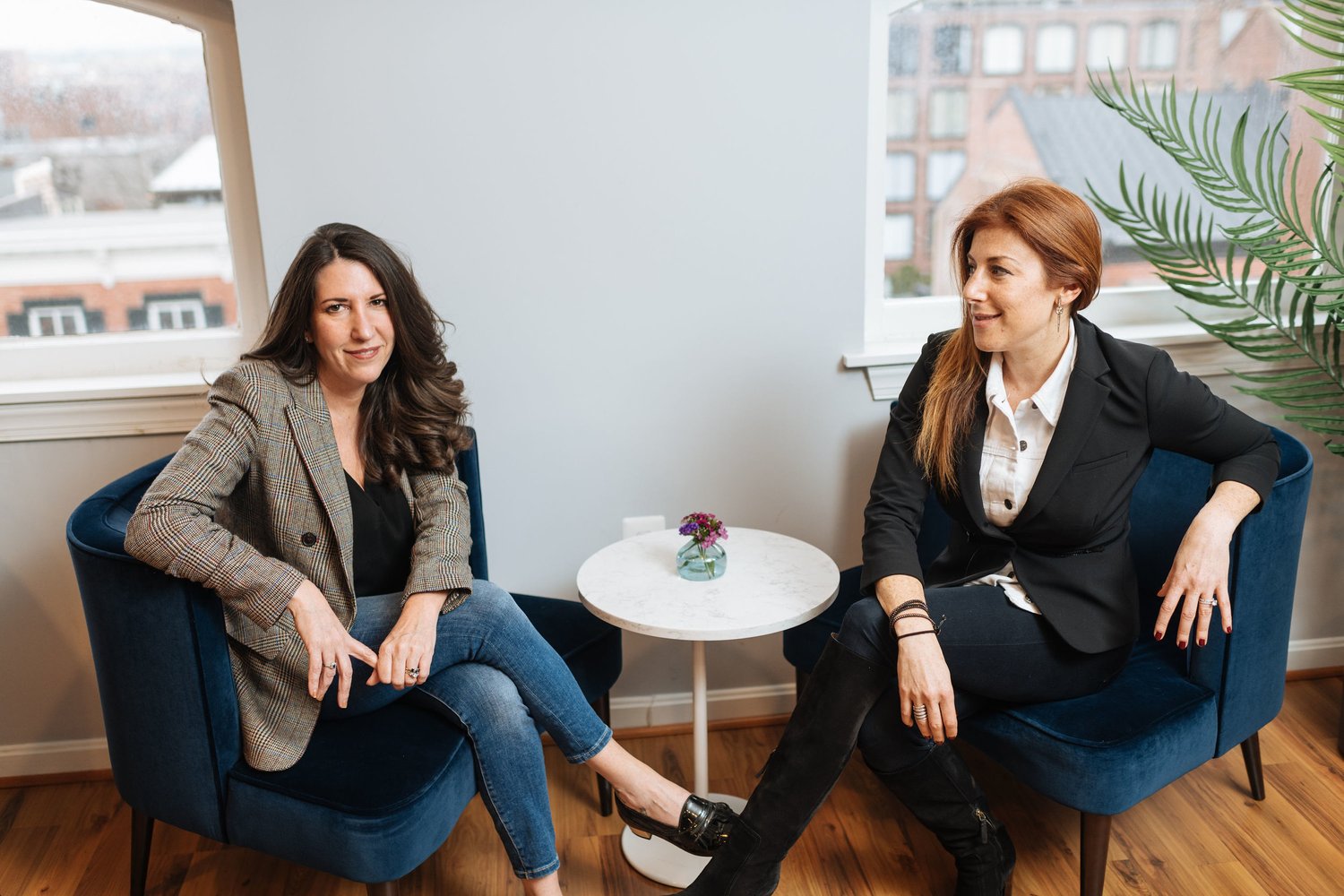
The beginning was a charity sale, which is an unusually useful place to audition a business partner. The room is live. The deadline is real. People have opinions. Barbara Martin and Jayne Sandman were working on Washington's District Sample Sale when they noticed two things: they were the only organizers who had not known each other beforehand, and their minds moved in opposite but compatible directions.
Martin, by her own account, is “very today.” Sandman thinks nine steps ahead. Sandman is energized by the room; Martin likes the discipline of a boundary. One says yes readily. The other believes in no. They did not mistake sameness for chemistry. They treated the event as evidence that each could act as a check on the other.
In 2010 they turned that evidence into The Brand Guild, an independent communications and marketing agency. The first client was Washington's W Hotel, then one of the city's most conspicuous openings. Martin later said the assignment let them “start at run speed.” It also exposed the central problem they would spend the next decade and a half solving: a brand can be seen everywhere and still fail to add up to anything.
The founding observation
Attention broke into pieces
The old publicity fantasy had a silver bullet: one magazine cover, one television appearance, one tastemaker who could place a product in front of the country. Sandman has argued that this audience no longer exists in one place. What replaces it is not merely more activity. It is coordination - the story, the pitch, the paid layer, the social conversation and the physical event making the same promise.
relations
strategy
marketing
experience
That is the practical meaning of “integrated” at The Brand Guild. The agency sells strategy, public relations, marketing, social and influencer programs, design, websites, packaging, live activations and crisis advice. Clients can hire specialists without hiring a collection of strangers. Its customers range from founder-led challengers to established names: Sweetgreen, Levain Bakery, Room & Board, Four Roses, Uncle Nearest, JLL, Skanska and The Inn at Little Washington.
“There are so many tools in the toolkit, and there's no silver bullet anymore.”Jayne Sandman, co-founder and co-CEO
Cookies, bourbon, sofas, blocks
The categories seem promiscuous until one notices the same assignment hiding inside them. A cookie company expanding beyond New York needs to preserve the intimacy of a cult favorite. A 136-year-old bourbon needs younger drinkers without performing youth. A furniture company needs national reach while sounding like itself. A real-estate developer must turn a building into a place people can imagine inhabiting.
For Four Roses, the agency began with research into a younger, lifestyle-minded audience, then built cultural doorways that did not erase the liquid. Collaborations with Ooni Pizza Ovens, Todd Snyder and OSMO Salt put the bourbon beside cooking, clothing and flavor. Press trips kept the master distiller and the craft in view. Events in Louisville, Los Angeles and New York sold out. The Brand Guild reports that media impressions rose 173.4 percent year over year, while the collaborations generated 9.8 billion impressions and $108 million in media value.
The numbers are the agency's own, and they describe reach, not magic. The more instructive detail is sequencing. Research found an audience. Partnerships provided an introduction. A live experience made the introduction tangible. Media extended the moment. The old audience remained present through the distiller and the product. Nothing was asked to carry the entire campaign alone.
The advantage of remembering eight stores
Agency websites favor the fireworks of a launch. The Brand Guild's more distinctive product may be memory. It began working with Sweetgreen when the chain had eight stores and stayed through expansion to more than 225 locations in over 40 markets, celebrity collaborations and the company's IPO. Its campaign around Sweetgreen's steak menu generated what the agency says was the highest single-day sales in the restaurant company's history.
Room & Board is more revealing still. It was an early client in 2010 and remained on the roster sixteen years later. The relationship has covered corporate initiatives, products and retail expansion. The agency's first employee also still leads its events practice. In a business known for account turnover and short institutional memory, those are cultural facts with operational consequences. The people who know why an old decision was made are still available when the new decision arrives.
The W Hotel supplies a running start; Room & Board begins a relationship that will endure.
Sweetgreen enters the roster at eight stores, years before reaching public-company scale.
Uncle Nearest appoints the agency for its national launch.
Affiliate marketing adds a trackable commerce layer to earned attention.
The roster expands with Spindrift, OpenTable, Graza and work spanning two Yum! Brands concepts.
The business model is conventional in outline: client fees for projects and longer agency-of-record relationships. Pricing and revenue are private. What clients are buying, however, is broader than press placement. They are buying the ability to move between a founder interview, an identity system, an influencer plan, a launch dinner and a crisis call without re-explaining the brand each time.
The phone still works
There is a pleasingly analog streak inside this many-channel proposition. Martin tells her team to “pick up the damn phone.” Technology can accelerate research, but a thoughtful pitch still depends on knowing a reporter, understanding the assignment and having something worth saying. The point is not nostalgia. A relationship is a form of bandwidth. It lets nuance travel.
That view also hints at what failed first in the wider market: the belief that distribution could rescue an indistinct story. More channels multiplied weak messages as efficiently as strong ones. The founders' response was to put different kinds of experts in the same room and begin before the press release - sometimes in audience research, sometimes in the founder's own history, sometimes in the design of the experience itself.
Uncle Nearest offers the clearest example. The whiskey was a young company carrying the 160-year story of Nearest Green, the first known African American master distiller. The Brand Guild centered Green, his descendant and master blender Victoria Eady Butler, and founder Fawn Weaver rather than treating the history as label copy. The work extended across thought leadership, launches, awards and distillery creative. The agency reports more than 43 billion impressions in 2024. The scale followed a story that could not belong to another bottle.
What a smaller team can copy
- Find the fact only your brand can credibly own. A generic virtue is not a narrative.
- Choose a cultural doorway your audience already understands, as Four Roses did with food and design.
- Design the physical moment and the media moment together. Each should give the other material.
- Keep the expert close. Founders, makers and operators supply detail that campaign language cannot fake.
- Measure the business event as well as the attention event. Impressions matter more when sales, visits or loyalty move too.
This approach is poorly suited to brands looking for a single cheap burst, leaders unwilling to give an agency access, or products with no defensible story beneath the amplification. Integration also costs coordination: every specialty must accept the same strategic center. Without that discipline, an all-in-one agency merely produces more kinds of noise.
The useful disagreement returns here. “Yes” finds the possibility. “No” keeps it recognizable. The Brand Guild has spent sixteen years arranging those instincts around client companies, from scoops to sofas and bourbons to blocks. Its wager is not that attention can be commanded. It is that a coherent story, repeated without becoming repetitive, can make attention accumulate.
Keep the conversation going
- Visit The Brand Guild or browse its campaign work
- Follow on LinkedIn, Instagram, X and Facebook
- Read the agency's case studies on Sweetgreen, Four Roses and Uncle Nearest