A mattress is a strange object on which to build an empire. People buy one perhaps once a decade. They struggle to describe what they want. The merchandise is bulky, personal and almost impossible to judge from a product photo. Yet Somnigroup International has assembled a business designed around precisely those inconveniences. It owns familiar labels including Tempur-Pedic, Sealy and Stearns & Foster. It manufactures bedding. Through Mattress Firm in the United States and Dreams in Britain, it also owns thousands of places where shoppers can take off their shoes, lie down and decide.
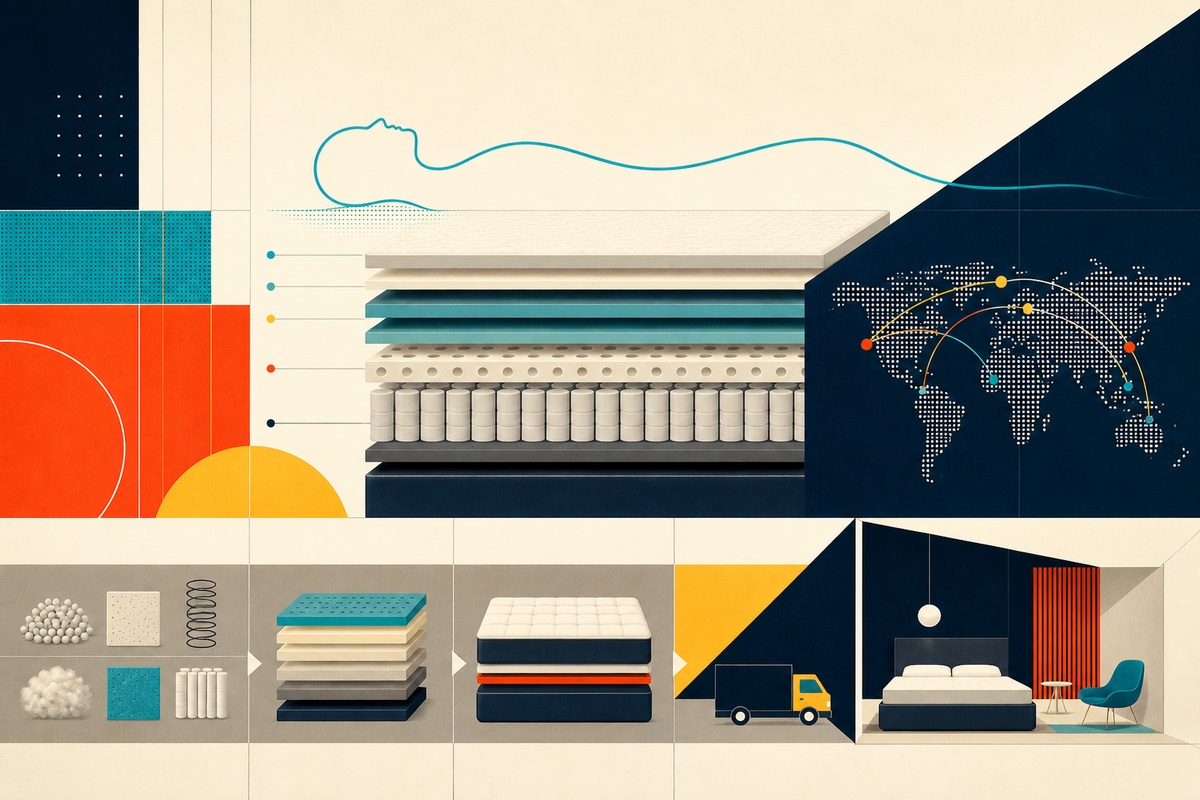
The result is not simply a large mattress company. It is an attempt to connect nearly every step between raw material and bedroom: research, product design, factories, brands, wholesale accounts, websites, storefronts, financing and home delivery. In 2025, its first year with Mattress Firm inside the group for most of the period, Somnigroup recorded $7.48 billion in net sales. More revealingly, direct channels supplied 63.5 percent of those sales, compared with 24.9 percent a year earlier.
A portfolio built for different kinds of sleepers
Somnigroup's labels do different jobs. Tempur-Pedic is the premium innovation brand, centered on proprietary material that adapts to weight, shape and temperature. Sealy stretches across wider price points and carries the Posturepedic promise of engineered support. Stearns & Foster supplies the craftsmanship halo: expensive innerspring beds, trained builders, stately materials. Sleepy's and private-label products give the portfolio more room at the value end.
This is useful brand architecture. One label does not have to mean affordable, technical, artisanal and luxurious at once. A shopper can trade up or down while remaining inside the same corporate portfolio. The company also makes private-label and original-equipment products for other sellers, extracting manufacturing revenue even when its own name is absent from the tag.
“The real product is not one perfect mattress. It is a route from a confusing showroom question to a delivered bed.”YesPress analysis
The oldest roots are almost comically distant from today's smart bases. Stearns & Foster began in Cincinnati in 1846 with cotton goods for carriage upholstery. In 1881, cotton-gin builder Daniel Haynes made mattresses in Sealy, Texas. Tempur-Pedic arrived a century later, after entrepreneur Bobby Trussell encountered a Swedish sleep system derived from NASA research. Its famous wine-glass demonstration turned motion isolation into something anyone could understand: one person could move without sending the other person's merlot into orbit.
The store was supposed to disappear
Online mattress startups once treated retail stores as dead weight. For some buyers, compressed beds in boxes did improve convenience. But the showroom survived because comfort resists a specification sheet. Firmness numbers are inconsistent. Foam density is abstract. The customer wants to feel the answer. Somnigroup's filing says most consumers still prefer to touch and feel a mattress and speak with a sales associate before buying.
Mattress Firm gives the group more than 2,100 U.S. stores, supported by 62 distribution centers and e-commerce operations. Dreams provides a distinct U.K. network and produces mattresses, bases and headboards at its own workshop. Tempur-Pedic boutiques address shoppers who want a more controlled, educational brand experience. Together with other banners, the group counted more than 2,800 owned stores at the end of 2025.
Owning the storefront changes more than revenue classification. Salespeople hear the words shoppers use when they cannot explain discomfort. Merchandisers see which beds get tried and which get bought. Return patterns expose promises that fail. That information can travel back to product teams and factories faster than a quarterly wholesale report. Somnigroup can then place new products in front of customers across physical and digital channels.
How the mattress math works
Somnigroup makes money in two broad channels. Direct revenue comes from owned stores, websites and call centers. Wholesale revenue comes from third-party retailers, hotels and healthcare customers. The distinction matters because direct sales capture the retail transaction but also bring rent, store labor, delivery coordination and inventory risk. Wholesale offers reach without owning every customer encounter, while leaving part of the economics with the dealer. Somnigroup wants both. Management describes the balance as an omnichannel system, but in plain English it means being available wherever a shopper decides comfort should be tested.
The portfolio also protects against the limits of a single price point. Premium Tempur-Pedic and Stearns & Foster products can lift margins; Sealy broadens the audience; private label fills gaps and keeps factories productive. Adjustable bases, pillows and accessories raise the value of a transaction that may not recur for years. Consumer financing makes a four-figure bed easier to buy, while delivery turns an awkward object into a service. None of these pieces is exotic alone. The advantage comes from fitting them together at scale.
That scale rests on specialized knowledge that is easy to overlook from the showroom. The company runs material research, engineering, testing, foam and innerspring production, sewing, assembly, distribution and retail training. Its workforce development uses a 70/20/10 model: most learning through job experience, then mentoring and formal instruction. The stated cultural anchor is “Doing the Right Thing,” a compact phrase with a large workload in a business balancing employees, dealers, owned stores, suppliers and rival brands under one roof.
A business of awkward alliances
Vertical integration creates a tension Somnigroup cannot wish away. Mattress Firm is a leading seller of Somnigroup products, but it also carries Purple, Beautyrest, Nectar, Serta, Simmons and Tuft & Needle. Those rival labels help the retailer remain useful to customers who want comparison. Meanwhile, Tempur Sealy still depends on independent furniture and bedding stores that may wonder whether their supplier now favors its own retail sibling.
The company addresses this structurally by running Mattress Firm, Tempur Sealy North America and Tempur Sealy International as separate strategic business units. That separation has to feel real in everyday assortment, pricing and service. The Federal Trade Commission tried to stop the Mattress Firm acquisition, arguing that the combination could suppress competition. A federal court denied the preliminary injunction, and the deal closed in February 2025 for roughly $5 billion. The strategic advantage arrived with a permanent management assignment: keep the integrated machine from looking closed.
Sleep technology enters the frame
Somnigroup's expertise is rooted in materials, ergonomics, manufacturing and retail execution. Increasingly, it also includes sensing. Fullpower-AI's Sleeptracker technology has powered TEMPUR-Ergo smart bases since 2019. By August 2025, the system had logged more than 250 million nights of sleep. Somnigroup invested $25 million for an approximately 15.6 percent stake in Fullpower and extended its exclusive right to embed the technology through 2036.
The smart base can turn an otherwise passive product into an ongoing service surface, offering sleep insights and coaching rather than waiting years for the next mattress purchase. Aggregated sleep information can also inform future products. The opportunity is practical, not magical: detect patterns, make adjustments easier and learn which interventions users value. It also shifts the competitive set toward wearables and wellness apps, where customers expect software to improve after purchase.
A bed used to lose contact with its maker the moment it left the truck. A connected base can keep the conversation going for years.
Now, deeper into the mattress
In April 2026, Somnigroup announced an agreement to acquire Leggett & Platt, a major component manufacturer and long-time supplier, in an all-stock transaction valued at about $2.5 billion when announced. If completed, the deal would pull springs, engineered components and manufacturing capabilities further inside the group while extending Somnigroup into some non-bedding markets. The companies said their combined 2025 net sales, after eliminating intercompany business, were approximately $11.2 billion.
The proposal sharpens Somnigroup's difference from brand-led rivals. A direct-to-consumer mattress company may control marketing and a website. A traditional manufacturer may own formulations, plants and wholesale relationships. A retailer may own the customer encounter. Somnigroup is trying to span all three, then reach upstream. That can reduce handoffs and accelerate product work, but it also increases integration risk, leverage scrutiny and concern among customers that buy components or mattresses from companies they compete with.
Where it sits in the sleep economy
Somnigroup belongs at the intersection of consumer goods, specialty retail, manufacturing and health-adjacent technology. Its customers range from a couple comparing queen mattresses on Saturday afternoon to hotel operators, healthcare buyers and third-party retailers. Its basic problem is universal: help people translate an intimate, subjective need into a confident purchase, then manufacture and deliver a giant object reliably.
Its scale does not remove the category's difficult economics. Mattresses are discretionary purchases. Housing activity, consumer confidence, financing and promotions matter. Product life is long, so repeat transactions are slow. Shipping is costly. The group competes with established manufacturers, online specialists, local dealers, furniture chains and its own retail partners' private labels. In 2025, more than 19,000 full-time employees worked across the company, with over 1,500 more in joint ventures. Coordinating that system is as central as inventing another layer of foam.
What makes Somnigroup worth watching is not a claim that it has solved sleep. It has built a fuller view of how sleep products are conceived, compared, bought and used. If the seams between its businesses hold, the company can turn showroom behavior into design, design into manufacturing, and connected products into longer relationships. If they pull apart, scale becomes upholstery over complexity. Either way, the mattress is no longer the whole story.