The origin story begins in 2003 with a purchase that felt wrong. Sam and Kacie Malouf, newly married and living in northern Utah, wanted better sheets. The options they found forced an old retail compromise: pay dearly for quality or accept something ordinary. They saw an opening, sourced Egyptian cotton sheets and began storing inventory in their spare bedroom. There was no master plan for a bedding empire. There was a product, a price problem and enough stubbornness to learn the rest.
For seven years, the couple did nearly everything themselves: development, photography, marketing, customer service, packing and shipping. An early warehouse did not even have a restroom; Sam has recalled walking about half a mile to a truck stop. When the company finally hired its first full-time employee, the lesson was not merely that extra hands create capacity. Specialists could do individual jobs better, leaving the founders free to look for the next gap.
Those gaps accumulated into Malouf Home. Sheets led to protectors, pillows, comforters and frames. Rolled mattresses made a bulky purchase easier to distribute. Adjustable bases put motors, massage, presets and phone controls beneath the foam. The business now sells the components of a bed as a coordinated system, from a $60 microfiber sheet set to a premium hybrid mattress and a base approaching $2,000.
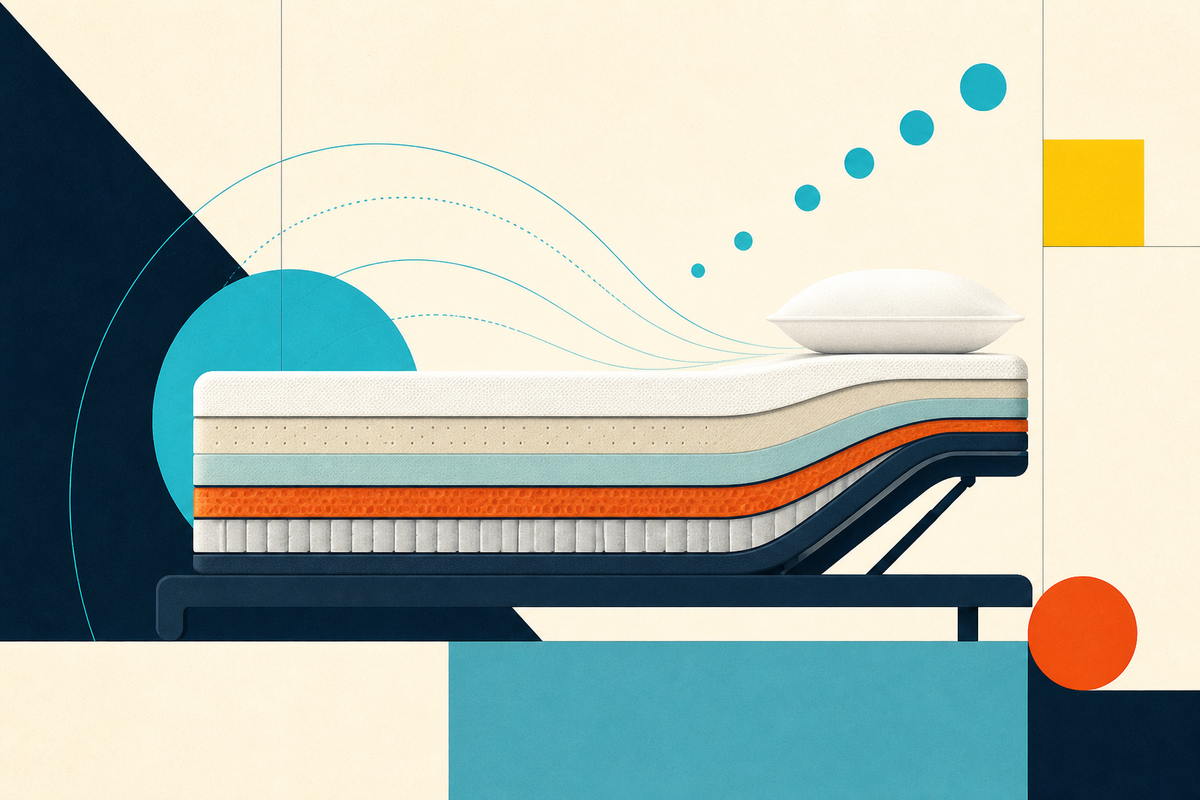
The product is the stack
Mattress marketing loves a hero ingredient. Malouf's premium Ice Cloud hybrid has several: a HyperChill cover intended to feel cool immediately; OmniPhase phase-change material designed to absorb and release heat; gel-infused CoolSync memory foam; bamboo-charcoal transition foam; zoned pocket coils; and base foam. Company testing says the mattress sleeps seven degrees cooler than a comparable Malouf mattress without OmniPhase. That is a specific, controlled claim, not a promise that every bedroom or every body will register the same number.
The stack matters because sleep complaints rarely respect product categories. A hot sleeper might need airflow in the mattress, moisture movement in the sheets and a protector that does not cancel both. A side sleeper may care about shoulder pressure and pillow loft. A couple can agree on a mattress but disagree about position, which is where a split adjustable base enters the sale. Malouf can answer each problem without handing the customer to another brand.
A storefront in front, infrastructure behind
The website presents a familiar direct-to-consumer experience: comparison tools, a mattress quiz, bundles, financing, free shipping and sleep trials. Yet Malouf is not simply another internet mattress label. It has long sold through furniture stores, mattress specialists and large online marketplaces. In January 2025, the company said its products were available in more than 16,000 U.S. retail locations and that its international team served more than 56 countries.
That hybrid model solves a peculiarity of the category. Shoppers research beds online, but feel remains stubbornly analog. A retail floor lets someone lie down, compare firmness and see an adjustable base move. Malouf supports the dealer with a broad catalog, showrooms, sales materials, a retailer portal and drop-shipping. The direct site, meanwhile, educates customers and captures buyers who already know what they want. One channel generates intent; the other can close the tactile gap.
The revenue model follows the same two-sided design. Consumers buy individual products and higher-value bundles through the online store; retail partners buy an assortment they can display, recommend and replenish. Mattresses create a large central purchase, while pillows, protectors, sheets and toppers offer more frequent additions at lower prices. Adjustable bases and bedroom furniture raise the possible value of a complete sale. Trials, warranties, financing and shipping reduce the perceived risk, but they also create costs that reward operational scale. Malouf's advantage is not simply having many SKUs. It is the ability to develop, explain, warehouse and deliver those SKUs across channels without making the retailer or shopper assemble the system from scratch.
This also reveals where the company sits in the market. Malouf is broader than a mattress-in-a-box startup and more brand-led than a generic wholesaler. It competes with Tempur-Pedic, Purple, Sleep Number, Saatva and Casper for the central mattress purchase; with bedding and pillow specialists for accessories; and with private labels across retail. Its answer is range. A dealer can cover multiple needs and price points, while a household can build a coherent bed without reconciling six product vocabularies.
sleep system
The unglamorous technology of being in stock
Cooling covers photograph well. Inventory discipline does not. But Malouf's 2025 decision to move all mattress manufacturing to the United States was framed around three practical goals: healthier in-stock rates, continued innovation, and stronger sales and customer support. The company said shorter lead times and tighter quality checks were expected as more production moved domestically. It also acknowledged that inventory consistency had been a problem.
In 2026, Malouf and Sinomax USA announced a strategic capital enterprise combining premium branding with American manufacturing. The relationship adds production knowledge and sourcing reach to Malouf's product and retail capabilities. By the summer, trade reporting described the businesses as integrating operations and previewing new products, including a split-head adjustable base and a redesigned Talalay latex pillow.
The logic is vertical without pretending everything must happen under one roof. Control more of the path from material and factory to showroom and customer's door. For retailers, the promise is fewer gaps and a simpler vendor relationship. For Malouf, better manufacturing access can shorten the distance between an idea and an in-stock product. It is less romantic than the apartment origin story, but it may be more decisive in a tariff-sensitive, promotion-heavy category.
For a sleeper
Use the range to match temperature, pressure relief, pillow loft and bed position, then buy as a bundle or compare pieces individually. The value is coordination, not a magical universal setting.
For a retailer
Use one supplier across mattresses, bases and accessories, with showroom support and drop-ship options that can extend assortment beyond the floor.
A mission with a separate operating system
Malouf describes its mission as helping people access and enjoy restorative sleep so they can achieve their potential. The corporate version extends beyond customers. Bedding donations to shelters, safe homes and foster families exposed the founders to the realities of sexual exploitation and abuse. In 2016, they formalized the Malouf Foundation, focused on education, survivor support and advocacy.
The arrangement is concrete enough to measure. Malouf supplies employee time, space, products and services so the nonprofit can direct more funds to programs. The company's 2023 impact report said the foundation directly affected 13,689 people that year, while Malouf contributed more than $230,000 in in-kind resources. Earlier packaging work also reduced plastic in sheet packaging by a reported 66 percent, while letting shoppers touch the fabric before buying.
Certification gives the claims an external frame. Malouf became a Certified B Corporation in 2019, submitting its practices across workers, community, governance, customers and environment to B Lab's assessment. Public descriptions of the internal culture return to three ideas: work hard, have fun and give back. Sam Malouf's shorter version is more useful: “Be the kind of person you want to work with.”
What Malouf really sells
A mattress is an infrequent, anxious purchase. It is expensive, hard to compare and impossible to judge from specifications alone. Accessories create their own maze of thread counts, fibers, foams, covers and cooling claims. Malouf's broadest solution is reduction: turn the maze into a system, establish a ladder of products, and let customers enter through the problem they understand.
That approach has limits. A wide catalog can blur the story, and shoppers may still prefer a specialist for one component. Cooling claims depend on test conditions and individual experience. An app-controlled base is useful only if the owner values its motion after the novelty fades. Malouf's task is to keep the system legible while the number of choices grows.
The company's history suggests it understands ordinary friction. It began because a set of sheets felt overpriced. It grew by noticing all the little failures around a bed: heat that lingers, pillows that miss the shoulder, mattresses that slide, partners who want different angles, stores that cannot stock every size. None is cinematic. Together, they make a market.
Two decades after the spare bedroom, Malouf Home is still following that map. The sheet touches the sleeper. The protector preserves the mattress. The mattress manages pressure and temperature. The base changes position. The frame holds the room together. Distribution makes the whole stack appear when promised. The company did not escape the commodity business; it learned how to connect the commodities.