Ralph Newhouse did not begin with a patent, a venture round or a solemn plan to reinvent dinner. He began in 2009 with about $18,000 - all the savings he and his wife had - and closeout merchandise he thought he could resell. The work was transactional and gloriously unromantic: find excess inventory, persuade a retailer to buy it, collect cash, repeat. It taught him what shoppers would pick up, what merchants would stock and how little patience either had for a product that could not explain itself from six feet away.
That education became Chefman, a privately held kitchen-appliance company based in Mahwah, New Jersey. Today its catalog runs from $30 kettles to air fryers, espresso machines, microwaves, blenders, pizza ovens and waffle makers. Newhouse said in a 2026 interview that the business had grown without outside funding to roughly $400 million in annual sales. Because RJ Brands, the legal company behind Chefman, is private, that figure is a founder-reported number rather than audited public-company revenue. Even with that caveat, the path is worth studying: distribution came first, design grew more ambitious, and software arrived only after a real appliance business could pay for it.
01 / The base businessThe boring engine under the clever machine
Chefman solves a crowded, ordinary problem: people want a countertop tool that is easy to understand, looks respectable and costs less than the premium brand beside it. Its customers are home cooks, apartment dwellers, gift buyers and families replacing a single-purpose appliance. The company sells through its own ecommerce store and large retailers such as Walmart, Target, Amazon and Costco. That mix gives it direct customer data without asking the direct channel to carry the whole business.
The differentiation is not one secret technology. It is the combination of breadth, price and feature selection. Chefman will put a window on an air fryer, a thermometer in an oven or a faster DC motor in a convection product, but the feature has to survive the retail shelf. Its newer reForm line pushes toward a more premium finish, a five-year warranty and products meant to remain on display. In 2024, concept designs for its Dominator air fryer and Obliterator blender received Red Dot recognition. The names sound like kitchen appliances chosen by a professional wrestler; the forms are restrained black objects with fewer visual seams.
What we wanted to do was build art that you can proudly display on your countertop.Ralph Newhouse, founder and CEO

The company claims to be America's number-one electric-kettle brand, and its product list is intentionally promiscuous. This is not a cult object company. It wants to be present when someone searches for almost any small kitchen appliance. The business model is a portfolio: lots of familiar hardware, sold at retail scale, with operating cash recycled into design, tooling, supply chain and research. Five consecutive appearances on the Inc. 5000 from 2019 through 2023 suggest the formula produced sustained growth, not one air-fryer season.
02 / The expensive experimentCHEF iQ wants appliances to talk about dinner
CHEF iQ is the focused technology brand sitting on top of that portfolio. Its connected-cooking journey began with a smart sous-vide device in 2016. The iQ Cooker followed in 2019, combining pressure cooking with an integrated scale, automatic steam release, onboard controls and guided recipes. The free CHEF iQ app added times, temperatures, videos, remote monitoring and software updates. In 2022 came iQ Sense, a wireless thermometer that relays food temperature through a Wi-Fi hub. In 2025 the iQ MiniOven completed the first useful loop: insert the probe, pair it with the oven and let temperature, rather than a guessed timer, decide when cooking should stop.
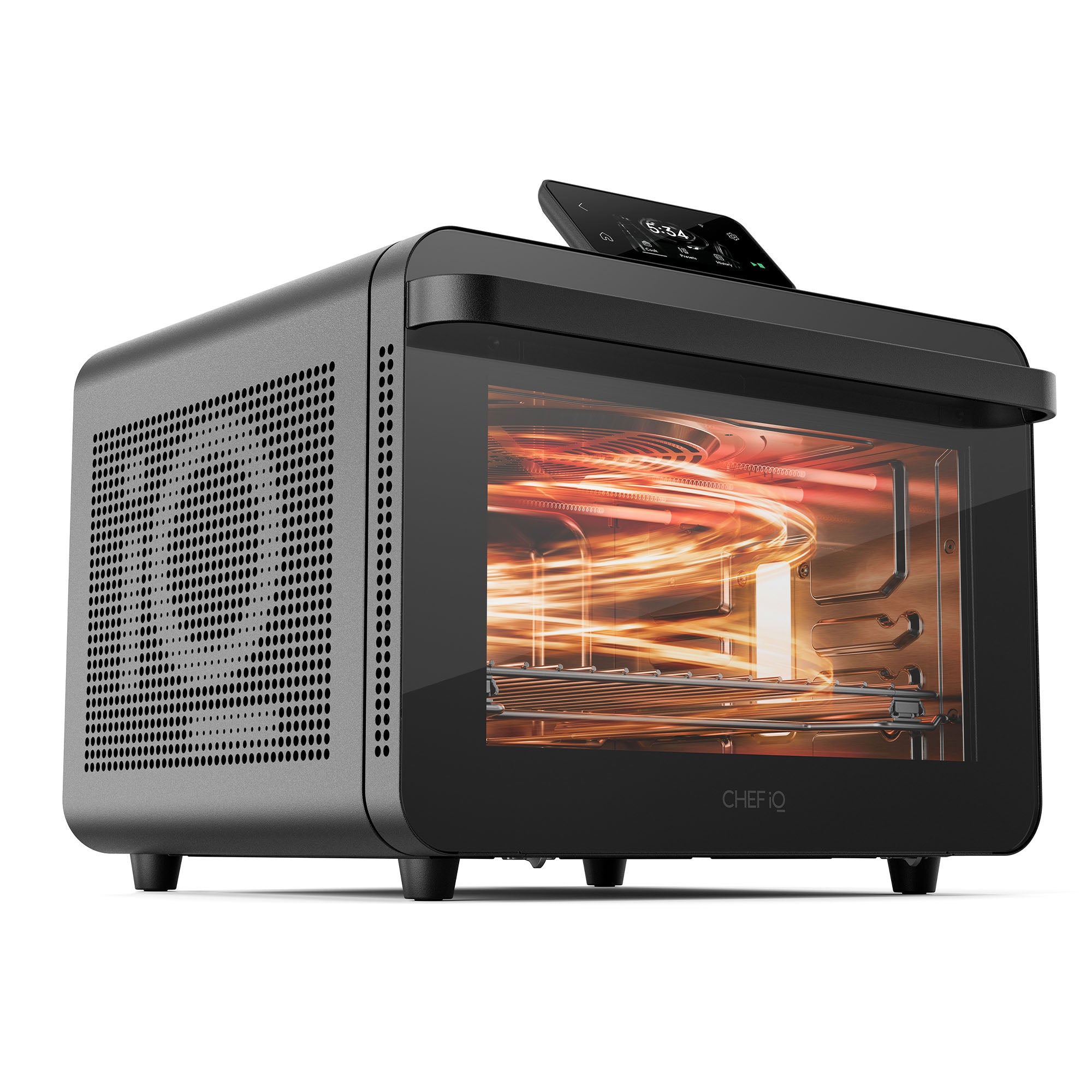
The range is small on purpose. The iQ Cooker lists around $200. iQ Sense starts around $100, with multi-probe bundles costing more. The 25-quart MiniOven lists at $599.99, a sharp step up from much of Chefman's catalog. It has 11 functions, a 500°F ceiling, a color touchscreen and a 3,200-rpm DC fan. Crucially, it can cook from its own panel. The app extends the appliance; it does not hold dinner hostage. That matters because a connected product is a promise to maintain accounts, servers, firmware and support long after the box leaves a store.
The ecosystem has a steep staircase
This is where Chefman differs from a startup shipping its first gadget. The parent already understands certification, packaging, returns, retailer margins and freight. It can place a CHEF iQ product beside a less expensive Chefman appliance and serve two kinds of buyer. It can also fund software from hardware profit rather than force a subscription onto recipes. Google Play shows more than 100,000 CHEF iQ app downloads; the company describes a community of more than 800,000 fans. Those figures measure different things, but together they show an audience larger than a laboratory trial.
03 / What failed firstThe supplier rejection that rewrote the plan
Hardware stories often hide the moment the spreadsheet met physics. CHEF iQ's arrived with the thermometer. Newhouse says the factory working on the product rejected the job because it was too difficult to manufacture profitably and managers did not believe in its potential. A wireless probe has to tolerate heat, measure accurately, stay thin enough for food, charge reliably and communicate through a metal oven or grill. Any one of those requirements can eat the margin.
The rejection changed management's mind about what to own. Instead of finding another supplier and sending the same drawings, CHEF iQ hired some people from the factory and established in-house production in China. The company did not vertically integrate everything; it took control of the bottleneck most likely to determine quality and scale. That distinction is the lesson. Owning a factory is not automatically strategic. Owning the failure point can be.
Let products that already sell finance the riskier research program.
Use repeated tests and retailer persistence before assuming demand.
Bring a capability inside when supplier economics threaten the user experience.
Make connected hardware valuable on its own, then improve it through the system.
04 / Where the recipe breaksA system is only as smart as its least maintained part
The approach is copyable, but not universally. Bootstrapping hardware works when the core catalog throws off enough cash to absorb tooling mistakes, inventory and returns. Retail persistence works when the product can still leave margin for the merchant. Selective vertical integration works when volume justifies people, equipment and quality systems. A founder without working capital, supply-chain experience or patient retail relationships could copy the sequence and still run out of money between prototype and reorder.
Connected cooking adds its own traps. Early reviews of the iQ Cooker liked the guided recipes but wanted a deeper library and fuller use of its built-in scale. Reviews of the MiniOven praised its probe pairing and broad cooking performance while noting that toast could be pale and MiniOven-specific recipes were still missing. Owners of wireless probes have publicly reported uneven experiences with battery life, connection and support. These are not side issues. When software, a battery or a replacement part fails before the heating element, the appliance feels obsolete even if the metal box is fine.
The market position is therefore slightly awkward and potentially useful. Chefman is a value brand climbing toward premium design. CHEF iQ is a technology brand supported by mass-market appliance economics. The broad company knows how to make a box people will buy; the narrow brand is learning how to make several boxes behave like one product. Its advantage is not that every feature is unique. It is that the oven, thermometer, cooker, recipes and support team can be designed under one roof.
05 / The stealBuild the cash machine before the kitchen computer
The most portable Chefman idea is an order of operations. Start with a transaction you understand. Learn distribution by selling something legible. Improve the product at the handful of points customers actually notice. Keep enough ownership to protect cash flow. Spend that cash on a more ambitious system. When a supplier refuses the hardest part, decide whether the refusal reveals a bad idea or a capability worth owning.
Chefman's answer was to own the capability. That decision will be tested for years, because autonomous cooking is less a launch than a maintenance schedule. A probe must stay accurate. An app must remain compatible. An oven must still work when the router sulks. If CHEF iQ manages those unphotogenic obligations, the $18,000 closeout hustle and the $599 connected oven belong to the same story: sell what works today, then use it to finance what might work tomorrow.