Colin Sapire’s route to the kitchen counter began with a qualification chosen for its luggage-friendly properties. Growing up in South Africa, he wanted a degree that could cross borders. A Bachelor of Commerce from the University of Cape Town supplied the paperwork. California supplied everything else: a public accounting license, a small Los Angeles practice, a partner in the wonderfully unsubtle trade of televised exercise equipment, and eventually an appliance that would make a great many bananas nervous.
The biography sounds tidy now. It was not. A 2016 profile recalled Sapire arriving in America in the early 1980s with $600, and at one point sleeping on the floor of an apartment where the kitchen had more cockroaches than counter space. He built an accounting firm because it was sensible. He disliked it because sense, left unsupervised, can become a cage.
His escape arrived through a client. Lenny Sands had sold fitness equipment through infomercials. Sapire began running that business from his accounting office, saw the possibilities in direct response, and helped form Capital Brands. The future blender founder first distinguished himself not with a blade, but with a reporting system. He built the data platform and management machinery that connected airtime, orders and operational decisions.
Television was the first dashboard
Direct-response television was performance marketing before the phrase acquired a fleece vest. Every advertisement created a measurable result. Change a demonstration, a price, a sequence or an offer and the orders answered back. Sapire learned to treat media as a feedback loop, and then to perform the more difficult trick: move a product beyond television into ordinary retail.
Capital Brands turned toward compact food preparation in 2002. The Magic Bullet combined several modest ideas into an upside-down, single-serve machine. It was small, simple to clean and easily demonstrated. NutriBullet followed after years of development, with a larger motor and an argument built around performance. One published account says the team knew it had crossed a line when the final prototype managed most of the work of a large commercial blender. The category had found its little engine.
The famous part is the scale. The more instructive part is the translation. A television object usually arrives wearing jazz hands; a retail brand has to survive fluorescent lighting, comparison shopping and Tuesday morning. Sapire and his colleagues moved from airtime to major stores, online sales and wholesale. The product did not merely win attention. It became a familiar verb-like routine: fill, twist, blend, leave.
A second draft with better manners
Success created the conditions for Sapire’s return. Personal blenders multiplied. Many became cheaper, noisier and more disposable-looking. He had spent years learning where the annoyances lived: in warped vessels, uncertain locks, unruly motors, messy transitions from blending to drinking, and machines that vanished into cupboards because their owners did not wish to look at them.
Beast Health, founded before its U.S. debut in 2021, is his answer to that afterlife. Its thesis fits into four words: “looks good and blends better.” The phrasing is jaunty, but the work underneath is stubborn. Sapire has said the ribbed vessel was among the hardest parts to engineer. Its internal geometry is meant to create turbulence, while its thick construction required a complicated triple-injection process. Development took years.
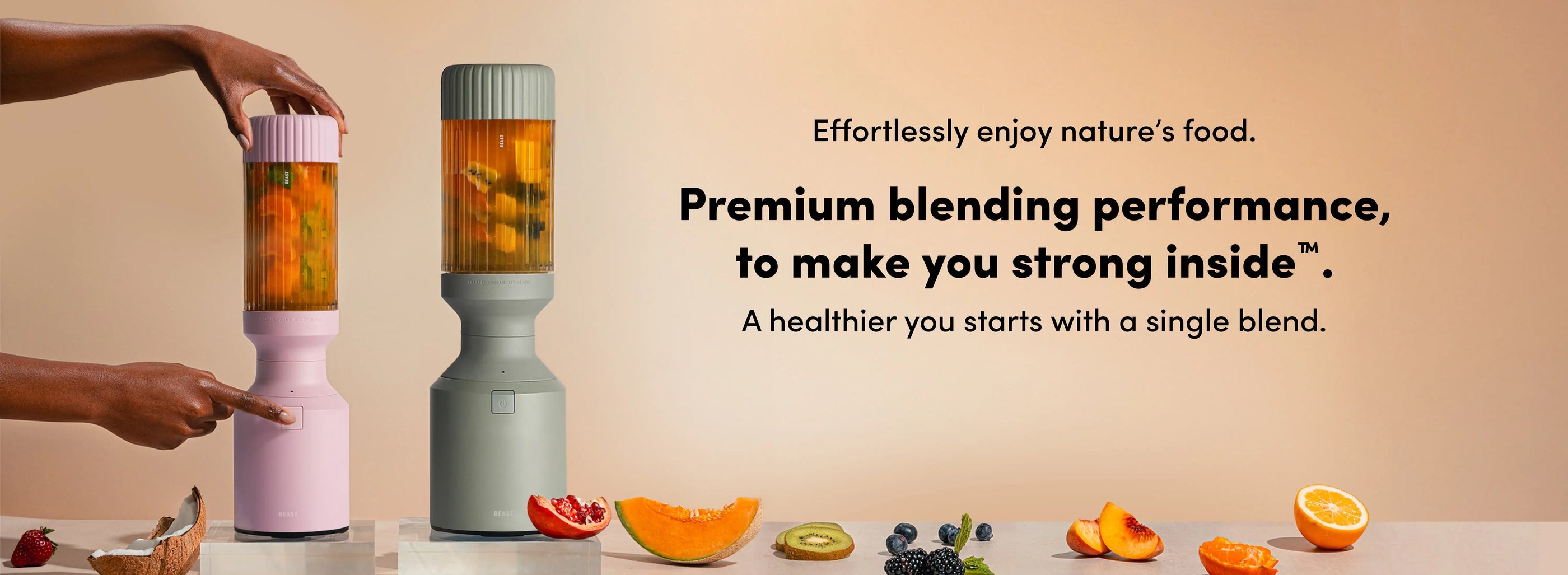
The motor uses copper coils. The vessels double as drinking cups. Patents naming Sapire and his collaborators cover safety interlocks, containers, lids, an infuser, a spatula and other pieces of the system. These are not the details that receive applause at a launch party. They are the details that determine whether the party’s centerpiece still works on an unphotographed Wednesday.
Read together, the patent trail resembles a backstage inventory. One grant describes contacts that prevent the motor from operating until the blade and base are correctly connected. Another covers two distinct safety mechanisms. Design patents protect the silhouette of a vessel, blender and lid. A beverage-vessel patent arrived in late 2024; another interlock grant followed in June 2025. The list makes Sapire’s product philosophy unusually legible. He is interested in the moment a component meets another component - where a user twists, locks, carries, cleans or discovers that the reassuring click was not merely theatrical.
It also corrects the lone-inventor portrait that founder stories tend to frame too neatly. Beast patents repeatedly name industrial designer Gregory Thune, Benjamin Bangser and manufacturing collaborators alongside Sapire. The object is authored by a network: design studio, engineers, toolmakers, factories, operators and the customers who report what failed. Sapire’s contribution is partly the persistence to keep that network pointed at a very ordinary act until the ordinary act feels resolved.
The second-act design brief
Then there is the button. One press starts a timed cycle; holding it pulses. In an industry fond of control panels that resemble regional airports, Beast opts for an unusually short conversation. Sapire calls the appliance a “daily driver.” The useful principle is behavioral: the fewer decisions between intention and action, the more likely a routine is to repeat.
The countertop is part of the product
Beast’s sculptural silhouette is not decoration after the engineering. It is distribution inside the home. A handsome machine earns counter space. Counter space creates a cue. The cue creates use. The owner’s kitchen becomes a showroom encountered several times a day, without retargeting pixels or an affiliate code in sight.
This makes the aesthetic ambition practical rather than precious. Sapire wanted a premium object, but he also wanted it to disappear into a routine. The interesting tension is that Beast must be conspicuous while idle and uncomplicated while working. Its form can ask for attention; its operation should not.
The accounting mind remains visible. For all the automotive comparisons attached to Beast, Sapire speaks about hardware growth with the sobriety of someone who has met inventory. Physical products bring supply-chain exposure, service demands and warranties that remain long after the campaign report closes. Beast spent its early U.S. years building its customer-experience operation and growing with care.
The same restraint guides distribution. The company added British retailers including Harrods and Selfridges after launching in the United Kingdom, while maintaining its direct online channel. It has since moved into additional international markets. Sapire’s stated approach is to keep the central identity intact while adapting to local food cultures and working with partners who understand the territory. Global, in other words, but not copy-and-paste.
Promotion receives the same edit. Beast’s early collaboration with former NFL player Marshawn Lynch supplied a memorable name and useful visibility, but Sapire has remained cautious about treating celebrity as a substitute for fit. The choice echoes his infomercial education: attention opens the door, then the product has to survive the return policy. Retail adds reach; direct sales preserve conversation; service turns a transaction into evidence for the next revision. Each channel has a job, and trouble begins when one is asked to impersonate the others.
Method, with a little mischief
Sapire’s old interviews reveal an operator suspicious of borrowed certainty. He has argued for calculated risk, warned against rushing major decisions and questioned market research that only describes the market as it already exists. His preferred question was how to change a market. It is a charmingly immodest question, provided one brings prototypes.
He also treats failure without incense. Business, in his telling, is a succession of problems to be handled methodically. That view lacks the sugar rush of founder mythology, but it travels better. It served an immigrant building an accounting practice, an operator measuring television, a team turning a loud pitch into a retail staple, and a second-time founder deciding that the humble blender vessel deserved years of attention.
Watch the long versionCreator Lab’s 80-minute conversation covers product design, direct response, customer feedback, hiring and international expansion.In 2024, Sapire added author to the collection of job descriptions. Fuel Up, written with Dr. Dana Cohen, turns the blender into the organizing device for recipes and practical routines; a paperback edition followed in 2026. The book extends the product thesis into print: an intimidating intention is more useful when converted into a small, repeatable action. The machine sits on the counter. The book tells it what to do next.
There are easier second acts. Sapire could have become a ceremonial adviser, offering aphorisms beside a tasteful fireplace. Instead he returned to motors, latches, customer service and freight. The decision suggests that his real attachment was never to a single famous brand. It was to the troublesome space between wanting to do something and having an object make it easy.
That is the durable idea inside Beast. Its premium materials matter. Its patents matter. Its retail shelves matter. But the larger wager is almost domestic: a useful object should deserve to remain in sight. Sapire’s first great chapter helped shrink the blender. His second is trying to give it enough character, craft and good behavior that nobody sends it away.
Keep spinning