The first Dyson vacuum cleaner was assembled from cardboard and indignation. James Dyson’s expensive Hoover kept losing suction because its bag clogged. At a nearby sawmill, he had seen an industrial cyclone spin dust out of the air without a filter bag. So he built a tiny version, attached it to the machine at home and discovered that the ugly contraption worked. Four years and 5,127 prototypes later, he had a bagless cleaner - and a problem. Vacuum manufacturers did not want it.
Their refusal made commercial sense. Replacement bags were a tidy recurring-revenue stream. Dyson’s invention removed the consumable and made the incumbent business model worse. He licensed an early version in Japan, then put his name on his own machine in Britain. The DC01 arrived in 1993 with a clear bin that let buyers watch their domestic shame whirl around in public. Market research disliked the transparent plastic. Customers enjoyed the proof.
That is the compact version of Dyson’s operating system: find an irritation people have accepted, attack it with physics, make the mechanism legible, and charge a premium for the difference. The company now sells cordless vacuums, floor washers, robot cleaners, purifiers, humidifiers, fans, hand dryers, hair dryers, stylers, straighteners, lights and headphones. In 2024, it moved more than 20 million products and reported £6.6 billion in revenue - about $8.9 billion at the conversion cited by Bloomberg.
The machine behind the machines
Calling Dyson an appliance company is accurate in the way calling a restaurant a plate company is accurate. The objects matter, but the reusable capabilities underneath matter more: high-speed digital motors, aerodynamics, filtration, heat control, batteries, sensors, software and materials science. Around half of Dyson’s more than 14,000 employees are engineers and scientists. Its research reaches into robotics, artificial intelligence, machine learning and energy storage, even when the thing on the shelf looks like a very determined hair dryer.
The digital motor is the quiet protagonist. Dyson began developing a smaller, lighter motor around 1999 and manufactured the first generation in Singapore in 2004. Miniaturization eventually allowed engineers to move a cordless vacuum’s motor and battery into the hand. A related arrangement put the Supersonic hair dryer’s motor in its handle, changing the balance and shrinking the familiar barrel. Motor control, airflow and heat sensing then became a platform for Airwrap, Airstrait and Supersonic Nural.
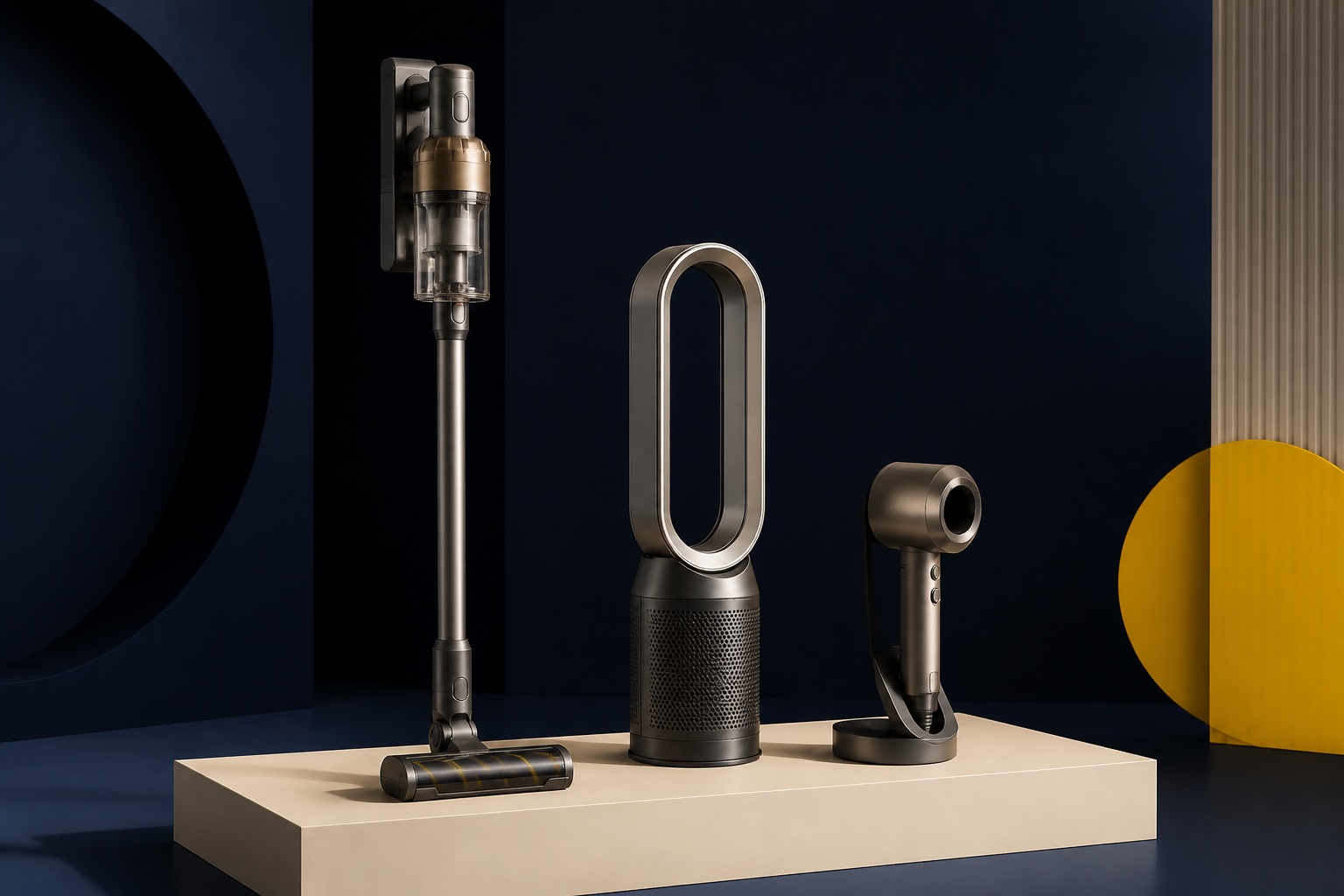
This is why the jump from cleaning to beauty was less random than it looked. Both categories reward compact motors, controlled air and an ability to manage heat. Dyson spent years building hair laboratories, studying damage across different hair types and watching how people style. In 2022 it committed £500 million to beauty research and a four-year pipeline of 20 products. The company was not merely painting a vacuum pink. It was carrying a technical stack into a ritual where performance, design and willingness to pay were all unusually high.
“Our engineers always start the product development process with a problem.”Dyson, on its development method
The premium is part of the product
Dyson sells to households that will pay to make recurring chores faster, cleaner or less damaging; to professional stylists who treat a tool as working equipment; and to businesses buying Airblade hand dryers, commercial vacuums and air-treatment systems. It reaches them through its own ecommerce operation and demo stores, major retail partners and professional channels. Accessories, replacement parts and refurbished machines extend the relationship, while commercial products put the same engineering story into airports, offices, salons and schools.
The prices are not incidental. A premium margin supports labs, tooling, patents, stores, customer support and the inevitable prototypes that go nowhere. It also creates an expectation that each object should look and behave unlike its cheaper rivals. Clear bins expose cyclones. Lasers reveal floor dust. Screens count particles. Sensors visibly lower a hair dryer’s heat near the scalp. Dyson turns measurement into theater, and theater into reassurance that the money bought more than a badge.
That tension sharpened in 2024. Dyson sold more machines than ever, yet revenue slipped from £7.1 billion to £6.6 billion. Earnings before interest, tax, depreciation and amortization fell from £1.4 billion to £900 million; pre-tax profit dropped to £561 million. The company blamed slower economic growth in some markets and one-off disruptions, while pointing to faster growth across Southeast Asia, India, the Middle East, Africa and Eastern Europe. A beautiful product portfolio is not exempt from consumer caution.
The first things that failed
Failure at Dyson comes in several sizes. Most prototypes fail quietly, early and usefully. The Contrarotator washing machine failed louder. Launched in 2000 with two drums turning in opposite directions, it cleaned well but cost too much to manufacture. Production stopped. The lesson was not that unusual mechanisms are bad. It was that superior motion does not excuse inferior economics.
Then came the electric car. Announced in 2017, the N526 became a working seven-seat prototype with ambitious range and an engineering team numbering in the hundreds. But a new automaker has to absorb batteries, crash testing, factories, distribution and warranty risk before enjoying anything like appliance margins. During development, Dyson concluded it would have to sell the vehicle at a price customers were unlikely to accept. The program ended in 2019. James Dyson later put his personal loss at about £500 million.
What changed his mind was not a broken car. It was evidence that the product could work while the business could not. That distinction matters. Dyson’s celebrated persistence is productive when each iteration cheaply improves a bounded mechanism. It becomes dangerous when a company treats market structure as one more engineering variable. No clever motor changes the capital intensity of becoming a global automaker.
The car was functional. The company around the car was not.The useful limit of prototype culture
The 2025 cabinet of curiosities
Dyson responded to the softer year with more formats, not fewer. At a Berlin event in September 2025, James Dyson unveiled 11 new and upgraded products. PencilVac compressed a cordless cleaner into a 38-millimeter body. V16 Piston Animal paired a 900-watt motor with conical anti-tangle brushes. Spot+Scrub Ai combined robot vacuuming, wet cleaning, cameras and LiDAR. HushJet shrank air purification and changed how air leaves the nozzle. Even the familiar V8 received more suction, longer runtime and a coming self-emptying dock.
The risk is portfolio sprawl. OnTrac headphones, introduced in 2024, used Dyson’s aeroacoustic knowledge but entered a category ruled by software ecosystems, music tastes and entrenched brands. Robotics adds navigation and object recognition, fields where suction is only one part of the experience. The farther Dyson moves from airflow, motors, separation and heat, the less its existing advantage explains the purchase.
Still, its market position is distinct. SharkNinja, Tineco, Miele, Bissell and iRobot attack floor care from different price and automation angles. GHD, Revlon, Shark Beauty and large cosmetics groups compete in styling. Bose, Sony and Apple define premium audio. Dyson’s answer is to be the engineering label that can cross the aisle - a private, family-controlled company willing to spend for years before a mechanism reaches a shelf.
What builders can steal
Write down the annoyances customers have stopped mentioning. Familiar frustration is often better raw material than futuristic spectacle.
Turn performance into something visible or measurable. Dyson’s clear bin made every cleaning session a product demonstration.
Expand where your technical advantage travels naturally. Motors and heat control moved into beauty; the whole car business did not.
The copyable bit is not “build 5,127 prototypes.” Blind repetition is an expensive personality trait, not a method. Start with one precise customer complaint. Build an instrumented prototype that isolates the mechanism. Define the performance threshold and cost ceiling before falling in love with the form. Let users see the improvement. Then ask whether the underlying capability can solve a neighboring problem without importing an entirely new business model.
The method works best when technical performance is easy to perceive, a high gross margin can fund development, the product is purchased often enough to build a brand, and the company can protect its advances through know-how, patents or manufacturing. It works especially well in stale categories where incumbents earn money from the inconvenience being removed.
It is a poor fit when the winner depends mostly on network effects, low prices, regulation, commodity supply, or an ecosystem the company does not control. It also fails when the technical improvement is real but too small for customers to notice - or too costly for them to buy.
Dyson’s enduring achievement is not persuading people to admire vacuum cleaners. It is making engineering legible at the exact moment of use. Dust spins into a transparent bin. A beam illuminates what the eye missed. A sensor changes the temperature before hair overheats. The customer sees the claim become an event. That is harder to copy than the colors, and far more useful than the mythology.