SharkNinja Ships 25 Gadgets a Year. Here's the Machine Behind It.
How a former sewing-machine importer turned consumer complaints into a $6.4 billion gadget factory - one air fryer, robot vacuum and viral ice-cream maker at a time.
Pull open a random kitchen cabinet in America and there is a good chance SharkNinja built something inside it. The blender. The air fryer. Maybe the countertop ice-cream maker that showed up in your feed. Walk to the hall closet and the vacuum is probably theirs too. That is the strange thing about this Needham, Massachusetts company: it is everywhere in the home, and almost invisible as a name. Most people know Shark. Most people know Ninja. Far fewer know they are the same $6.4 billion machine.
SharkNinja did not start with a grand product vision. It started with sewing machines. The business traces back to a Montreal family that sold domestic sewing machines through a dealer network in the 1950s. In 1994, Mark Rosenzweig founded Euro-Pro, importing household appliances - ironing systems, steam presses, food processors - and grinding out sales one category at a time. The first full year brought roughly a million dollars. By the early 2000s it was a few hundred million. The headquarters moved from Montreal to the Greater Boston area in 2003, and the company began looking less like an importer and more like an inventor.
The idea that started itThe turn came in 2007 with a single observation: people were spending more time cleaning their vacuums than their homes. Filters clogged, suction faded, and the machine you bought to clean became one more thing to clean. Shark launched with "no loss of suction" technology aimed squarely at that annoyance. Two years later, in 2009, the Ninja kitchen brand arrived with the same instinct pointed at the counter. By 2015 the company had renamed itself SharkNinja, leading with the two brands that had outgrown their parent.
That sentence is close to a company operating system. President since 2008 and CEO since 2023, Mark Barrocas has repeated a version of it for years: consumers will tell you everything you need to know, if you are smart enough to listen. The listening is not a slogan. It is a pipeline. SharkNinja launches roughly 25 new products a year, and it enters two entirely new product categories annually - not by luck, but as policy.
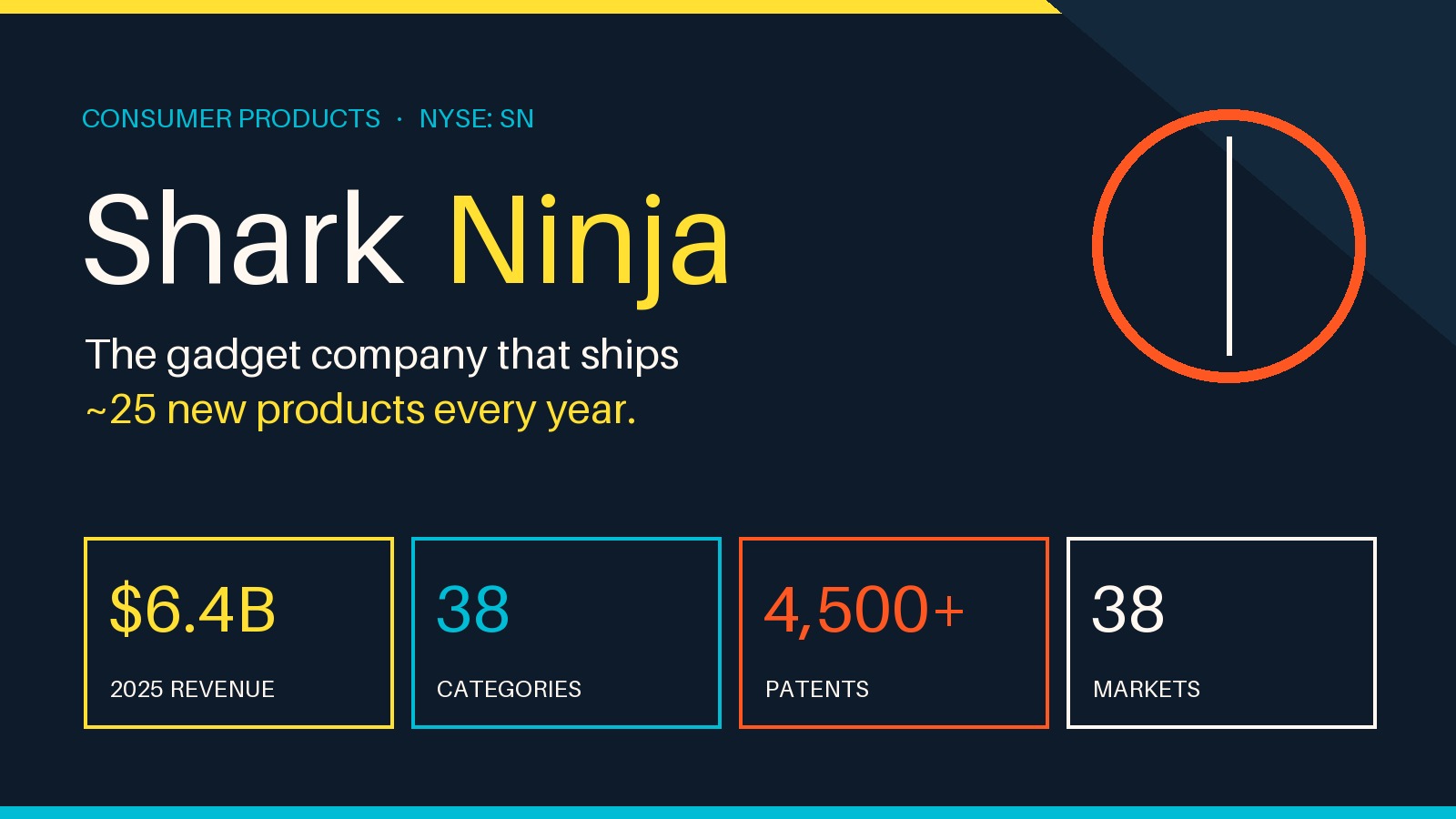
When Barrocas joined in 2008, the business did around $250 million a year. In 2025 it reported about $6.4 billion. That is not a straight line drawn by one hit product - it is the compounding effect of a company that ships constantly and rarely walks away from a category once it enters. Growth has run in the high teens and low twenties in percentage terms for years, with multiple consecutive quarters of double-digit gains.
SharkNinja annual revenue
The product line splits cleanly. Shark owns the mess: upright, cordless and robot vacuums, steam mops, and more recently fans, air purifiers and beauty tools like the FlexStyle and SpeedStyle hair systems. Ninja owns the meal: high-powered blenders, the Foodi line, air fryers, coffee, and a run of viral countertop hits - the CREAMi frozen-dessert maker, the SLUSHi frozen-drink machine, and in 2025 the Ninja Swirl by CREAMi. That same year Ninja stepped outside entirely, launching propane grills and outdoor fire pits and pushing the category count to 38.
A useful tell about how this company thinks is the naming. CREAMi. SLUSHi. FlexBreeze. These are not appliance names - they are things designed to travel across a social feed, and several of them went viral before they hit mass retail. SharkNinja spent its first decades on "As Seen on TV" infomercials. It has spent its most recent one turning TikTok into a product-launch channel.
Ask what makes SharkNinja different from Dyson, iRobot or Vitamix and the answer is not usually a breakthrough nobody else has. It is pace and price. The company tends to wait for a premium brand to prove a category exists, then arrives with comparable performance at a lower number. The Shark FlexStyle, aimed at the Dyson Airwrap, landed at roughly half the price. Ninja did something similar in air fryers and multicookers, riding rapid new releases and deep retail relationships to a US air fryer share that climbed from around 15% in 2020 to roughly a third by 2023.
The distribution engine matters as much as the design one. SharkNinja sells through Walmart, Amazon, Target and other big retailers, and increasingly direct to consumers. Its retail track record is strong enough that chains reportedly clear shelf space for new products on reputation. That omnichannel reach, paired with the constant launch cadence, is what lets a single company run two billion-dollar brands at once.
Inside the product machineThe 25-launches-a-year figure sounds like marketing until you look at how the company gets there. SharkNinja runs a large in-house engineering and design operation and treats consumer research as raw material rather than a check-box at the end. Teams watch how people actually use products in their homes, catalog the small frustrations, and prototype fixes fast. The 4,500-plus active patents are less trophies than exhaust from that process - the byproduct of trying a lot of things and shipping the ones that survive contact with real kitchens and hallways.
The category discipline is what keeps the cadence from turning into clutter. Entering two brand-new categories a year forces the company to keep hunting for adjacent annoyances - from floors to hair to fans to outdoor grills - while the existing lines get refreshed underneath. It also spreads risk. No single product carries the company, and when one brand cools, the other can lead. That balance showed up plainly in 2024, when Ninja's revenue share crossed over Shark's for the first time without either brand stalling.
Going globalThe third growth lever is geography. SharkNinja now sells across 38 international markets, and some of its sharpest gains have come abroad rather than at home. In the UK, for instance, the company's air fryer share climbed dramatically as Ninja became a household default. International expansion is deliberately staged: prove a category in one market, adapt the product and price for the next, and let the same omnichannel playbook - big retail plus direct-to-consumer - carry it. It is the least flashy of the three pillars and, over time, possibly the most durable.
Boring where it countsNot all of the story is gadgets. By the end of 2025, SharkNinja had moved nearly all of its production out of China to blunt tariff and geopolitical risk - a quiet, expensive operational rebuild that rarely makes headlines but shapes the margins that fund the next 25 products. The company went public in 2023, spinning off from Hong Kong-listed JS Global Lifestyle and beginning to trade on the NYSE under the ticker SN at a market cap around $4.2 billion. Within two years that figure had roughly quadrupled.
From sewing machines to robot vacuumsThe customer is mainstream and value-conscious: the shopper who wants premium-level results without a premium price, reached through the aisle and the app. Millions of them, across 38 markets. For anyone building products, the transferable lesson is unglamorous. Start from a specific, common annoyance. Match the performance of the category leader. Undercut the price. Then do it again next quarter, and the quarter after that, until the cadence itself becomes the moat.
Barrocas describes the leadership style that runs underneath all of it in three words: low ego, high empathy. It is a fitting motto for a company that made a fortune not by predicting what people want, but by paying close attention to what they complain about - and then quietly fixing it, one countertop at a time.