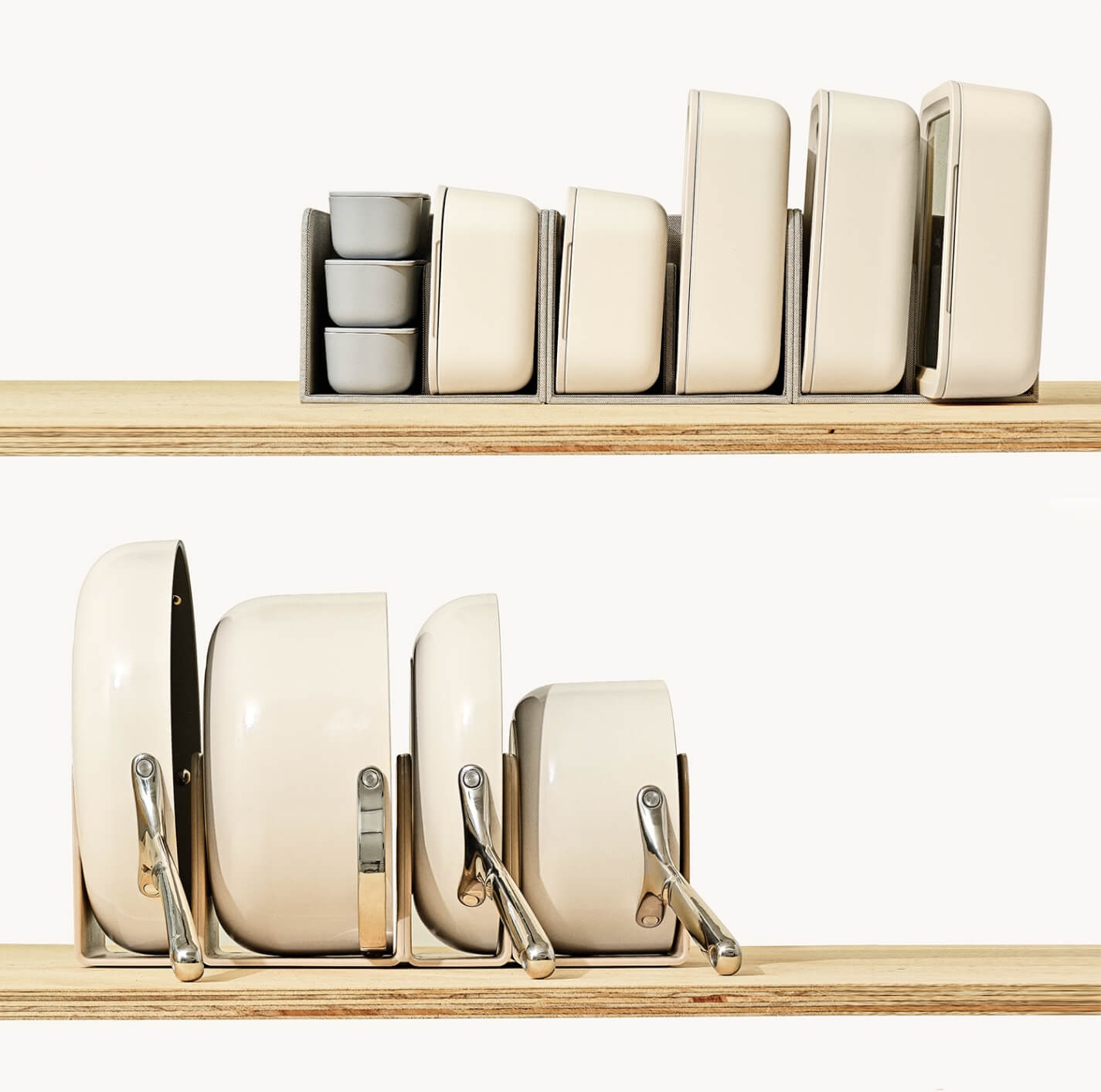
Look at a Caraway cookware set after someone has put it away. The pans stand upright in their racks. The lids have their own organizer. Everything appears to have an assigned seat. This is an unusually revealing place to begin a company story. Most cookware promises concern the moment food touches a hot surface. Caraway also makes a proposition about the other twenty-three hours of the day: your kitchen could feel a little less like a rummage sale.
- Ceramic-coated cookware, coordinated colors and storage sold together.
- A premium home brand for cooks who care about materials and appearances.
- Direct online sales widened into Amazon and physical retail.
- PFAS-free claims have support; sweeping safety comparisons need care.
A pan, an accident, a different question
Jordan Nathan says the idea followed an accident: he overheated a traditional nonstick pan and became ill from the fumes. He had been working inside the kitchenware business, so the experience changed an object he already understood commercially into something he wanted to reconsider personally. The question became what the cooking surface should contain, and whether an alternative could also look inviting.
Development began in 2018. The first collection arrived in November 2019. That distinction explains why the company’s origin year and its public launch sometimes differ. The initial offer was a ceramic-coated cookware set, including storage. Contemporary reporting put its price at $395. A customer was buying a coordinated collection in one decision, with the domestic choreography already worked out.
These are metal pans with a ceramic coating, rather than vessels made entirely of ceramic. That detail matters. “Ceramic” describes the cooking surface; it does not explain every part of the object. Caraway’s signature collection combines an aluminum core with stainless steel handles. The coating is made without PFAS, including PTFE and PFOA, and the company publishes third-party testing information.
The buyer wanted a room, too
There is an obvious customer here: someone who wants food to release easily and cleaning to require less persuasion. There is also a less obvious one: someone furnishing a home. A pan has to cook, but it may spend years in plain sight. Caraway gives that person colors, matching pieces and organization. The visual coordination makes the purchase legible before anybody fries an egg.
GreenPan offers another route into ceramic nonstick. Our Place competes for customers attracted to designed kitchen objects. Made In and All-Clad offer alternatives for shoppers focused on premium metal cookware. Caraway’s position sits across these concerns. Its distinction is the combined offer: material choice, appearance and storage presented as one household improvement. No single element belongs exclusively to it.
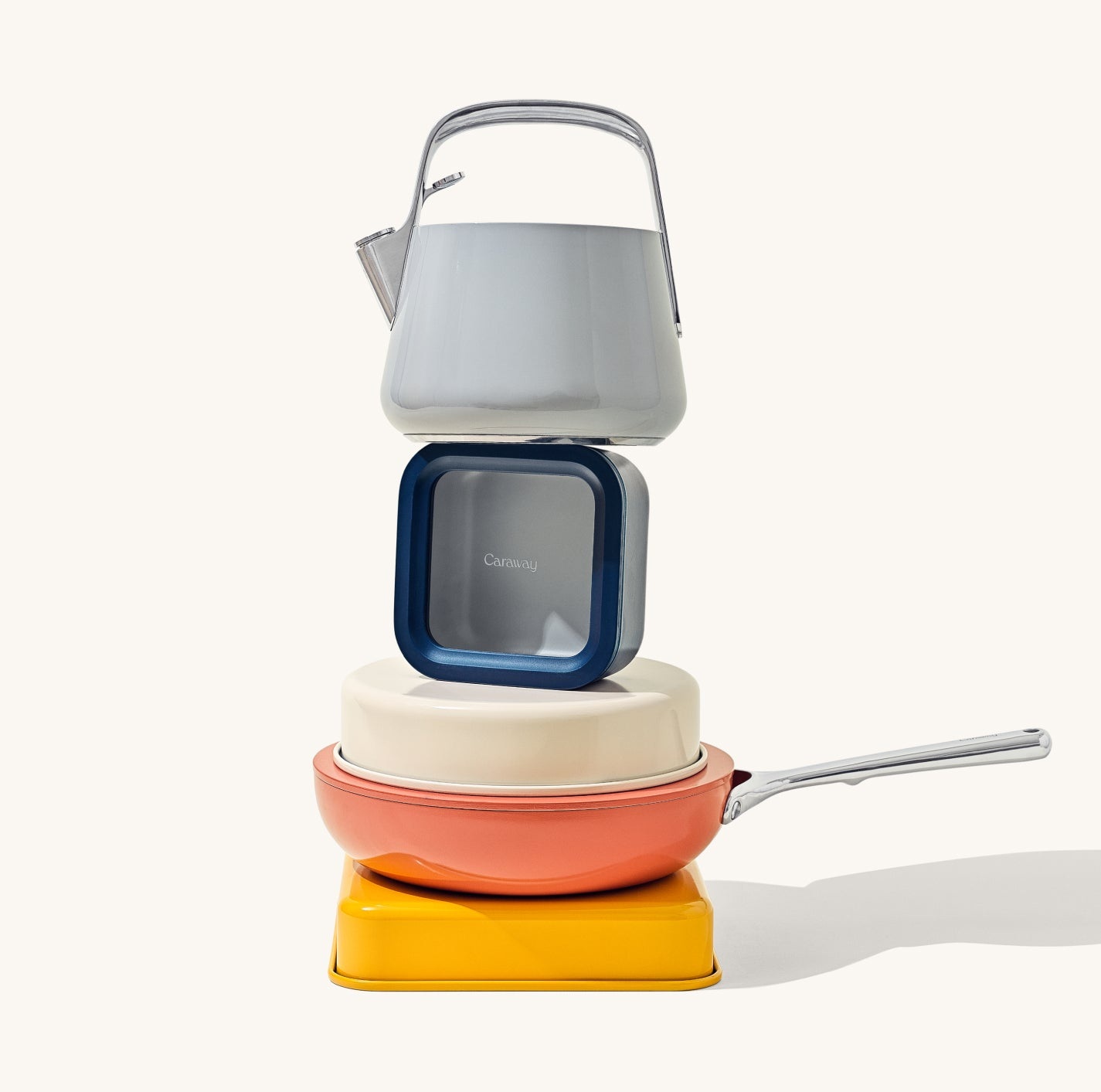
The range now includes bakeware, food containers, cutting boards, utensils and kettles, alongside stainless steel and enameled cast iron cookware. Those last two collections are revealing. The brand can keep its design vocabulary while changing the cooking material. An egg, a loaf and a deeply browned piece of meat do not ask the same thing of a pan.
The first obstacle had a cheque book
Before there was a recognizable product, Nathan had to persuade investors who had already seen other cookware pitches. He told Honest Ecommerce that the initial raise took roughly ten months and brought in about $1.8 million. The early stumbling block was getting the project financed. Tooling and inventory had to be paid for before the attractive kitchen could become a customer’s kitchen.
“Every time I got a no, I asked for an introduction.”Jordan Nathan, Honest Ecommerce
A $5.3 million seed round was announced in 2020. In September 2022, a $35 million investment led by McCarthy Capital backed product development and retail expansion. Capital bought room to broaden the assortment and distribution. It did not make the physical business disappear: this company still had to manufacture, package, ship and sell objects people would keep.
The business model is straightforward product retail: sell sets and individual pieces directly, then reach shoppers through other merchants. Target’s 2022 rollout covered 350 stores. Physical shelves let buyers see the colors and handle the product. They also put Caraway in front of people who were shopping for cookware rather than searching for Caraway.
The customer won the argument
Nathan says he initially wanted nothing to do with Amazon. Caraway added the channel in 2022. His explanation is usefully unromantic: customers have preferred places to shop. A brand may introduce the product through its own advertising and still find that the buyer wants to complete the transaction elsewhere. Controlling discovery does not guarantee control of checkout.
That is a lesson another business can copy. Study the customer’s route, including the inconvenient final turn. The same thinking applies to storage: observe what happens after the celebrated moment of use. A rack will not redeem a poor pan, and a new sales channel will not repair bad economics. But both can remove an obstacle from a product people already want.
The promise has instructions
Caraway’s ceramic care guide asks for low to medium stovetop heat, hand washing and utensils that will not damage the coating. Overheating can impair performance and longevity. This is a meaningful condition of ownership. A household devoted to fierce heat, metal spatulas and the dishwasher should evaluate a different material rather than expect color coordination to change the rules.
The advertising has limits, too. In August 2025, the National Advertising Division supported Caraway’s PFAS-free and non-toxic cookware claims but recommended modifying or discontinuing certain comparative claims about competing cookware’s safety. In February 2026, Groupe SEB USA and Meyer filed a federal complaint alleging false advertising and related harms. Those allegations are not findings. A claim about your ingredients requires different evidence from a verdict on your rivals.
Now the coffee takes its turn
In September 2026, Caraway introduced a $495 ten-cup coffee maker, its first powered appliance. The company says development took five years and 200 iterations. A stainless steel and glass brew path extends its materials argument into breakfast. Caraway also reported more than 2.5 million customers by then. The cupboard has opened onto the countertop; the next test is whether the same careful proposition makes a satisfying cup.