The most revealing thing about the Beast blender is not that it looks like a tiny grain silo designed by a Milanese architect. It is that the machine has almost nothing to ask you. Fill the ribbed vessel. Twist it into place. Tap the lone button to pulse, or hold it long enough to begin a timed blend. The theater lasts about a minute. Breakfast appears.
That restraint is the point. Beast Health is the second personal-blender company from Colin Sapire, the founder and former chief executive of NutriBullet. Sapire helped make the single-serve blender a household appliance, then watched the category breed the usual mass-market offspring: cheaper components, louder motors, vessels that age badly and machines destined for the cupboard. Beast, launched in Los Angeles in 2021, is his correction.
The company makes corded and cordless blenders, hydration bottles, insulated steel vessels, lids, blades, cleaning tools and other accessories. It sells direct and through retailers including Amazon, Walmart, Crate & Barrel, Macy's, Nordstrom, Bloomingdale's and Kohl's. The customer is the person who blends breakfast most mornings, cares about texture, dislikes visual clutter and is willing to pay to avoid buying the same appliance twice.
The correctionHe knew exactly what failed first
Beast's design brief reads like a warranty desk's diary. Budget gears can wear. Thin plastic vessels can deform, weakening the seal and inviting leaks. Weak motors leave seeds and fibers behind. Too many controls add ceremony to a task that should happen before coffee. Sapire's answer was not to connect a blender to Wi-Fi. It was to improve the physical loop.
The original B10 paired a 1,000-watt motor with metal gearing, an aluminum housing, a thermal safety sensor and thick Tritan vessels. Its 12 internal ribs create turbulence, pushing ingredients back toward the blades instead of letting them spin politely around the wall. A circuit board monitors speed and torque. The vessel shape also gives the brand a recognizable profile and a grippy surface. One feature does engineering, ergonomics and marketing at once - unusually efficient work for a piece of plastic.
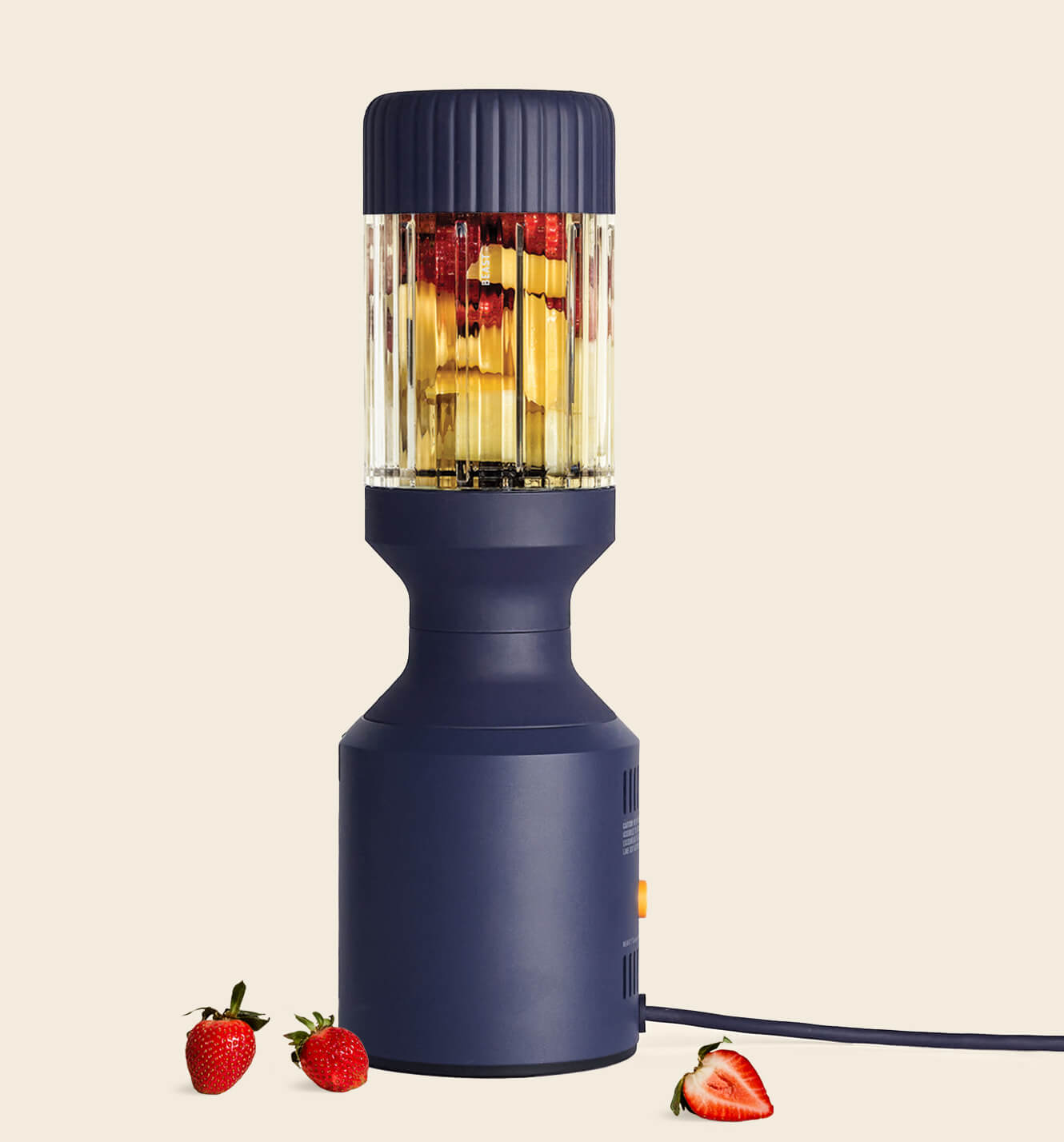
The first system cost $138 at its 2021 launch, or $168 with the hydration setup. Today the range stretches from the $124 base Mighty 850 to the $219 Mega 1200 Plus. The Mighty 850 Plus - three vessels, storage lids, drinking fittings and straws - lists for $149. The cordless USB-C Beast GO lists for $114. These are not impulse prices in a category where rechargeable rivals can sit below $100.
“We've really focused on building a customer experience team that's genuinely committed to helping our customers.”Colin Sapire
The actual productA health habit wearing an appliance costume
Beast markets wellness, but it does not need mystical nutrition language to make its case. Its practical promise is friction reduction. Frozen fruit, greens and protein become a drink. Chickpeas become hummus. Herbs become dressing. Nuts become sauce. The vessel can receive a drinking lid, so there is one less object to wash. Recipes and the new Fuel Up book, written by Sapire with physician Dana Cohen, supply ideas for keeping the motor in rotation.
That matters because the machine's value compounds only with frequency. A blender used five mornings a week can save decisions, cleanup and abandoned produce. A blender used twice a month is expensive sculpture. Beast therefore sells the ritual around the motor: recipes, portioned vessels, carry caps, storage lids, hydration bottles and, now, double-wall stainless-steel cups that keep contents cold. Compatible Mini and Mighty vessels work with the cordless GO base. That interoperability makes an upgrade feel like adding a room instead of moving house.
convenienceBeast
premium personalFull-size
professional power
The position is narrow and defensible. Beast is more expensive and material-conscious than many personal blenders, more compact than a conventional Vitamix, and less obsessed with portability than a motor-in-the-lid gadget. It wants the smoothie drinker who sees a blender daily and the design buyer who treats counter space like Manhattan real estate.
The constraintPremium hardware punishes impatience
Sapire's experience did not make the second launch reckless. He has described Beast's United States growth as deliberately cautious. The reasons are gloriously unsexy: inventory risk, supply-chain exposure, service and warranty obligations. A software bug can be patched overnight. A container of imperfect blade assemblies can spend months at sea, arrive late and turn customer support into a crisis.
That burden changed the company's posture. Beast built its customer-experience operation and addressed the hardware foundation before accelerating. It offers a two-year limited warranty and 30-day returns on direct purchases. It sells replacement blades, lids and vessels. It also runs Beast ReNew for refurbished machines. For founders, this is the part worth circling: the launch creates attention; the parts catalog and service team protect the promise.
The revenue model follows the same logic. A hero appliance acquires the customer. Plus bundles lift the first basket. Extra vessels, drinking lids, blades and brushes extend the relationship. New formats such as the cordless GO and stainless-steel collection create reasons to return without making the old system irrelevant. Retail distribution widens discovery while the direct store keeps the full ecosystem visible. Beast does not publish revenue, valuation or credible funding totals, so the scale of that engine remains private.
Where it works
- Daily single-serve smoothies
- Fibrous greens and frozen fruit with liquid
- Dressings, dips and small sauces
- Buyers who value build, noise and appearance
Where the spell breaks
- Hot ingredients or steaming soup
- Large household or professional batches
- Repeated dry ice crushing
- Occasional users shopping on price alone
The honest testSmooth kale, stubborn ice
Independent tests mostly validate Beast's chosen job, while clarifying its limits. RTINGS found the Mighty 850 Plus excellent for single-serve smoothies, fast with fibrous ingredients and sturdy in build. Its metal drive gears and quiet-for-a-blender operation stood out. TechRadar turned kale, oat milk and blueberries into a smooth drink without leafy flecks and pulverized frozen berry seeds in one cycle.
But the Mighty is not a universal kitchen machine. RTINGS found it weak at crushing batches of ice, with heat building after repeated attempts. It cannot safely blend hot ingredients. Its useful capacity is personal, not party-sized. TechRadar also found that sticky ingredients collect in the vessel's grooves, demanding more attention than the charming trick of blending soapy water and declaring victory. Design signatures have cleanup consequences.
This is where the $149 argument becomes conditional. It works when smooth fibrous drinks, lower perceived noise, robust parts and handsome counter presence matter repeatedly. It does not work when the buyer primarily needs crushed ice, hot soup, family portions or the lowest possible price. A premium is not a personality trait. It is rent paid by frequent utility.
“Can't be a beast if you're not getting the right nourishment.”Marshawn Lynch, with admirable economy
The brand trickMake the partnership alter the specification
Beast's 2023 collaboration with former NFL star Marshawn Lynch worked because the joke arrived pre-written. Lynch was Beast Mode; the company was Beast. But the partnership did more than place an athlete beside a product. The forest-green Beastmode edition raised output to 1,200 watts and included a stainless-steel hydration bottle. The celebrity changed the object.
That is a useful standard for collaboration: if the partner can vanish without changing the color, capability, use case or story, the brand probably rented attention. Beast and Lynch made a louder version of the same worldview. His line - “Can't be a beast if you're not getting the right nourishment” - is corny, compact and perfectly attached to a blender.
Steal thisThe copyable parts cost less than a motor mold
This playbook fails when use is rare, the category has no visible frustrations, or the higher-quality fix cannot support enough margin to fund service and inventory. It also fails if aesthetics outrun performance. A beautiful blender that leaves kale on your teeth becomes a countertop accusation.
Beast Health's more interesting achievement is not inventing blending again. It is noticing what happened after blending became ordinary. The company turned degraded materials, noisy operation and cupboard-bound design into reasons for a second purchase. Its machine is theatrical to look at and almost boring to operate. For daily hardware, boring can be a hard-won luxury.