Trina Spear’s first trip to meet her future co-founder included a tennis match. She won. Heather Hasson was impressed. There are worse ways to begin a business partnership than discovering that the person across the net intends to return the ball.
It was June 2012. Spear was working on Wall Street when a mutual friend introduced her to Hasson, who was developing better scrubs in Los Angeles. After their first phone conversation, Spear booked a flight with four days’ notice. The visit became a series of visits. For months, she flew west every few weekends while keeping her finance job. A new career was being assembled between return flights.
The familiar founder story asks us to admire the moment someone quits. Spear’s is more interesting just before that moment. She had a substantial career to leave, and a product whose appeal could be checked in person. Customers could examine the clothes, ask questions, and buy them. A transaction supplied a useful answer to an otherwise rather expensive question: would anyone want this?
A flight, a tennis match, a different working life
Spear grew up in Miami, with a family example of entrepreneurship close at hand. Her father built a real estate business alongside her grandfather; her brother later joined it. She has described wanting to make something tangible. Finance offered training and a demanding environment, but the prospect of building a company of her own kept its appeal.
Her route was hardly a rejection of business education. She earned an economics degree at Tufts, graduating magna cum laude, worked for four years in Citigroup’s investment banking and private equity divisions, and completed an MBA at Harvard Business School. Blackstone’s hedge fund group followed. These were jobs in which a business could be examined through its numbers. FIGS would require her to help produce the numbers herself.
There had also been an earlier, less grandly titled apprenticeship: working the counter at Johnny Rockets as a teenager. Spear remembers thinking about how to earn more tips. The episode has the charm of a first job and the practicality of one. A customer’s response arrives promptly at a restaurant counter. It is difficult to conceal a disappointing experience inside a quarterly presentation.
Hasson brought a designer’s view to their partnership. Her starting point was a friend’s ill-fitting work clothes and the attention lavished on athletic apparel elsewhere. Spear had encountered the scrubs business through a private equity deal. Between them, they could see both a garment that might be improved and an established market in which to sell it.
Seven o’clock, twice a day
The founders’ early selling schedule followed their customers’ working schedule: seven in the morning and seven in the evening. They parked near shift changes, offered coffee, and sold scrubs from a car. It was customer research with a remarkably short distance between the question and the cash register.
Coffee, a conversation, and clothes within reach.
In January 2013, Spear left Blackstone and New York for Los Angeles, committing to FIGS full time. She also cashed out her 401(k) to help fund the business. The choice put her own savings into a venture she had already spent months testing. It gave the phrase “personal investment” a more literal meaning than most corporate biographies allow.
A work uniform is an unusual place to look for expression. Repetition is part of the job description. The same general outfit appears day after day, and familiarity can make its shortcomings seem permanent. FIGS treated fit, fabric, shape, and color as decisions worth revisiting. Buying directly online also gave the company a relationship with the wearer rather than leaving the entire experience to a retailer.
One small feature captures the method. A customer on FIGS’ advisory board described repeatedly losing wedding rings at work. FIGS developed a ring pocket. The idea was modest enough to fit inside a garment and specific enough to explain why anyone would care. A design meeting can spend hours discussing identity; a place to keep a ring makes its case rather more quickly.
Customer contact also affected service. FIGS built a round-the-clock customer service operation for people whose working hours often ran beyond the ordinary shopping day. The practical insight was that a business serving unusual schedules ought to notice the schedules. Attention to that detail gave the brand a way to act on its interest in customers.
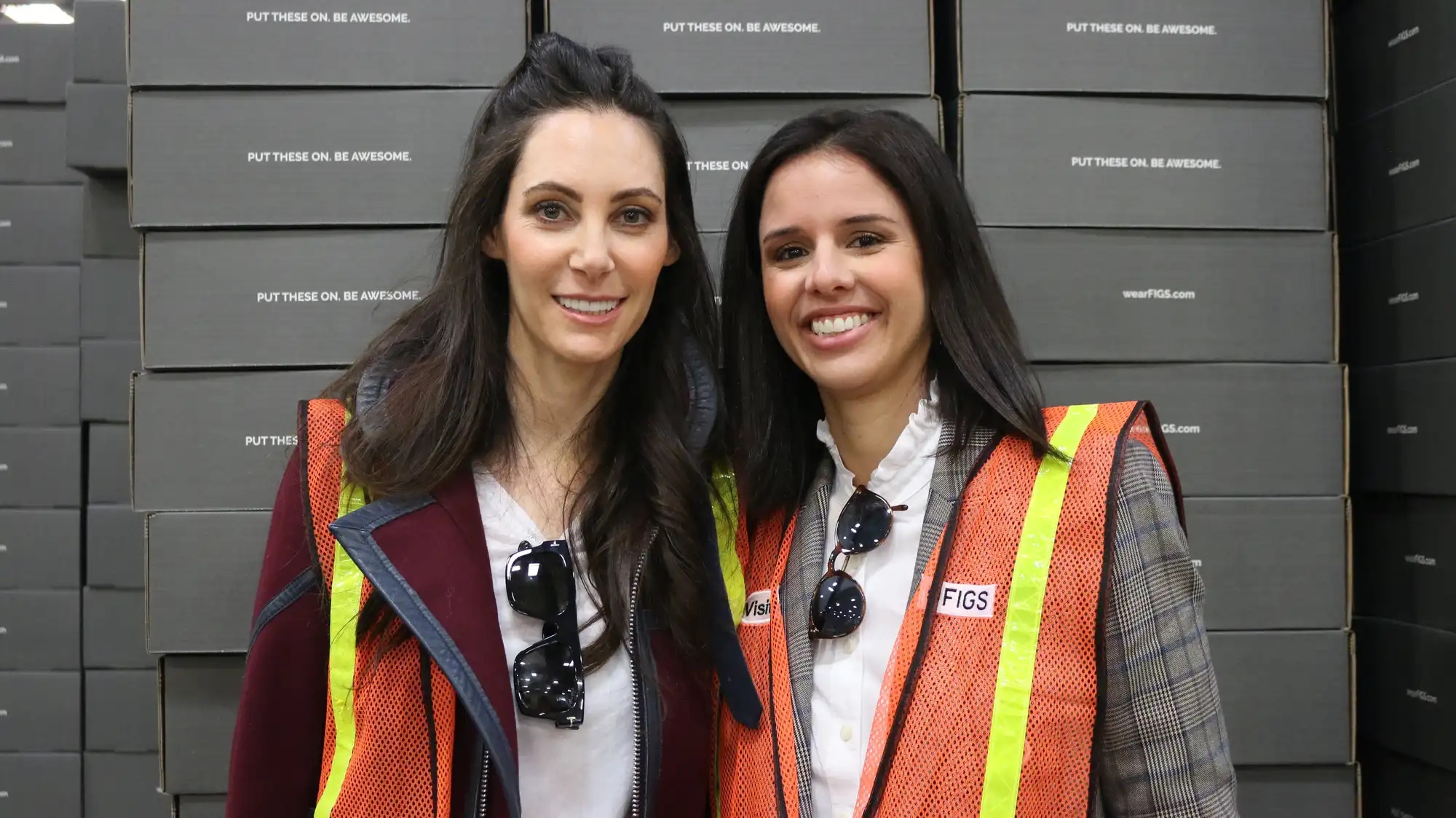
The partnership changes its titles
FIGS went public on the New York Stock Exchange in May 2021. Spear recalls bringing about 60 customers into the exchange for the occasion. For a company that had begun by approaching people outside work, the guest list carried a pleasing continuity. The people who wore the product had a place in the photograph when the company entered public markets.
The listing made the founders visible in a different setting. They had built a company together, and they arrived at the exchange together. A public company, however, brings a calendar that cannot be improvised around a weekend flight: reporting periods, board decisions, and investors waiting for explanations. The bell is a ceremony. The obligations repeat.
- 2013Spear moves to Los Angeles. FIGS begins.
- 2021The company lists on the NYSE.
- 2022Spear becomes sole CEO.
Effective August 4, 2022, Spear became sole CEO and Hasson became executive chair. The partnership continued, with responsibilities expressed through a different structure. FIGS subsequently described Spear’s remit as strategic execution and operations, with Hasson focused on product innovation. The shift matters when reading their history: the shared CEO title belongs to an earlier chapter.
It also gives Spear’s finance background a continuing place in the story. An apparel company needs imagination about clothes and discipline about buying, holding, and delivering them. A style can be appealing while the inventory behind it is awkward. FIGS described making smaller initial purchases of limited-edition products and using demand data to guide further buying. Here, the spreadsheet earns its place beside the sketch.
An online company opens a door
On November 3, 2023, FIGS opened its first permanent retail location at Century City in Los Angeles. It called the space a Community Hub. For a company that had built its business largely online, a door in a shopping center was a new kind of invitation.
Spear’s explanation included the ordinary pleasures of apparel shopping: feeling a fabric, trying on a garment, asking someone about it. There was also room for events, conversations, and customers meeting one another. A screen can show a seam very well. It cannot tell you quite how the sleeve feels when you move your arm.
The move followed earlier physical experiences, including pop-ups, and customer responses that encouraged the company to invest further. It arrived a decade after the founders’ roadside sales. In that respect, the store restored something familiar at a different scale. The first transactions had involved people standing together, discussing a product. The website grew the audience. A permanent room offered another way to meet.
The word “community” can become vague in business conversation, particularly when it appears immediately before a checkout button. A physical space at least gives the idea an address and a practical test. People can choose whether to come back, attend an event, or bring someone else. Spear’s proposal has to work in the room as well as in the description.
A uniform travels
In February 2024, Spear joined the board of Amer Sports, the group behind Arc’teryx, Salomon, and Wilson. Its board biography points to her consumer retail experience. The appointment places her in conversation with another set of businesses concerned with what clothing and equipment should do for the people using them.
FIGS’ own connection to sport became visible through its partnership to outfit the Team USA Medical Team at Paris 2024. The company then announced a kit for more than 150 team members at the Milano Cortina 2026 Olympic and Paralympic Winter Games. The partnership extends through Los Angeles 2028.
The winter collection included scrubwear, outerwear, knitwear, and accessories, with Team USA emblems and a red, white, and blue palette. A new fabric, FIBREX, debuted in the collection. The design problem had acquired a different setting: clothes intended for a support team traveling to a Winter Games have more to contend with than the temperature of an office.
There is a neat reversal in the relationship. The founders originally looked at the attention athletic brands gave their customers and wondered what that attention might mean for another profession. Their company eventually arrived at the Olympics dressing people working behind the sporting occasion. The resemblance to athletic apparel became a contract, a kit, and a set of actual garments.
Still close enough to see the seams
By the second quarter of 2026, FIGS reported $196.6 million in net revenues, up 28.8% from a year earlier. Its active customer count stood at 3.1 million on June 30. International revenues were $37.9 million, compared with $158.7 million in the United States. These figures describe a considerably larger operation than two founders could carry in a car.
Spear continues to describe opportunities beyond the company’s existing reach. The operational challenge is to widen that reach while retaining the ability to notice what an individual customer needs. International sales and new categories make the business larger; they also create more places where an assumption about the customer can go untested.
“being an individual contributor first and foremost”Trina Spear on leadership
Her stated approach to leadership involves working directly on detailed problems, whether a product, a campaign, or an operational decision. It is a useful answer from someone whose title now puts her at a distance from most transactions. The founder who once watched people consider a pair of scrubs still argues for getting involved in the work.
The tennis match makes a good opening anecdote. The weekends that followed explain more. Spear returned, tested, listened, and eventually moved. She built her second career around an object people already knew very well. The interest lay in examining it closely enough to believe it could be made differently, then staying around to see whether anyone agreed.