A suitcase is an awkward foundation for a lasting relationship. Make it well and its owner may disappear for years, happily dragging it through airports without giving its maker another dollar. Victor Tam understands the problem. He is building Monos around it anyway. The cofounder and CEO wants a travel company that can endure beyond the first purchase, the next advertising campaign and the enthusiasm surrounding a new funding round. The interesting part of his story is what he has chosen to put around the suitcase.
There are bags, clothes and packing accessories, of course. There are also physical stores, and a hospitality venture called Postcard. These extensions suggest a particular ambition: to give people reasons to return even when their luggage is working perfectly. A dependable suitcase does its job quietly. A business built around one has to find something else to say.
Tam arrived at that question after years spent making the internet pay. He had already built and exited a furniture business before founding Monos with Hubert Chan and Daniel Shin in 2018. By then, he knew the appeal of selling directly to customers. He also knew that a pleasing photograph was only the beginning of the work.
The apartment before the airport
His early education in business happened online. Tam recalls getting his first computer at eight or nine, initially using it for games. Internet access during high school opened another door. He learned to make websites, built a site around downloadable games and applications, attracted visitors and found ways to earn money from the traffic. He decided against post-secondary education while already running online businesses.
Those ventures could be small in human terms: himself, perhaps one or two partners, a home office. Growing a larger organization would require a different set of abilities. A website can be adjusted alone at midnight. A team needs decisions that other people can understand and act upon.
In 2011, Tam founded Rove Concepts from his small apartment, according to his own career account. The company sold mid-century furniture online. He describes his underlying interests as consumer psychology, branding and design, with digital marketing at the center. Furniture gave those interests a physical consequence. An attractive chair still has to be made, delivered and lived with.
He left Rove in 2018. His account of that experience emphasizes bootstrapping and learning how to scale a consumer business. The change from furniture to luggage looks smaller through that lens. Both categories ask a customer to trust a digital picture of something substantial, then judge the company by what arrives at the door.
A handle is a promise
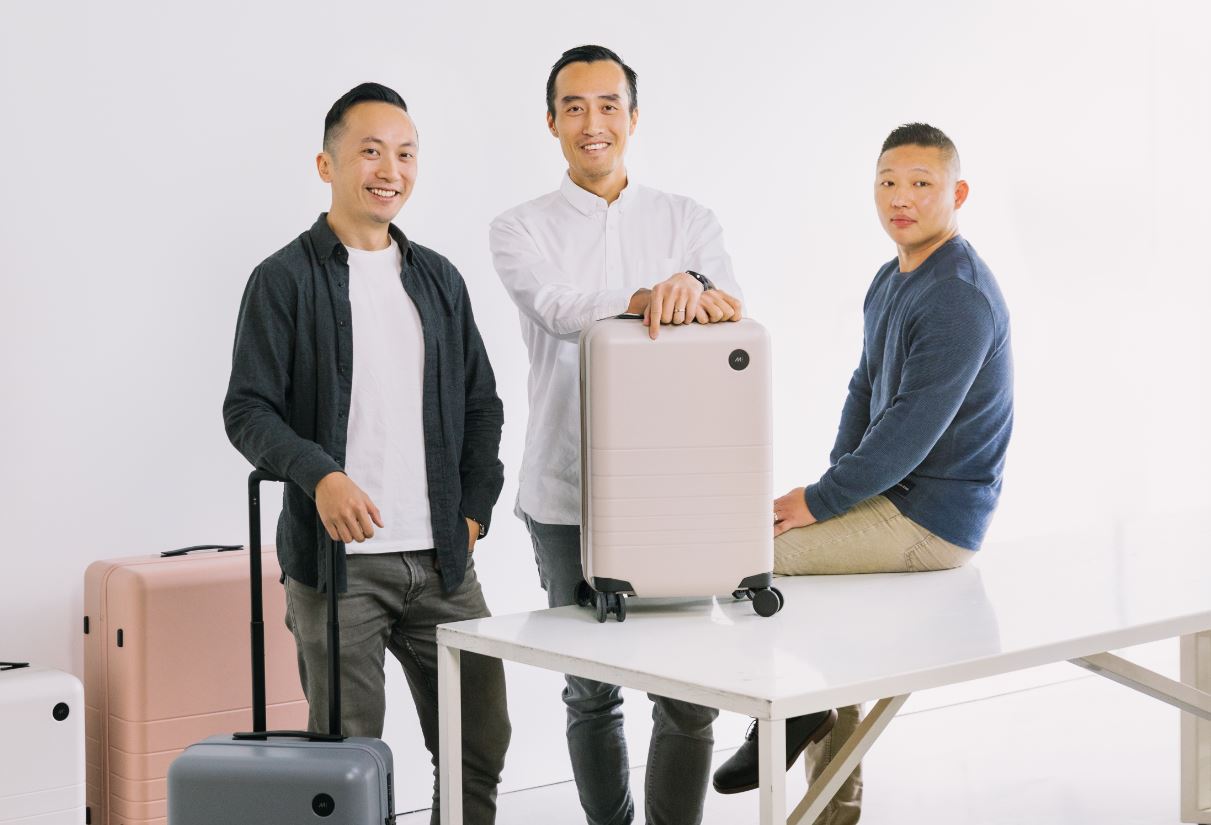
Monos began with three people who had known one another since high school. Tam and Shin brought experience with online businesses; Chan brought the creative side. The luggage launched in 2019. Longstanding friendships gave the venture a history before it had customers, but the product still had to justify its place in a crowded category.
The company's name draws on the Japanese expression mono no aware, an appreciation of beauty in passing moments. Its public origin story places that idea beside restraint in design and access to better-made travel goods. There is a useful tension there: a brand named for fleeting experiences sells objects intended to remain useful after those experiences end.
Tam has been specific about the making. He says the team developed the suitcase from its handle and wheels to its interior, rather than assembling a selection of existing factory components and attaching a logo. That is his account of the process, and it explains why he talks about manufacturing alongside branding. A suitcase has little patience for purely visual charm when a wheel refuses to turn.
By 2023, Monos had extended into apparel with Everywear and its Algarve capsule of Canadian-made linen clothing. Tam described that expansion in terms of comfort and usefulness across a journey. The same customer might need a bag at departure and clothes at the destination. His ambitions were already reaching beyond a row of hard shells in different colors.
The money that stayed put
In 2022, Monos raised US$10 million in a Series A, followed by a US$30 million Series B. Venn Growth Partners led the latter round, with participation from Strand Equity and Michele Romanow. The company also brought Marcello Bottoli, a former chief executive of Samsonite and Louis Vuitton, onto its board. Tam had moved from funding businesses himself to sharing a table with investors and an experienced luggage executive.
Then came an unusual admission. In July 2023, he said the company had looked at its account toward the end of 2022 and found the entire US$40 million still there. Monos said it had been profitable from inception. The money had provided confidence and options; operating cash had continued to support the business. This was a statement about that period, rather than a running account of what happened to the funds afterward.
“We're in the business to be profitable.”Victor Tam, 2023
A financing announcement ordinarily points readers toward what will be spent. Tam's story pointed toward the capacity to wait. He did not say raising capital had been a mistake. He said the experience taught him something about how much a profitable company with a good cash conversion cycle might need.
Two rounds. $40 million raised. Tam said the full sum remained in the bank at the end of 2022.
The numbers inside the company
Tam's approach to scale can be bluntly numerical. In 2023, he described a staffing guideline of one employee for every $1.5 million to $2 million in company revenue. At that point, the business had spent much of its early life with Tam handling marketing himself. The ratio was his description of a preferred operating rhythm, rather than a formula that every retailer could simply borrow.
That economy of resources sits alongside a willingness to share information. His leadership interviews repeatedly return to trust, empathy and the freedom to organize work around life. The question for a founder is practical: if you want people to make decisions, how much context are you prepared to give them?
Tam was named a 2024 Canada's Most Admired CEO in the mid-market category. In a March 2025 interview accompanying the awards, he explained that employees had direct access to him through the company's communication channels. Decisions and their reasoning were passed through the organization. He also acknowledged that a culture which worked at one stage might need revision at the next.
“My role is to continue to care.”Victor Tam, 2025
It is an unshowy description of the chief executive's work. Growth makes distance easier: more employees, more countries, more opportunities for a decision to arrive without its explanation. Tam's answer requires continued attention rather than a culture statement framed once and left on a wall.
Even the carbon gets a budget
His environmental commitments have an accounting dimension, too. Monos became Climate Neutral Certified in 2021. In an April 2023 interview, Tam described applying an internal carbon tax across the organization, making climate work a shared budget concern. Departments were expected to stay involved as the business grew.
He described visiting contract factories and working with overseas partners on emissions reduction, while acknowledging the difficulty of getting supply-chain participants engaged. He also discussed modular design that could make repairs easier and reduce waste. These are operational choices, with costs and tradeoffs attached, rather than a suggestion that travel products can be made without environmental consequences.
“Start with your materials,” was his advice to other companies. The plainness is useful. Materials, production locations, shipping and warehouses make a product's impact concrete. They also bring the discussion back to Tam's earlier experience: someone has to follow the appealing object through the less photogenic parts of its life.
A website discovers the street
The first permanent Monos store opened in Vancouver's Kitsilano neighborhood in July 2023. Before it came a pop-up at Toronto's Stackt market in late 2022. That temporary space served as a place to learn how customers handled products and what they expected when shopping in person.
For someone whose working life began with websites, a store creates an appealing reversal. Customers can pull a handle, roll a case and ask a question before committing. The business can learn from gestures that a page-view counter never records. Tam's digital background helps explain the value he sees in a channel with fewer screens.
Postcard extended that thinking into hospitality. Tam discussed the cafe as another entrance to the Monos world, a place people could return to far more frequently than they would buy luggage. By October 2025, Chicago had a Monos store with the cafe. The suitcase had acquired a reason to stay in the neighborhood.
In an October 7, 2026 update, Tam said further retail expansion remained on the horizon, while the immediate focus was stronger roots in existing communities. He also described a more balanced approach to Canadian and US markets as tariffs changed the conditions of doing business. The language had shifted from entering places to spending more time in them.
The light packer with a long itinerary
There is a traveler behind these choices. In a 2021 essay, Tam wrote about a road trip through Mallorca, including the narrow bends of the Sa Calobra highway. He remembered conversations among companions from five different walks of life, and the way travel gave those conversations room to develop. The destination mattered; so did the time inside the vehicle.
As a packer, he describes himself as light. Packing cubes are part of his routine. In June 2025, he said he had spent a year testing a forthcoming hanging packing product designed to move from suitcase to hotel. It is a small detail, but a telling one: the CEO's own journey becomes a place to notice what the next product should do.
The business he wants to build has a longer itinerary. Luggage supplies the first meeting. Useful accessories, physical spaces and hospitality supply possible next ones. Whether those relationships last will depend on the ordinary things Tam keeps returning to: the product, the people, the money and the attention required to make each work. For a light packer, he has given himself plenty to carry.