Shrey Sharma’s early business education had a sweet counter. As a schoolboy in Jaipur, he spent spare hours at his grandfather’s mithai shop, watching a family business at work. Years later, his own trade would involve software, tutorials and consulting. The setting changed considerably. His interest in how a business works had already found somewhere to sit.
He grew up in a business family, but his route into entrepreneurship wandered. Early startup ideas failed. He tried working with his father, found the arrangement difficult, and turned to programming. It is a useful complication in a founder’s story: the family business was available, yet it did not supply a ready-made place for him.
In college, he worked through programming languages and data structures, then encountered Salesforce. He also became a doubt-clearing instructor, helping students with the things they had not understood. That job description has none of the glamour of chief executive. It does, however, make a rather good introduction to customers: someone has a problem, and your explanation has to help.
Teaching became a business of its own through S2 Labs, his Salesforce training venture. Students wanted guidance; Sharma had something he could explain. The ambition was specific enough to act on, in a city he already knew. A classroom offered a place to begin without requiring him to solve his entire future first.
The classroom gets a play button
A room imposes an awkward limit on an educator. There are only so many seats, hours and questions one person can accommodate. Sharma began putting course materials and explanations on YouTube, opening the lessons to people beyond the physical classroom. Free tutorials made his teaching available to learners who could not sit in front of him in Jaipur.
He called the channel Salesforce Hulk. It is a memorable choice for someone explaining enterprise software, a subject whose vocabulary rarely arrives wearing a cape. Under that name, he made tutorials and career guidance around the Salesforce ecosystem. S2 Labs and the channel gave his teaching two distinct homes: an institution for training and a public library of video lessons.
The recognition that followed was concrete. On April 2, 2019, Salesforce included Sharma in its announcement of 48 new Salesforce MVPs. The programme recognises community contributions and the willingness to help other people succeed. For a founder whose work included answering beginners’ questions, the award fitted the activity already occupying his time.
That distinction also helps explain his public identity. People might encounter a CEO through a company announcement; they could encounter Salesforce Hulk while trying to understand a lesson. A tutorial gives the viewer a chance to judge the explanation directly. Does this make sense? Can I use it? Those are modest questions with considerable commercial weight.
- 2018Cyntexa begins with five people
- 2019Salesforce MVP recognition
- 2025400+ team members at year seven
Company milestones at the dates shown; MVP recognition announced April 2, 2019.
Five people and a basement
Cyntexa began on January 22, 2018, with a five-person team in a residential basement. There was no furniture at the beginning. Sharma’s consulting assignments had grown beyond what he could handle alone, and forming a company gave the work somewhere larger to go. Co-founder and chief technology officer Vishwajeet Srivastava became a central colleague in building the business.
The company worked on Salesforce consulting and development, helping businesses put the platform to use. An early account of its approach emphasised understanding the business problem and using Salesforce’s existing capabilities before reaching for custom development. That is an unshowy engineering preference with a clear purpose: a client needs useful software, and additional complexity needs a reason.
By February 2020, Cyntexa described a team of more than 70 certified Salesforce experts. Its work brought together developers, architects, consultants and administrators. The basement operation was acquiring the mix of responsibilities a consulting firm needs when delivery stops being something its founder can personally supervise from beginning to end.
The beginnings remain part of Sharma’s account of the company, but the more revealing change is in the work itself. Answering a student requires clarity. Delivering a client project also requires coordination, deadlines and people who can make decisions together. As the team expanded, explaining how to do the job became only one part of making sure the job got done.
Jaipur stays in the picture
Sharma stayed in Jaipur despite opportunities to work elsewhere. His ambition was to make the experience of working for a multinational company available to local talent. That meant building a workplace where people could pursue substantial technology careers while remaining close to home. Geography was part of the proposition from the beginning.
In a 2025 conversation with The Guiding Voice, he described the practical friction of that choice. Some prospective hires associated a company operating from Jaipur with a small business, even when the role could be remote. The address arrived with assumptions attached. A founder could explain the work and still have to explain why the city should not settle the argument.
He also described advantages: lower operating costs than in larger technology centres and the familiarity of building in his hometown. The choice contained both a recruiting challenge and an economic benefit. Jaipur was neither a decorative origin story nor a problem he had to escape before the business could become credible.
There is something appealingly concrete about this ambition. Bring worthwhile work to people who already live somewhere, and an abstract conversation about talent becomes a question of everyday life. Which opportunities require a move? Which can exist nearby? Sharma’s answer was to build an employer in the place where he had chosen to remain.
The founder learns to hand things over
In January 2025, Cyntexa marked its seventh anniversary with a team of more than 400. The company’s work had expanded across Salesforce, ServiceNow and cloud technologies. It had also developed AppExchange products including ChargeOn, Easy Incentivizer and Aarch Merchant Tool. A business that began with five people now had considerably more knowledge to organise.
Sharma’s account of growth includes a change in his own behaviour. He had initially wanted involvement in every detail. Later, he learned to delegate, give colleagues ownership and invest in their development. “Trusting my team has been crucial,” he said. For someone accustomed to knowing the answer, allowing other people to supply it becomes part of the job.
He also gives luck a place beside effort. That admission makes room for timing and circumstance in a story otherwise easy to reduce to determination. He credits preparation and hard work while acknowledging that opportunities have to arrive. It leaves a more believable picture of entrepreneurship than a formula promising identical results to everyone who copies it.
In his January 2025 Hyderabad talk, Sharma discussed scaling, retaining people and keeping Cyntexa bootstrapped. He said the company had turned down funding offers. The choice is part of how he describes the business he wanted to build: one whose growth would be shaped by the work, its people and the decisions the founders were prepared to make.
“Trusting my team has been crucial.”
Shrey Sharma
Mango trees in the management lesson
Sharma’s writing about leadership reaches for a mango tree. To develop people, he argues, a leader has to select carefully, provide a suitable environment and invest resources over time. The analogy makes patience visible. Pouring on more water does not turn a seed into a mature tree by next month’s review meeting.
In the same essay, published in March 2025, he gives knowledge, authority, position and money a role in development. He also stresses that different people progress at different speeds. The manager’s responsibility includes making the direction of growth understandable. Handing someone a title does not finish the work of helping them become capable of carrying it.
The teaching instinct is easy to recognise here. A business concept becomes an ordinary object, then a sequence someone can follow. He calls the wider ambition “manufacturing talent”: developing people who can, in turn, develop others. The industrial phrase sits rather amusingly beside the gardening lesson. His explanation depends on cultivation and repetition, with no instant harvest promised.
A visual reading of Sharma’s mango-tree analogy. Growth has its own timetable.
A job title is a small container
His career writing applies similar scrutiny to the choices people make for themselves. In an essay on finding a workplace, he asks readers to examine whether they want an opportunity for its substance or for the approval it might attract. One test is whether the desire survives when nobody else will know about the achievement.
He places emphasis on colleagues, learning and the ability to contribute, rather than treating a familiar employer’s name as sufficient evidence of a useful career move. His own path gives the argument context: programming, teaching, consulting and running a company sit within one career, although they demand different work from the person doing them.
His discussion of risk is similarly procedural. List the possible gains and losses, consider their importance, and look at the decision with some distance. He remembers being afraid when starting a Salesforce-focused training business. Confidence enters this account alongside calculation. A founder can be enthusiastic about a decision while still having a sensible interest in what happens if it fails.
Still taking questions
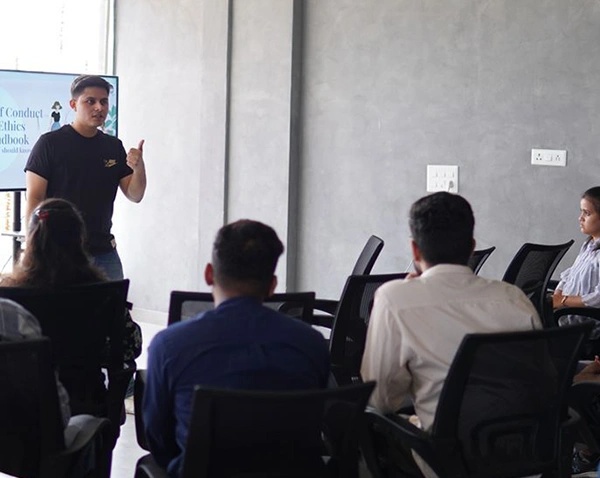
By September 2026, Sharma’s public activity still moved between students and enterprise technology. He had shared an account of addressing more than 700 students at Banasthali Vidyapith, discussing skills, networking, technology and AI with fellow panellists Saurabh Mittal and Gaurav Sharma. Returning to first-year students had reminded him of his own college days.
He had also announced plans to attend Dreamforce in San Francisco from September 15 to 17, 2026. That was a forthcoming visit, with conversations about Salesforce, automation, data and AI on his agenda. Cyntexa’s current services include Agentforce and Data Cloud work, extending the range of problems the company offers to help businesses solve.
The distance between a college classroom and an enterprise technology conference looks large on a calendar. In Sharma’s working life, they remain close neighbours. Someone is trying to learn what a tool can do. Someone else has to explain its possibilities clearly enough for a decision to follow. The students’ questions have changed company, and the company has grown around the work of answering them.