The merchants were using the product incorrectly. Or, more usefully, Santiago Sosa and his friends had built the wrong product. Their student venture was supposed to gather buyers and sellers into a shared online marketplace. Some sellers seemed far more interested in having a window of their own. They wanted a place to show their goods, express their identity and deal directly with customers. The founders had imagined a destination. The merchants were asking for the keys.
This is a rather inconvenient thing to discover about an idea you have spent years developing. It is also an excellent reason to keep talking to customers. Around 2010 and 2011, the team changed direction. The result became Tiendanube, known in Brazil as Nuvemshop: software that lets businesses create and run their own online stores. Its cofounder and CEO has been working through the implications of that choice ever since.
In August 2021, a $500 million funding round valued the company at $3.1 billion. That number supplies the tidy ending a startup story is expected to have. Sosa’s more revealing story lies in everything the number leaves out: the failed first model, the patient work of entering Brazil, and a founder learning to manage an organization far larger than a table of friends.
A university assignment with unusually long consequences
In 2008, Sosa and his fellow students at the Instituto Tecnológico de Buenos Aires faced a familiar requirement: practical work experience to complete their studies. They asked the course director whether starting a company could count. She agreed. There are internships that leave a line on a résumé. This one eventually required a regional organization.
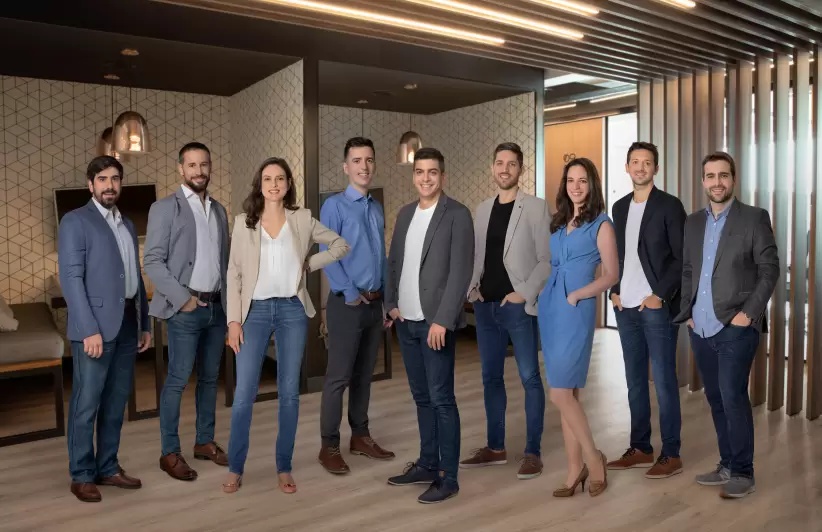
Sosa trained in software engineering. The founding group included Martín Palombo, Alejandro Vázquez, Alejandro Alfonso and José Abuchaem. Their early project, LinkedStore, drew on the possibilities of social networks. If buying online felt uncertain, perhaps connections between people could help transactions happen. It was a plausible idea with an awkward problem: the business did not develop as they had hoped.
The alternative emerged from watching people use what already existed. Small merchants wanted an accessible way to sell under their own brands. A store could carry a particular identity rather than disappear into a common catalogue. That request changed the job of the software, and changed the business the students were trying to build.
One early customer was a founder’s mother, who made stamps for businesses. Another came through a coworking space. The team also went door to door to find merchants; fashion designer Natalia Antolín became a lasting customer. The route to a digital business included a good deal of walking. Software may travel instantly. Trust generally prefers an introduction.
A change in who holds the keys.
The education after the degree
Sosa remembers getting his first computer at five or six. His interest in technology preceded his interest in running an organization. The company supplied a second curriculum. He has said he went without a salary for the first four years, while contemporaries found jobs and began receiving paychecks. An idea can be thrilling and still make a poor substitute for income.
Looking back, he acknowledged that the team sometimes took too long to recognize that something needed changing. That admission makes the pivot more interesting than a neat tale of intuition. They did not simply spot a solution and glide toward it. They had to revise work they had already invested in, and accept that their users understood something they had missed.
His early experience also included a three-month internship in India with Palombo. Most of his working life, however, has unfolded inside the company he helped create. The familiar career ladder, with its sequence of employers and promotions, offers little help in describing that route. The employer stayed substantially the same while the work kept changing.
By 2022, he described the transition from engineering student to entrepreneur as an exercise in learning sales, marketing, legal questions and recruitment. Writing code was one responsibility among many. A founder can inspect a piece of software and identify a fault. An organization presents faults with considerably less helpful error messages.
“Bajar las barreras de emprender a cero.”
Santiago Sosa’s stated ambition: reduce the barriers to entrepreneurship to zero.
He admits that ambition has a utopian quality. It supplies a direction rather than a claim that every obstacle has disappeared. Even a straightforward shop must find customers, buy inventory and fulfill orders. Removing the technical difficulty of launching a website leaves plenty of work for the person running the business.
Brazil did not arrive with an instant translation
Tiendanube launched in Brazil as Nuvemshop in 2012. The founders divided their time between a Brazilian coworking space and their Argentine office. The expansion came early enough to make regional thinking part of the company’s formation, rather than an optional project once everything at home was comfortable.
A map makes neighboring markets look deceptively simple. Merchants encounter local payment methods, tax requirements and shopping habits. A common software foundation can help, but it does not make those differences vanish. Building for Latin America meant learning how a business actually operates in each country.
Sosa said in 2022 that succeeding in Brazil had taken almost a decade. That is a useful corrective to the compressed version of startup history, in which a launch announcement becomes an achievement and a new country becomes a pin. A launch is permission to start learning. The pin cannot answer a merchant’s question.
By the following years, the platform’s footprint included Argentina, Brazil, Mexico, Colombia and Chile. The regional project gave Sosa a recurring management problem: preserve a common purpose while accommodating local realities. Merchants need tools that work where they sell, not a lecture on the elegance of a single global design.
The valuation, and the work underneath it
The company’s first angel round in 2011 brought in $300,000. A $30 million Series C followed in 2020. In August 2021, Insight Partners and Tiger Global Management co-led the $500 million Series E. Comparing the first and later rounds is enough to suggest how far the founders had traveled, without pretending capital alone explains the journey.
$300k2011 · Angel round
$30m2020 · Series C
$500m2021 · Series E
Sosa has said that achieving a billion-dollar valuation was never the company’s guiding objective. It was an acknowledgment that something substantial had been built. His recollection of the early days was more domestic: friends eating hamburgers after university and discussing what they hoped to make, with their notebooks as the principal equipment.
Those memories help keep the scale intelligible. A company can become large enough for its valuation to obscure its ordinary purpose. Tiendanube still has to make selling easier for a merchant whose concern is whether an order gets paid for and reaches its destination. The financing matters insofar as it supports that work.
The platform expanded beyond storefront creation into payments, logistics and marketing. Acquisitions included logistics business Mandaê, marketing automation platform Perfit and E-commerce na Prática, an education business. Each addresses something a store owner must do after the site goes live. A handsome shopfront is a beginning; the parcel still needs a journey.
A founder learning to leave room for others
Sosa’s public conversations regularly return to the limits of what one company can solve alone. Tiendanube opened an API for outside developers in 2013. It built an ecosystem in which other businesses could add applications and services. A merchant’s needs could extend beyond the platform’s own priorities without becoming a dead end.
The approach also changes the founder’s role. Sosa works alongside Vázquez, now the company’s president, and Palombo, its chief product officer. His official remit emphasizes supporting the team and the platform’s regional development. The software engineer’s project has become an exercise in enabling other people to do useful work.
On the Cracks podcast, he discussed ego and the difficulty of learning while refusing to admit mistakes. In a Startupeable conversation, he recommended Thinking in Systems and singled out Kaszek’s Nicolás Szekasy as an influential investor. Both conversations offer a glimpse of someone interested in how parts interact, including the part labeled founder.
In 2025, Sosa, Palombo and Vázquez joined the Endeavor network. For a business built around helping entrepreneurs, the connection is fitting. It puts the founders into a wider community of people wrestling with expansion, decisions and the consequences of scale. Their original group of university friends now participates in a much broader circle.
The newest question is still a merchant’s question
In August 2026, Sosa described two practical uses for AI: helping merchants sell or reduce costs, and improving Tiendanube’s own operations. He reported about 180,000 customers and $3 billion in merchant sales during 2025. Those sales belong to the businesses using the platform; they are a different measure from Tiendanube’s revenue.
He pointed to paid chat agents handling conversations on WhatsApp and Instagram, and to Lumi in Brazil, which helps with tasks such as product descriptions and search tags. These are specific pieces of work, rather than an invitation to admire a technology in the abstract. Their usefulness depends on what happens in the store.
He also questioned treating AI chiefly as a way to cut costs, arguing that companies should reconsider the assumptions behind their organization. That curiosity connects the present CEO to the student whose first business model failed. An established arrangement can deserve another look, even when people have grown accustomed to it.
The merchants who wanted their own window gave Sosa an enduring problem to work on: how to make independence practical. The tools have grown more elaborate, the company has crossed borders, and the numbers have acquired more zeros. The person selling something still needs a store that feels like theirs. That is where his story keeps returning.
Continue the conversation
- Tiendanube: the company and its leadership ↗
- Santiago Sosa on LinkedIn ↗
- Santiago Sosa on Instagram ↗
- Sosa’s Tiendanube author page ↗
- The early years: a 2021 conversation ↗
- The origins revisited in December 2025 ↗
- AI and daily work: the August 2026 interview ↗
- Startupeable: ecommerce, growth and fundraising ↗
- Cracks: learning, leadership and ego ↗
- Watch: Conquistando el e-commerce de América Latina ↗
- Watch: Sosa’s Forbes interview ↗