Daniel Shim had a fairly efficient way to explain why he was leaving J.P. Morgan. He was going to become a “sock broker.” It was a joke with a business plan attached, although the business plan would take considerably more work than the joke. A sock can be sold in a sentence. Getting it to behave inside a shoe is another matter.
His departure came in September 2019. ONDO’s online store launched in October 2020. Between those dates sits the less photogenic part of a founder’s story: working with factories and deciding what, precisely, deserves to exist. Shim’s answer was an article of clothing designed to escape attention. A no-show sock should remain below the shoe line. It should also remain on the foot. The second requirement had been proving surprisingly negotiable.
By October 2026, that narrow starting point had led to ONDO’s first acquisition, Champion System, a custom performance apparel business. Shim now has both discreet daily essentials and race clothing in his company’s portfolio. The change gives his farewell pun a rather longer shelf life than anyone at the bank could reasonably have expected.
An ocean in the sock drawer
Shim grew up in South Korea and the United States. During college, he noticed that he and other international students bought socks in Asia and brought them back to America. He kept doing it after entering the corporate world. In his telling, the combination of quality and price made the habit worth maintaining. There was a tiny import business happening inside people’s luggage, without anybody calling it one.
He attended Emory University from 2010 to 2015. His subsequent finance career included Bank of America Merrill Lynch and J.P. Morgan. The route put him close to the workings of companies before he started one himself. A bank account, after all, is one of the places where an ambitious idea eventually has to encounter arithmetic.
The sock observation initially suggested a straightforward venture: bring Korean socks to the United States and sell them under a brand. Then he narrowed the idea to no-shows. That decision made the proposition easier to understand. Customers would be able to judge the product by a familiar nuisance, rather than by a founder’s enthusiasm for a country’s manufacturing. The shoe would supply its own product review.
There is something appealing about an origin this ordinary. Nobody needs a lengthy explanation of the irritation. The promise can be tested on a walk. Shim had found a small problem that could carry the full weight of a purchasing decision.
The heel gets a vote
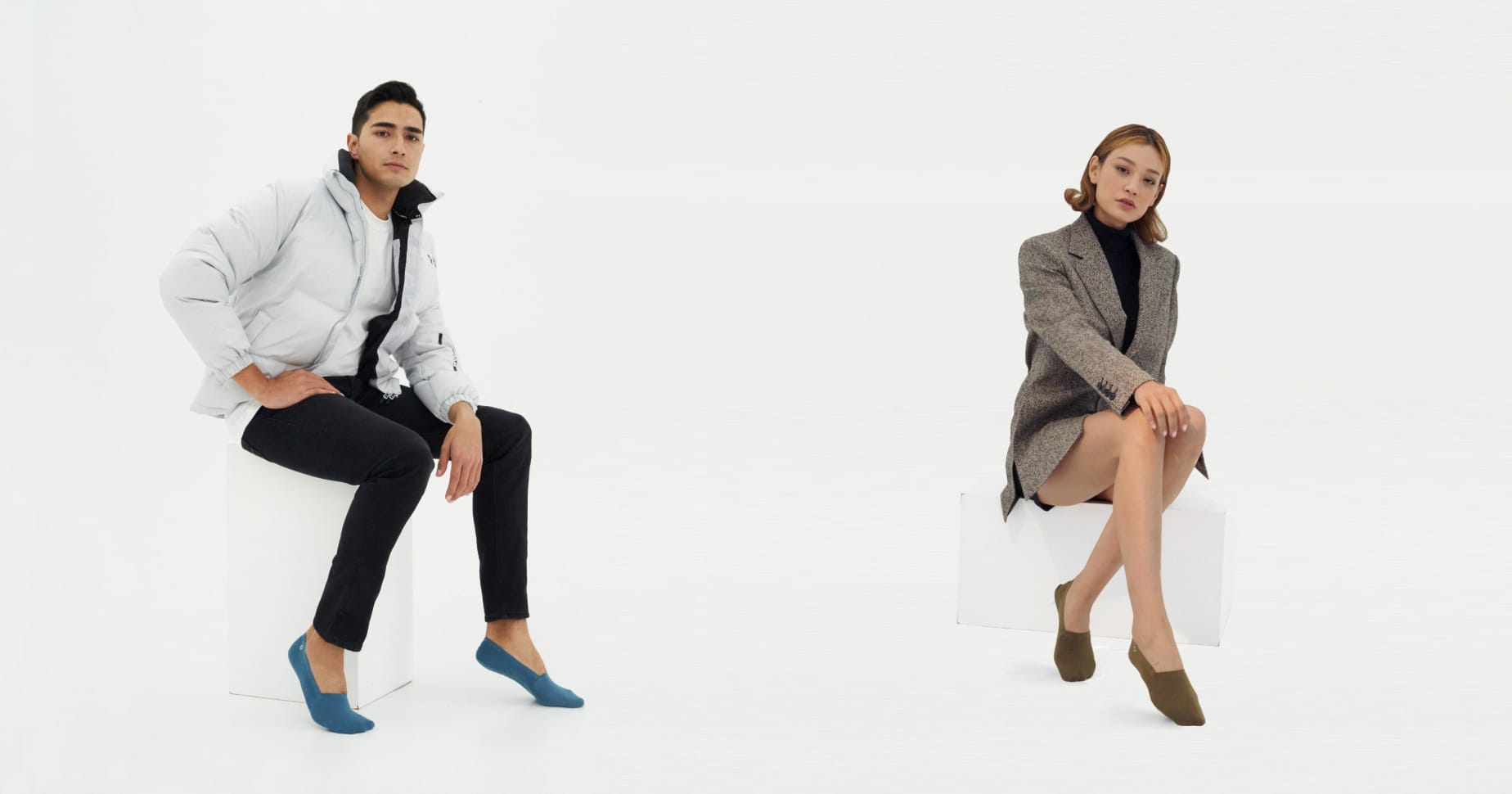
At launch, Shim described extra toe protection and a fabric blend developed for ONDO. He also made the heel grip central to the pitch. The product’s job was to preserve the tidy appearance of a bare ankle without requiring its wearer to keep rearranging the contents of a shoe. The design brief had the virtue of being stubbornly physical.
ONDO’s low-cut product page identifies its silicone feature as patented. The company backs its no-show socks with a No Slip Guarantee. That is a particularly legible promise for an online purchase: the customer knows the failure condition before opening the package. It gives a piece of clothing an unusually clear pass-or-fail question.
Independent wear testing has focused on the same detail. The heel’s broad silicone grip is more substantial than the scattered rubber dots familiar from many no-shows. A garment that stays in place can disappear from the wearer’s attention. For this category, being forgotten during the day is a useful outcome.
The premise also explains why the category’s crowded shelves did not settle the question for Shim. A large supply of socks says little about whether a particular design does the particular thing a buyer needs. His wager rested on the distance between owning the product and being satisfied with it. That distance could be as small as a heel.
A banker meets the shopping basket
By May 2021, ONDO had already reached six figures in monthly sales after three months in business. The early response established that the idea could produce orders. The next questions concerned the mechanics of selling: pack sizes, checkout choices and the information needed to run an online shop.
Shim tried Shop Pay Installments despite doubting that customers would spread payments for everyday apparel. Socks seemed a modest candidate for a tool he associated with more expensive purchases. Customers buying eight- and twelve-packs supplied the answer. Installment checkouts had twice the average cart size of regular checkouts, he reported at the time.
He also reported a 28 percent increase in conversion for May. These are historical figures from an early checkout experiment, rather than a current promise about what every shopper will do. Their interest lies in the surprise: a founder with a finance background still had an assumption about money overturned by people buying socks.
Keeping the shop, payments and reporting together mattered to him. The transaction was useful beyond the sale itself because it made customer behavior easier to see. A product business contains two kinds of detail work. One keeps fabric in position. The other keeps the operator from mistaking a plausible theory for something customers have actually chosen.
A company with people behind the seams
ONDO’s name means temperature in Korean and Japanese. The brand has built its language around warm and cool, work and rest, style and performance. Those pairings give room to sell more than one shape of sock without abandoning the company’s original interest in things people use every day.
The materials follow that broader brief. ONDO describes organic cotton combined with its aerolight fibers, alongside Australian merino wool used in its wool socks and headbands. It also describes a dedicated fabric research and development team. These are the company’s stated choices and commitments, attached to products rather than to a grand theory of fashion.
Shim’s public updates make the people involved visible. He celebrated product lead Donghwan Kim when Kim’s chef uniform designs appeared in Culinary Class Wars. It is an unexpectedly good detail in a sock founder’s public life: a colleague’s work, in another setting, becomes something the chief executive wants people to notice.
His LinkedIn biography asks a compact question: “Is it ONDO?” The tone of his posts is similarly informal. He jokes about the sock business, shares new products and credits the team. An enterprise selling discretion can still have a founder who enjoys a punch line. The invisible garment need not require an invisible personality.
What an invisible sock means in Britain
In 2026, ONDO approached students on the MSc Psychology of Fashion course at London College of Fashion with a question about the UK market’s perception of no-show socks. International expansion had brought the company back to an old problem: the product may be familiar, while the reasons people choose it can change.
The students conducted interviews and surveys, combining qualitative work with quantitative analysis. They presented findings to Shim and ONDO’s analytics and marketing team. Their suggestions covered campaign messaging and product ideas. The collaboration put a decidedly everyday purchase inside a discipline concerned with why people dress and buy as they do.
Shim’s response was appreciative and specific. He said the presentations combined analytical and creative thinking, with practical commercial ideas. He also pointed out the psychological significance of an item designed to disappear from sight. It is a neat observation about clothing whose visual purpose is to be absent.
The question deserves the effort. A no-show sock helps produce a look while withholding itself from that look. People can buy the same object for different shoes, routines and preferences. Asking those people directly is a sensible next step for a founder whose first idea began by noticing what friends packed in their luggage.
“even an invisible sock carries quite a bit of psychological weight.”Daniel Shim, on ONDO’s UK student research collaboration
From hidden essentials to the starting line
On October 6, 2026, ONDO announced details of its acquisition of Champion System. Founded in 2005, Champion System makes custom apparel for cycling, triathlon, running and teams. It serves recreational competitors and clubs as well as elite athletes. The transaction made it the second brand in ONDO’s portfolio.
Shim’s explanation joined two established capabilities: Champion System’s relationships with teams and ONDO’s experience building a brand and acquiring customers directly. Lever Style, the previous owner, will remain a manufacturing and supply-chain partner. The financial terms were undisclosed. The announcement describes an expansion into a company with multiple performance apparel brands.
The juxtaposition is pleasing. ONDO began with something meant to vanish under a shoe. A custom race kit is meant to identify its wearer, often from a considerable distance. Both have demanding practical jobs, but they occupy opposite ends of clothing’s relationship with being seen. Shim can now sell the detail someone forgets and the uniform a crowd remembers.
The acquisition adds a different sort of responsibility. Developing another product within ONDO and bringing an existing brand into the company are distinct tasks. Champion System arrives with its own history and customers. The continuing manufacturing relationship gives this new chapter a practical connection to the business that was already there.
The joke is still doing useful work
Shim’s story keeps returning to a modest observation and what can be built around it. Friends brought socks across an ocean. A low-cut pair slipped. A shopper bought a larger bundle. Students asked why British customers chose what they chose. Each is a small piece of information with consequences for the next decision.
The size of the ambition has changed. The original sock business now sits beside a custom apparel brand, with customers wearing its products in very different circumstances. The useful discipline is to keep those circumstances in view. A founder can explain a portfolio in a presentation; a wearer encounters it one garment at a time.
There is still room for the original pun. It says something accurate about a career that crossed from financial institutions into physical merchandise without becoming solemn about the crossing. Seven years after leaving the bank, Daniel Shim has more clothing to think about and more people to make it for. Somewhere, the entire proposition still comes down to a sock staying where it was put.