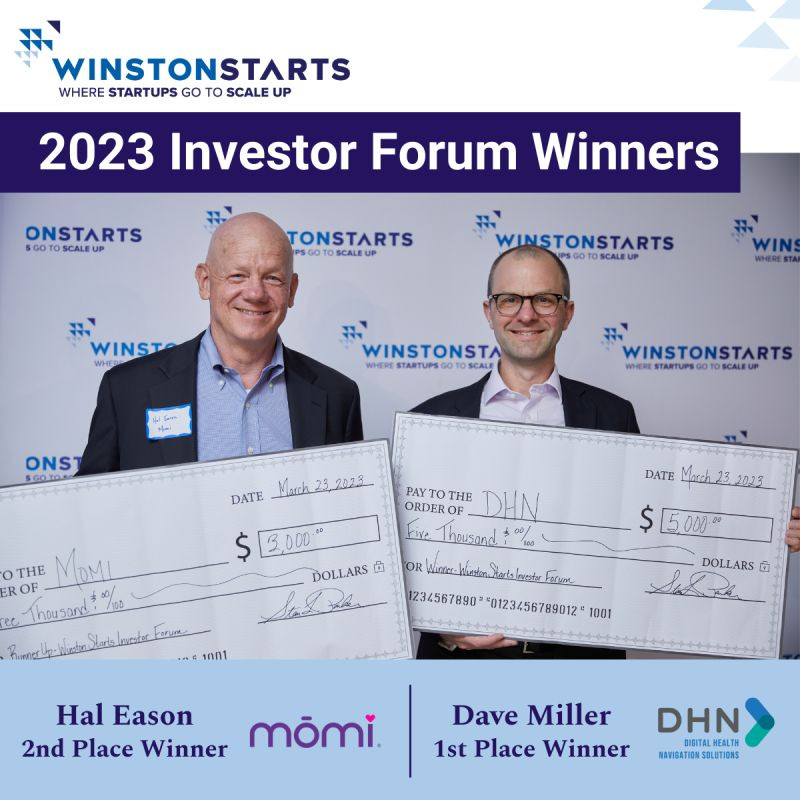
In 2009, Hal Eason explained a career decision with the kind of line a novelist might envy. After founding a biotechnology company and advising private equity firms at Bain, he wanted his next move to be an acquisition. “I want to own a business, but I don't want to start from scratch this time,” he said. “I want to start with a teenager, instead of a baby.” The joke has aged beautifully. Eason eventually became chief executive and co-founder of a baby-products company whose central object took roughly twelve years to reach the shelf.
Momtech Inc., the Charlotte company behind the mōmi brand, is built around a deceptively plain proposition: make a bottle behave more like nursing. Inventor Carr Lane Quackenbush began the work in 2011 after leading the United States business of breast-pump maker Medela. He spent years in his workshop designing and revising. Eason became the commercial counterpart, carrying an unusual object through capital raising, manufacturing, marketing, and distribution.
The result looks like a product that should have been easy. It is a small bottle with a soft, solid silicone tip. That simplicity is the trophy. Hardware becomes elegant only after someone has volunteered to suffer all the ugly complexity on its behalf.
01 / The long route
A man trained for speed discovers the use of waiting
Eason arrived at Momtech with the résumé of an accelerator. He studied English and mathematics at Vanderbilt, then theology, then finance and entrepreneurship at Harvard Business School. He finished the MBA in 2000 with High Distinction, as both a Baker Scholar and a John L. Loeb Fellow. The honors reward two kinds of fluency: broad academic performance and unusual command of finance. Afterward, he worked as a strategy consultant at Bain & Company.
From there his career scattered across industries but not, on inspection, across purposes. He founded Plureon in biotechnology. He started Agilis Equity Partners to search for, acquire, and run a promising operating company. He became involved with Vertigo Music, co-founded Aeva Bioscience and Foenestra, served on startup boards, taught in a Wake Forest entrepreneurship program, and coached founders at Winston Starts. He later co-founded WSPR Fund, a regional angel group.
The common job is translation. Turn science into a company. Turn a company into an investment case. Turn an investment thesis into operating choices. Turn a founder's conviction into a plan that survives contact with customers. At Momtech, the translations became physical. A concept had to become tooling, silicone, packaging, inventory, and a product someone could order from a phone at two in the morning.
Harvard MBA with High Distinction, followed by strategy work at Bain.
Agilis Equity Partners begins a live search for an operating company.
The product idea that becomes mōmi starts its long development.
WSPR Fund adds investing to years of startup coaching.
The first mōmi nipple reaches customers.
02 / The hidden object
The simpler the product looks, the more secrets it may contain
Quackenbush brought category knowledge and the invention. Eason brought the machinery around the machine. Their manufacturing partner, Canada's Silcotech, brought liquid-silicone expertise and a tolerance for stubborn problems. Eason has said it was the only manufacturer the team found willing to take the design on.
The first commercial version required three silicone formulations. Later versions reduced that to one while changing the geometry. This is a useful picture of innovation after the applause: remove a material, adjust a curve, listen again. The work is less like a lightning strike and more like editing a difficult paragraph in a language where every revision needs a mold.
“As simple as this product looks, it's the first of its kind in the market and presented a number of design challenges.”Hal Eason on building mōmi with Silcotech
Eason's most memorable observation from the partnership is not about silicone. It is about temperament. Quackenbush uses the phrase “ego stable” for collaborators who can absorb a large disappointment without making the room worse. Eason describes the desirable response plainly: skip the finger-pointing and move into solving, alternatives, and the next attempt.
That sounds like decent office manners. In hardware, it is closer to infrastructure. Physical products create excellent opportunities for reality to embarrass everyone at once. Materials misbehave. Suppliers hesitate. A feature works in the lab and objects in the field. The team either converts frustration into information or burns time deciding whose fault the information is.
03 / Launch is a comma
The product sold. So they changed it.
Momtech brought the first mōmi nipple to market in 2023. Its initial release reached $100,000 in monthly sales within eight months, according to the company's next-product announcement. For a small company, traction can become a sedative. It tells everyone that the hard judgment is finished and the market has kindly approved the answer.
Eason's team kept editing. The 2024 babypace 2 changed the nipple's shape and simplified its construction. In April 2025, the company relaunched bottles in a taller, narrower silhouette. The reasons included bottle warmers and stroller or car cup holders. There is a little comedy in spending a decade on a technical thesis only to meet the ancient industrial power of the cup holder. There is also a serious operating lesson.
Consumer products do not live in presentations. They live on crowded counters, inside bags, beside sinks, and in the one open hand a customer has left. A grand principle can win attention. Compatibility earns repeat use. The useful founder learns to care about both without becoming precious about either.
The money arrived in increments too. Public filings show $700,000 sold in a 2020 debt offering, $1.379 million in 2021, $1.272 million in 2024, and $552,794 in a 2025 debt offering. These are not the numbers of a frictionless software launch. They are breadcrumbs on a physical-product route: fund the next stage, learn what the object says back, continue.
04 / The teacher in the operator
Do the real work, then explain what it taught you
Long before Momtech, Eason gave nine Wake Forest MBA students and recent graduates an unusual summer assignment through Agilis Equity Partners. They would not analyze a tidy case with a known ending. They would help on an active company search, working in teams on industries, investment theses, and specific acquisition targets.
“This is not practice; this is the real deal,” Eason said. The line captures a preference that runs through his record. Education should have consequences. His later work at Wake Forest and Winston Starts kept him close to founders in the untidy middle, where a lesson becomes useful only after somebody risks applying it.
Public recommendations from former colleagues describe a leader who connects business needs with employee development, gives people assignments beyond their comfort zone, and offers enough guidance for them to find their own route. Quackenbush calls him endlessly curious, with interests spanning finance, marketing, biomechanics, and video production. The range is not ornamental. A six-person consumer company makes specialists of everyone and generalists of them five minutes later.
“You really need people around the table who can take a huge disappointment and… simply dive immediately into solving for the disappointment.”Hal Eason on “ego stable” collaborators
05 / The second draft
A career can rhyme without repeating itself
There is no straight line from English and mathematics to a silicone bottle nipple. There is, however, a recognizable rhythm. Eason enters where ideas need structure. At Bain, the raw material was strategy. At Agilis, it was an acquisition search. At startup programs and WSPR Fund, it is a founder's early conviction. At Momtech, it is an inventor's object and a customer's ordinary day.
Even the odd detour fits. Eason is a named co-inventor on a 2018 media patent for synchronizing social streams, a world away from baby bottles in material and close to them in method: take a behavior people understand, find the friction hidden inside it, and engineer a different route.
The tempting version of his story is persistence. Twelve years is a handsome number for that moral. The sharper version is discernment. Persistence without revision is merely expensive stubbornness. Momtech changed materials, geometry, and bottle shape. It chose partners for character as well as capability. It listened when the customer brought up the cup holder.
Eason once wanted to begin with a teenager. Instead, he found a company that demanded infancy, adolescence, and repeated growth spurts. Perhaps that is why the work suits him. Every stage gives the operator another translation to make, another person to teach, and another draft to improve. The bottle on the shelf is not the end of the sentence. It is simply the first version customers can hold.
Explore / Connect