The product loop, made physical
Michael Sharon likes a product that talks back. Long before he co-founded Taika, the San Francisco beverage company whose cans carry a phone number like a dare, he was working on social software that changed according to where people stood and what device sat in their palm. His career has moved from code to coffee, but the central preoccupation has barely budged: put something into the world, watch what people do with it, and let their behavior revise the thing.
The route was gloriously crooked. Sharon studied English and Law at the University of the Witwatersrand in South Africa, then went to New York University’s Interactive Telecommunications Program. In 2004, he built the Stranglophone, a gestural interface meant to make electronic music performance more visibly expressive. It was a wonderfully ITP sort of object, half instrument and half argument. Moving a mouse can make sound, but it is lousy theater. Sharon wanted the audience to see the musician’s intention.
He went on to co-found Socialight, an early location platform that let people leave digital notes attached to physical places. He taught “Designing Around Place” at NYU with Dennis Crowley. Then, in 2008, Facebook hired him as its first mobile product person. He spent more than five years helping the company develop its mobile products and strategy, later leading Pages across products, revenue and tools used by more than 60 million businesses, celebrities and organizations.
A beverage with release notes
When Sharon and Finnish barista champion Kal Freese began working on Taika in early 2019, they did not wait for a grand launch. They made early versions in Sharon’s kitchen, bottled them by hand and sold them through friends and startup offices around the Bay Area. Sharon called the approach D2B, or direct to business. Office fridges became test environments. Drinkers became a standing research panel. Some cans carried version numbers, as if a latte might arrive with release notes.
The pair sold more than 50,000 cans during that private beta. The number matters less as proof of scale than as proof of contact. Every delivery created another chance to notice what was working. Unlike software, however, a canned drink cannot be patched after someone pulls the tab. Ingredients, flavor, packaging and production all harden into inventory. Iteration still exists; it simply acquires weight, shelf life and a freight bill.
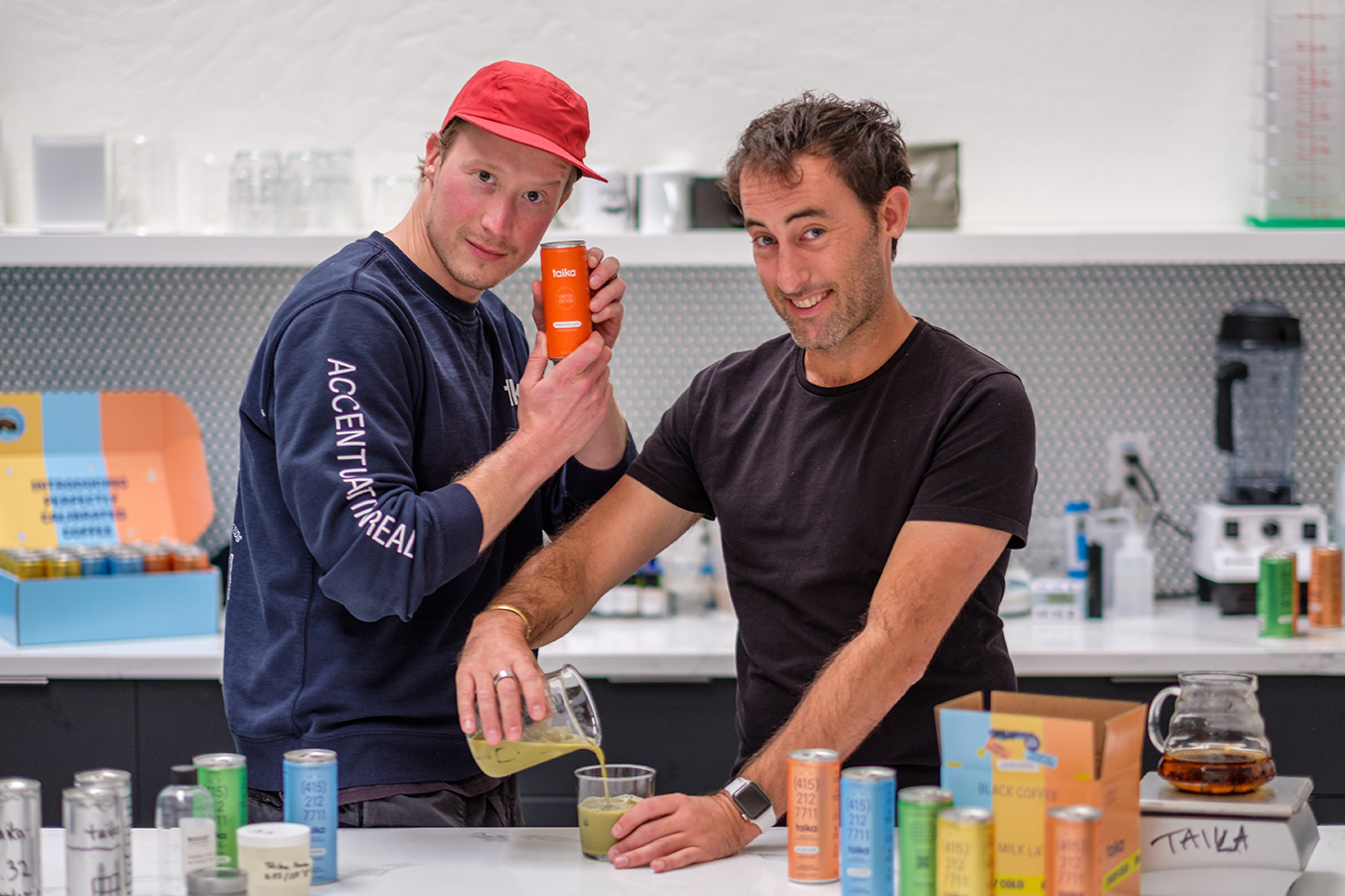
An early production problem made the difference plain. Once the founders moved beyond Sharon’s kitchen to a small bottling operation in Oakland, the coffee coming off the line tasted strange to them. Others accepted it. Sharon and Freese kept looking. They discovered the co-packer was adding citric acid, a standard move for the lower-grade coffee it usually handled. In their batch, it flattened the flavor they had built around custom-roasted beans. Removing it restored the drink.
“We’re constantly making new mistakes, and not making the same mistakes.”Michael Sharon on the operating habit behind Taika
It is a crisp founder philosophy because it allows for both confidence and embarrassment. The operator has to insist the batch is wrong when the room shrugs. The same operator must remain ready to discover that yesterday’s certainty has expired. Sharon’s advantage was not that software had taught him all the answers. It had taught him to expect another version.
When the first market vanished
Taika’s public launch arrived in May 2020, at precisely the moment office-fridge distribution became a historical reenactment. Its original customers went home. Revenue from the business channel disappeared. The company had already been considering direct sales and retail, but the shutdown turned a strategic option into an immediate requirement.
Channel evolution
The obstacle was not merely finding a checkout button. Taika’s first product was refrigerated. Shipping liquid is already a triumph of paying money to move weight; adding ice packs made the arithmetic particularly rude. The team changed co-packers and rebuilt the drink as a shelf-stable product. Sharon has said the reformulation took three months. By January 2021, the new cans were ready to scale.
Direct-to-consumer sales gave the company reach and a strong repeat channel, but Sharon was blunt about its ceiling: shipping beverages is expensive, while retail offers far more room. Taika began learning the grammar of the shelf. At Erewhon, the team could read sales through the retailer’s portal and test promotions. Sharon said placing a stand where customers entered tripled or quadrupled sales for the month. Physical placement was another interface.
Retail scale indicators
The front of the can is a conversation
The phone number began as the way friends ordered from the private beta. The founders would chat with them, then drop off coffee. When Taika launched publicly, the number stayed and grew visually louder. Customers texted from stores to ask whether they should buy the drink. Others wrote after an order or simply to see who might answer.
Sharon called the system a “brand experience touchpoint.” Freese called the human side “scalable hospitality.” Taika built software on top of Twilio, but code was only the routing layer. The memorable part was that funny people responded. Thousands of conversations accumulated. Some customers kept writing for years. A can had become a tiny door into the company.
This is a portable piece of Sharon’s playbook. Most packaging behaves like a monologue: claims on the front, instructions on the back, legal type in the basement. Taika used the front of its can to invite a reply. The move made feedback easier to collect, but it also made the company accountable to the personality printed on the aluminum. If the can promised wit, somebody had to be awake at the keyboard.
Watch · James HoffmannTaika - Coffee As A DestinationLet the bestseller edit the thesis
Taika began in coffee, but customers complicated the category. The company launched its Matcha Latte in 2021 after raising a $2.2 million round led by Obvious Ventures. It became Taika’s bestselling product. By 2024, Sharon said it was the third-best-selling ready-to-drink matcha in the United States. The evidence moved matcha from line extension to strategic center.
Strawberry Matcha followed in 2024, traveling from concept to market in four months, the company’s fastest development cycle. This time the route to retailers was mapped during development instead of improvised after launch. The drink became one of BevNET’s Best New Products of the year. Sharon said matcha had “redefined a little bit of how we think of ourselves,” a revealing sentence from a founder willing to let sales data revise the origin story.
The brand’s creative orbit widened in 2023 when filmmaker Taika Waititi joined as chief creative officer and an equity partner. The connection began with happenstance: Sharon wore a Taika shirt to a Los Angeles party, where a woman mentioned having a friend named Taika. The encounter eventually reached Waititi, who already knew of the cans bearing his first name. It is the kind of anecdote brand consultants would reject as too neat if reality had not supplied it.
The thread through the crooked route
Sharon once described himself as “constantly curious, clearly capricious, quietly quantitative and accidentally amusing.” The alliteration is playful; the career beneath it is serious about crossing boundaries. English and law led to interactive media. A gestural instrument led to location software. Socialight and teaching led to Facebook. Facebook led, eventually, to a kitchen full of hand-filled bottles.
Look closely and the route becomes less random. Socialight asked what digital products should do in physical places. Facebook mobile asked how a vast network should behave on a small screen carried everywhere. Taika asks how a physical object can create a digital relationship. Each project sits at a seam, the spot where human behavior makes a tidy product diagram untidy.
Sharon’s stated ambition for Taika is broad: create products that fuel creativity. The more instructive ambition may be embedded in the operating method. Keep the invitation open. Treat the shelf as data, the package as interface and the odd-tasting batch as a question nobody else has answered. Then reply when somebody texts. Magic, after all, is easier to trust when it has read receipts.