A soap factory with a farm on its roof sounds like a drawing made by someone who has misunderstood the assignment. In Chicago’s Pullman neighborhood, it became an actual building. Downstairs, Method made household products. Upstairs, Gotham Greens grew leafy greens and herbs. Drew Fraser was Method’s CEO during the development of this unusually productive arrangement. For a business selling bottles that people might leave beside the sink, the factory gave its environmental ambitions a much larger address.
The South Side Soapbox, completed in 2015, offers a useful way into Fraser’s career. His work has moved through Procter & Gamble, Clorox, Whirlpool, Method, and now Main Post Partners. These are businesses concerned with things people buy, use, replace, and buy again. The settings have changed from established corporations to a distinctive consumer brand to private equity. The recurring subject is the machinery behind an ordinary purchase: people, production, distribution, and the decisions that allow a company to keep its promises.
At Main Post, Fraser is Portfolio Operations Leader. He began working with the team in 2020, after ten years as Method’s CEO. The title puts operations near the center of his present chapter. To understand what he brings to that work, it helps to look at the earlier company, where keeping the place recognizably Method was part of the job.
The executive arrives after the idea
Method belonged to its founders’ imagination before Fraser arrived. Eric Ryan and Adam Lowry had built a cleaning-products business around design and environmental considerations, treating a household staple as something worth looking at. The familiar teardrop hand-wash bottle made that proposition visible. A bottle could do its work and earn its place on the counter. Beauty was allowed into a category usually associated with chores.
Fraser brought experience from the other end of the consumer-business spectrum. Before Method, he had worked in sales and marketing at Procter & Gamble, spent a decade at Clorox, and moved to Whirlpool in 2004. His Clorox responsibilities included running the Canadian business. At Whirlpool, he led North American sales and trade marketing across products, brands, and channels. Method appointed him president and CEO in 2009.
There is a particular difficulty in arriving at a company once its identity is established. The founders have already answered the question of why it should exist. Customers have begun answering the question of whether they care. An incoming executive inherits both answers, alongside whatever habits the business developed while everyone was busy getting it off the ground.
Fraser’s background suggests why he fitted that moment. A consumer brand can have a memorable voice and still need someone to think about the delivery. Retailers need products when promised. Sales teams need something to show them. Production needs to know what is coming. Every successful launch creates another reason for the departments to speak to one another before a deadline has acquired teeth.
A little order, preferably on one sheet
One early account of Fraser’s Method years turns on an unglamorous problem: departments were not always coordinating their work. Finance chief Andrea Freedman described salespeople missing samples and product launches missing dates. After initial forecasting improvements, Fraser encouraged her to extend the planning work. They joined a ten-person group that reviewed processes twice a month, identifying responsibilities and deadlines. The concession to an entrepreneurial culture was wonderfully practical: each process had to fit on one sheet of paper.
That last detail deserves its own small salute. A single page asks the author to decide what matters. It also gives the reader a reasonable chance of reaching the end. At a creative business, a process can be useful enough to follow and short enough to escape becoming a separate occupation.
The episode makes a modest, persuasive argument for Fraser’s kind of work. A product launch contains dozens of dependencies that customers never see. Making those dependencies legible gives people a better chance of doing the work they were hired to do. From the outside, a brand can appear effortless. Inside, effortlessness requires appointments, deadlines, and the occasional sample arriving before the salesperson leaves.
Hiring for the company you want to keep
People supplied another part of that operating system. Earlier in Fraser’s career, leadership advisers at Vantage encountered him as a young Clorox general manager and asked how he had developed his talent-management skills. His explanation was direct: a manager had taught him and held him accountable for the strength of his team. The anecdote gives responsibility a human chain. Someone demonstrated the work, then expected him to do it.
At Method, recruitment included a question about preserving the company’s eccentric character. Ryan’s hiring process asked finalists to tackle strategic and practical problems, then explain how they would keep Method weird. Candidates presented to a group drawn from different functions. Fraser, Lowry, or Ryan would attend. The founders’ concern for culture had made its way into a decision procedure, with senior leadership taking part.
For an incoming executive, that arrangement has an obvious attraction: it lets the company examine how someone thinks before giving them a place inside it. It also makes the values more demanding. A personality printed on packaging is easy to admire. A company has to decide who will make the next package, resolve the next disagreement, and sit in the next meeting. The interview becomes a rehearsal for working together.
Belgium enters the picture
In 2012, Method joined Ecover. The welcome at Method’s San Francisco headquarters included a high-five tunnel, Belgian beer, and trivia about Belgium. Corporate integration had acquired a party game. Ryan and Lowry stayed involved, and Fraser continued as Method’s CEO. The combination also opened an opportunity for the businesses to help distribute one another’s products on opposite sides of the Atlantic.
The celebration is a useful piece of company history because it captures the setting in which Fraser operated. The transaction changed ownership while the founders remained part of the business. A brand with a conspicuous sense of humor had to work inside a larger arrangement. After the handshakes and the trivia, the daily business still needed to function.
Fraser’s decade also included Method and Ecover becoming part of SC Johnson in 2017. He left Method in 2019. Taken together, those dates describe a substantial stretch of executive work across changing ownership. A company’s history can look orderly when reduced to a row of transactions. Living through it means attending to the people and products between those dates.
The roof gets a second job
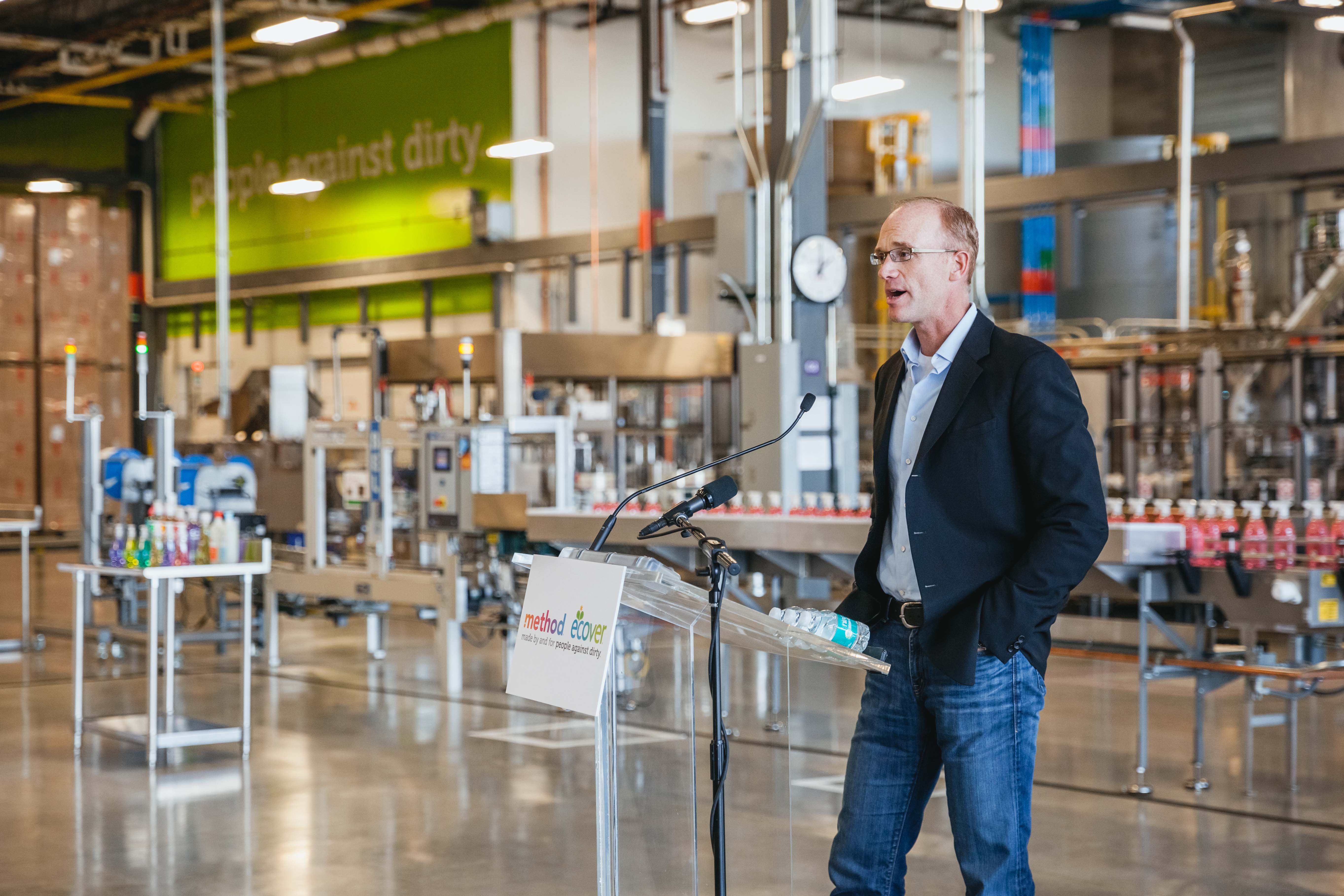
The Chicago factory made the company’s priorities physical. Designed by William McDonough + Partners with an architectural and engineering team, the 150,000-square-foot facility was completed in 2015 and received LEED Platinum certification. Large windows and daylight were part of the design. Colorful awnings gave the frontage a recognizable personality while serving as sun shades. The building took a consumer brand’s interest in design well beyond the bottle.
Its rooftop greenhouse was developed with Gotham Greens, which expanded into Chicago in 2015. The greenhouse put another business above the manufacturing floor, producing greens for the region. Roof space, usually a place for equipment and the occasional pigeon, became part of a working agricultural operation. The arrangement is amusing to describe, but it is also a concrete example of two companies sharing a site in different ways.
Two businesses. One roof.
Conceptual diagram of the Pullman partnership.
The location mattered, too. The project occupied a former steel-mill site in Pullman, within a wider redevelopment effort. Chicago Neighborhood Initiatives helped with local recruitment, and the completed project received a 2016 neighborhood development award. Manufacturing, employment, design, and land use met in a place with an industrial past.
“Business can and should be a powerful force for good.”
Drew Fraser, on the South Side Soapbox
There is room to take that sentence seriously without making Fraser the sole author of the building. A project like this has founders, architects, engineers, civic partners, employees, and another company operating upstairs. Its achievement belongs to an arrangement of people. That is part of what makes it relevant to an executive’s story: the result is visible, while much of the coordination is hidden.
A factory also gives a brand fewer places to hide behind pleasant language. It occupies land, consumes resources, receives deliveries, and employs people. Decisions about its design and location become durable. They are harder to revise than a campaign. The Soapbox gave Method an industrial expression of ideas customers had previously encountered on a store shelf.
From one brand to the next conversation
Fraser’s next chapter brought him to Main Post Partners, a consumer-focused private equity firm that works with founders and management teams. He now sits on the operating side of that partnership. His earlier jobs supply a relevant range of settings: established consumer companies, a founder-created brand, and changes in ownership. Each puts a different kind of pressure on the same basic question of how a business gets its work done.
His public activities have also included returning to Cornell, where he earned his business degree, for a December 2021 discussion of conscious consumption and green marketing. In September 2025, he appeared on the board roster of Special Olympics Northern California. The teaching conversation and the board position add two further settings to a career largely spent inside consumer businesses.
The factory remains the memorable image. It is easy to remember the lettuce upstairs and the soap downstairs. Fraser’s career invites a closer look at everything required to make an arrangement like that work. Someone has to translate an ambition into responsibilities, hire people who can carry it, and help the enterprise through its next change. Even a building with a farm on top needs a plan that the people below can read.
Continue the conversation
- Drew Fraser at Main Post Partners
- Drew Fraser on LinkedIn
- Method’s planning story
- Talent development at Clorox
- Method’s hiring process
- Method’s Ecover welcome
- Inside the South Side Soapbox
- Gotham Greens’ company history
- The Pullman neighborhood award
- Fraser’s factory photograph
- SC Johnson’s acquisition record
- Conscious Consumption: eCornell event and replay access
- 2025 nonprofit board roster
- Main Post Partners