The career advice arrived in a green polka-dot box. Anthony Marino came home to find his wife with a cashmere sweater bought through ThredUp. She had discovered a way to sell clothes the family no longer wanted and buy something she did. Marino had worked around technology, investment and Richard Branson’s consumer businesses. Here was a consumer proposition explaining itself in his kitchen, with considerably less ceremony than a board presentation.
He began looking into the company. About six months later, the family moved from New York to California, and in August 2013 he became ThredUp’s chief marketing officer. There is something pleasingly inconvenient about this beginning. An executive accustomed to evaluating businesses had been introduced to his next one by a customer who happened to live with him. The product had reached the household before it reached the career plan.
Today Marino is Managing Partner, Operations at L Catterton. Between that kitchen and the investment firm sits a decade at ThredUp, including nearly six years as president. But his story also runs backward through hotel development, venture capital and software. Across those settings, a recurring question comes into view: what must a business do behind the scenes to make the customer’s decision feel simple?
A hotel room before a clean-out bag
Before the move west, Marino helped put Virgin into the hotel business. He was the founder, CEO and a board member of Virgin Hotels Group from August 2009 to November 2012. The venture had a famous name attached to it. Fame, however, is a fairly poor substitute for a room ready when the guest arrives.
At the brand’s launch in September 2010, the announced plan was a four-star lifestyle hotel business, with properties in North American gateway cities. Marino led the management team as executive director, alongside experienced hotelier Raul Leal. Virgin also established a property venture with Alberto Beeck and Diego Lowenstein. These were plans for acquiring, developing and operating buildings, with the complications those verbs imply.
Marino’s explanation began with the consumer. Virgin already knew people through travel and leisure businesses, and he argued that understanding their frustrations could inform a hotel experience. His compact distinction was memorable: “it’s one thing to be known, it’s another to be liked.” A familiar sign outside the building gets you only so far. The stay has to supply the rest of the argument.
“it’s one thing to be known, it’s another to be liked.”
Anthony Marino, discussing Virgin Hotels, 2010
The timetable also offers a useful check on the romance of launching a brand. By May 2014, the planned Chicago hotel had still not opened, and Marino had left the business. He helped establish the concept and prepare it for expansion; the opening belonged to a later chapter. Hotels make ambition wait for construction. The distinction matters when considering what he actually built.
The unlikely preparation
Marino’s earlier career began at Bellcore, where he led engineers and scientists commercializing voice-over-IP software. He later became a principal at Venrock, the venture capital firm founded by the Rockefeller family. From June 2000 to June 2006, he worked there before moving to Virgin Group as a managing partner that September.
Software, venture investment and hotels make an untidy set of business cards. They also place someone on different sides of the same problem: developing something, deciding whether it deserves capital, and organizing people to deliver it. At Virgin Group, his work included involvement in the creation of Virgin Money and Virgin Voyages. ThredUp would give that varied experience a particularly tangible object to work on: clothing that had already belonged to someone else.
His education has a similar sideways interest. At Princeton, he earned an AB, magna cum laude, and received the New York Herald Prize for scholarly work on the marketing and communications strategies of the U.S. executive branch. He also earned an MBA at Harvard Business School. The Princeton topic puts communication in the picture well before clothing advertisements or hotel brands.
There was a less solemn Harvard activity, too. His education entry lists him as a lead actor and vocalist in the 1999 HBS Show, then producer in 2000. The future operations partner had spent time both onstage and organizing a production. It is an agreeable detail in a résumé otherwise populated by institutions, titles and commercial responsibilities.
Investment
Creation
Marketing
President
Operations
The numbers behind the pleasure
Once at ThredUp, Marino’s description of the job mixed customer delight with arithmetic. In 2014, he said he began every day by reviewing the numbers. He joked that the M in his title might stand for metrics. The business watched repeat purchases, customer satisfaction and cohort return rates. The pleasure of finding a garment had a measurable aftermath.
He described customers who wanted style and convenience without spending a fortune. Word of mouth and referrals brought in new shoppers. Email had to give the recipient something worthwhile. These are ordinary marketing concerns, made more interesting by the product: a secondhand item needed to feel dependable enough to buy without touching it.
At the time, Marino reported that ThredUp was adding about 10,000 items a day and employing 200 people. Those are snapshots from 2014, rather than figures for today. Their significance is the workload hiding inside the promise. Each incoming item had to become a product someone could assess on a screen.
The customer could enjoy the discovery. The company had to organize it. A handsome sweater is persuasive in a kitchen because someone has already done the checking, description, pricing and delivery. Remove that work and the buyer is left with a collection of questions. Put it together reliably and the recommendation becomes easier to make.
ThredUp snapshot reported by Marino in February 2014
A pile of clothes needs a translation
By the time Marino became president in January 2018, the remit had widened. Across his ThredUp career, he led commercial functions including marketing, product, brand, engineering, merchandising, pricing systems and data science. That list is revealing. The person responsible for consumer growth was working across the systems that shaped what the consumer could actually buy.
Resale requires an unusual translation. Clothing arrives with a previous life, rather than as an identical batch from a manufacturer. A seller wants the clearing-out process to be easy. A buyer wants useful information and confidence in the condition. The business sits between them, converting an individual item into a listing and eventually a purchase.
In his 2019 discussion of the model, Marino emphasized how ThredUp took possession of goods and handled their preparation and fulfillment. He also described the tension between asking sellers for better inventory and making the service too demanding. Convenience on one side produces work on the other. That is a central operational bargain in a managed resale business.
The sweater story provides an unusually good illustration of that bargain. His wife experienced the finished proposition. Marino’s subsequent work brought him into the functions that had to reproduce it. An anecdote got him interested; a decade of responsibilities followed.
A simplified illustration of ThredUp’s managed resale model.
The digital business and the mailbox
One of Marino’s public appearances puts him in an especially fitting setting: seated among clothing and work surfaces, explaining a relationship with the U.S. Postal Service. In 2016, ThredUp was using USPS to ship merchandise. The Postal Service also helped it launch its first direct mail campaign.
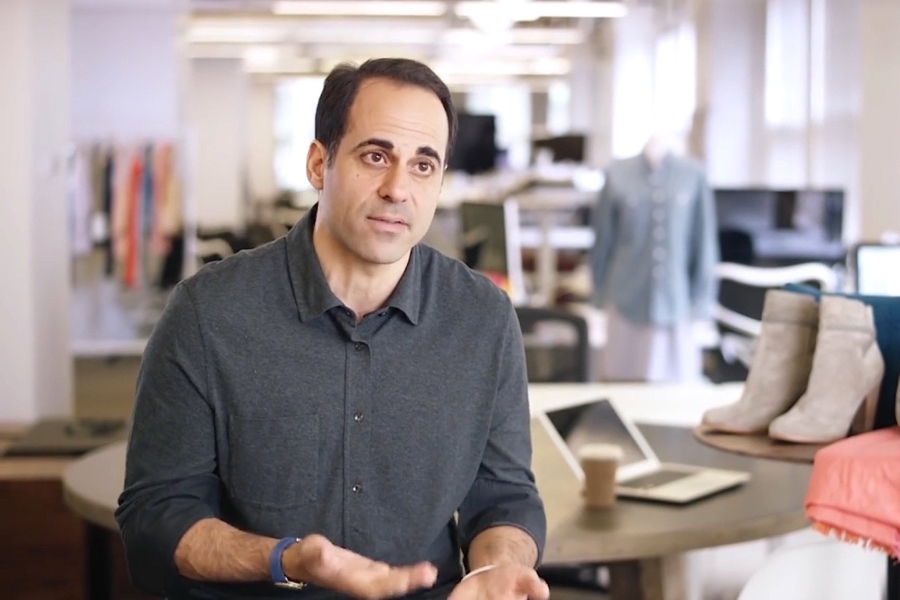
He spoke enthusiastically about the willingness to innovate together. The episode makes a useful point about his work without requiring a grand theory of technology. Online shopping has physical consequences. Something needs to arrive, and someone needs a reason to order again. A mail campaign and a shipment belong to that same customer relationship, even if they occupy different lines in a budget.
It also complicates the easy image of a digital executive operating entirely through screens. Marino’s ThredUp years connected the advertisement to the item, and the item to the parcel. The brand could be encountered in a feed, an inbox or a polka-dot box. Each encounter had a job to do.
When the customer started saying “thrifter”
By 2022, Marino was talking about a change in the language of shopping. He recalled internal debates over whether customers would like the word “thrifting.” Now people were identifying themselves with it. The company was no longer simply trying to persuade shoppers that buying used could be acceptable.
He saw retailers and brands entering resale as another shift. Their interest brought opportunities to reach customers, but also a worry that used products could compete with sales of new ones. His discussion acknowledged that commercial tension. A resale program had to fit the brand and offer an experience the customer wanted.
That August, ThredUp appointed Noelle Sadler as its first dedicated chief marketing officer in nearly five years, reporting to Marino. He described a coming period in which the marketing task would differ from the previous one. The audience was expanding beyond enthusiasts who already loved the treasure hunt.
People accustomed to buying new would need their own reasons to switch. Marino wanted to develop the interest of the next generation of shoppers. It was a continuation of the original kitchen demonstration, at a different scale: make the proposition attractive to someone who has other perfectly usable places to buy clothes.
What he took east
In July 2023, Marino notified ThredUp that he intended to resign. He stayed as president through December 31 to support the transition. The departure closed a decade at the company, from its first chief marketing officer to a president responsible for a broad stretch of the commercial business.
His farewell thanked co-founders James Reinhart and Chris Homer, the executive team, the board and colleagues. He also thanked the customers who had chosen used clothing. He described his time there as the period when a conviction about profits and purpose took shape, and expressed an intention to keep building enduring platforms capable of both.
In 2024, he announced that he had joined L Catterton as a managing partner. His family would relocate from San Francisco to the New York area, and he would work from the firm’s Greenwich headquarters. The return east had a new title attached, with operations now explicit in his role.
The geography had come around. The work had accumulated. Software commercialization, investing, hotel creation and secondhand retail now sit behind his responsibilities at a consumer investment firm. The most memorable entry point remains a sweater somebody else had worn. Marino’s wife saw a purchase worth making. He saw a business worth joining. Both judgments depended on what arrived in the box.