A shirt can begin in a wooden camper and end up in a conversation about private equity. In June 2026, CHAMP, the investment partnership between L Catterton and Patricof Co, announced an investment in Rhoback. The apparel company had spent a decade building a business without outside capital. Scott Dahnke, L Catterton’s global CEO, pointed to its products, storytelling and community. The financial transaction followed something people had already decided they wanted to wear.
There is a neat complication in that scene. Dahnke has a degree in mechanical engineering. His business concerns tastes, loyalties and the strange human ability to recognize oneself in a label. A machine has specifications. A consumer has preferences, which are liable to change just as everyone finishes the presentation. His career has unfolded where those two kinds of problem meet: the operation that must work and the customer who must care.
He has been a consultant, a public-company chief executive and an investor. Now he leads a consumer investment firm based in Greenwich, with businesses and colleagues across countries. The interesting part of that progression lies beneath the titles. Again and again, Dahnke returns to a question that a founder, a factory manager and a shopper might answer differently: what would make this business more useful, more desirable and capable of serving more people?
First, learn how the parts fit
Dahnke graduated from Notre Dame in 1987 and earned his Harvard MBA in 1991. His early experience included General Motors and Goldman Sachs’ merger department. He subsequently became a partner in McKinsey’s Chicago office, working with consumer businesses on strategy and operations. The movement from engineering into management gave him successive views of a company: its practical workings, its financial arrangements and the decisions made by the people running it.
Then a client became his employer. InfoUSA, the business and consumer marketing information company now known as Data Axle, had been a McKinsey client. Dahnke became its chief executive. Williams-Sonoma’s career record dates that appointment to 1997-1998. The distinction matters. Advising a manager and being the manager come with different calendars. A recommendation can be elegant on Friday; on Monday someone must decide who will carry it out, what it costs and which other task will wait.
Private equity followed. From 1998 to 2002 he was a managing director at AEA Investors, leading its consumer-sector investment efforts. Deutsche Bank Capital Partners came next, followed by Catterton in 2003. The route had supplied experience on both sides of the meeting table. By the time he arrived at Catterton, he had worked on corporate problems as an adviser, assumed executive responsibility and invested in the companies confronting them.
- 1987Engineering degree
Notre Dame - 1991MBA
Harvard - 1997Chief executive
InfoUSA - 2003Managing partner
Catterton - 2016Global co-CEO
L Catterton
The factory behind the label
Consumer investing offers plenty of attractive packaging. Dahnke’s explanations often go straight past it. Consider Ainsworth, the family-owned pet-food business behind Rachael Ray Nutrish. In 2014, its sales were growing, but manufacturing costs were growing faster. The family needed an investor who understood the business and could help it expand. Popularity had created an operating problem. A full order book is a flattering way to discover that the factory needs attention.
During L Catterton’s ownership, the company expanded manufacturing capacity and distribution. The investment story connected a recognizable consumer preference with specific changes inside the business: more output, broader availability and additional marketing. Ainsworth was sold to J.M. Smucker in 2018. The point is the relationship between the shelf and the production line. A customer cannot buy the product that a factory cannot supply, however affectionate the customer feels about its name.
Dahnke used a memorable phrase for the financial freedom an investor could offer: “erase the corners of the box.” It invites a founder to reconsider familiar limits. Would another facility help? Would a different distribution arrangement matter more? Capital gives those questions room. Deciding which answer deserves the money remains the job. That is where his history in consulting and operating management becomes relevant to the investment thesis.
Indexed illustration of the 70% capacity increase Dahnke described in 2019. These are relative units, not factory output volumes.
A passport for an investment idea
In January 2016, Catterton, LVMH and Groupe Arnault announced the combination that created L Catterton. Catterton’s North American and Latin American operations were brought together with the European and Asian operations of L Capital and L Real Estate. Dahnke and J. Michael Chu became global co-CEOs. It was an organizational change with a geographical argument: knowledge gathered in one consumer market could become useful in another.
Dahnke’s explanation at the time centered on the movement of media, technology and ideas across borders. The attraction was access to people and resources in different markets, alongside the ability to invest. The relationship with Bernard Arnault’s businesses added a particular kind of experience. LVMH works daily with the demands of brands whose appeal must survive travel, translation and changes in fashion.
Expansion makes a pleasing slide. It also creates stubborn practical questions. What should travel with a brand? What must change locally? Who knows the retailers, and who understands the customer? L Catterton’s regional teams gave the combination an operating structure. Seen through Dahnke’s career, the partnership looks like another effort to put the necessary parts in reach of one another. A global map becomes useful when somebody on it can answer the phone.
Being recognized is only the beginning
By 2019, Dahnke was describing a shift from brand awareness toward brand meaning. Consumers, he argued, increasingly wanted brands that helped express who they were. He also described specialization, operating capabilities and a collaborative culture as parts of the firm’s advantage. Those ideas belong together. Knowing a name is a modest relationship. Choosing it repeatedly, recommending it and making it part of daily life require something more.
The difference has consequences for investors. A familiar label may have little room to grow. An emerging one may have customers who care intensely, while lacking the people or distribution to reach the next group. Dahnke’s emphasis on meaning asks the investment team to look at the relationship before deciding what to build around it. The mechanism still has to be examined. Affection does not ship an order, recruit a manager or negotiate shelf space.
His own transaction experience reaches across consumer categories. A 2020 company filing credited him with more than thirty investments, naming businesses including Kettle Chips, Ferrara Candy, Heartland RV and Edible Arrangements. There is something instructive about that assortment. A potato chip and a recreational vehicle occupy very different shopping trips. Both involve choices that mix practical requirements with taste, habit and an idea of the life the buyer wants.
“it’s about brand meaning”
Scott Dahnke, 2019
The investor who answers the phone
The people on the other side of a partnership supply a smaller, more revealing scale. Paul Davis, a former Kettle Foods CEO, described Dahnke on LinkedIn as “engaging, accessible, intelligent and a lot of fun.” Deborah Ellinger’s recommendation likewise emphasized his availability and the value of his advice across their years of working together. These are colleagues’ descriptions, with the familiarity and enthusiasm that recommendations carry. They offer a human detail alongside the institutional language.
Accessibility has an unromantic use in a business. Problems rarely observe the schedule of board meetings. A chief executive may need a second view while a decision is still open. The recommendations suggest that Dahnke’s contribution was experienced through continuing contact, as well as through transactions. Fun is a useful addition. A partnership likely to encounter disagreements benefits from people who can remain bearable company.
His governance work extends beyond the firm’s private investments. He joined Williams-Sonoma’s board in 2019 and serves as its chair. The company also lists him as chair of the compensation committee. Those responsibilities put him close to a different rhythm: a public retailer, its leadership and the continuing scrutiny of shareholders. His work spans the founder’s expansion question and the established company’s decisions about oversight and incentives.
Back on campus, another kind of conversation
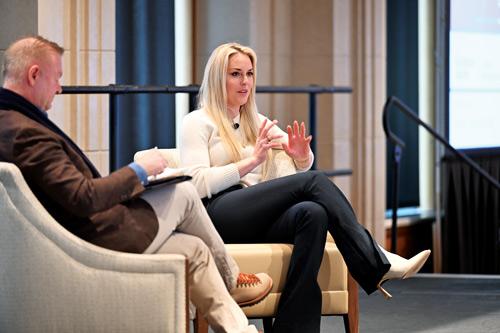
Notre Dame remains a recurring place in Dahnke’s life. In 2023, he moderated a conversation with Lindsey Vonn at the university’s Women’s Investing Summit. The event brought competition, entrepreneurship and leadership into the same discussion. The photograph captures an ordinary arrangement: two chairs, an audience and a question in progress. For once, the investor’s immediate task was to make room for someone else’s account of achievement.
That year he also spoke to students in Notre Dame’s Applied Investment Management program. The students’ account highlights his discussion of research methods, consumer trends and identifying the source of an investing advantage. His career advice emphasized people and culture. That is a concrete piece of guidance for a student comparing employers. A title is visible before joining; the quality of daily working relationships takes more investigation.
He became a Notre Dame trustee effective July 1, 2023. His connection includes family: he and his wife, Loretta, have four children, and the university’s announcement noted that two were graduates and another was then a student. The couple also gave the 500-seat Dahnke Ballroom in the Duncan Student Center. It is a contribution with an appropriately social purpose. A career spent assembling partnerships has helped provide a room where people gather.
When the athlete owns a piece
CHAMP brings the consumer question into a newer setting. Announced in April 2026, it gives athletes the opportunity to participate alongside L Catterton and Patricof Co as co-owners of portfolio companies. The launch named more than 250 participating athletes, including Joe Burrow, Mike Trout and Kevin Durant’s 35V. The partnership builds on earlier shared investments by the two firms, including Cholula Hot Sauce, Kodiak Cakes and RealTruck.
Ownership changes the arrangement around influence. An athlete brings attention and an audience, but also participates in the company’s fortunes. The model’s stated aim is to connect that involvement with growth. Dahnke’s contribution is recognizably continuous with his earlier arguments: understand where consumers place their attention, then create a business arrangement that can make that attention useful. The public ambition is clear; the results will depend on individual brands and execution over time.
Rhoback makes the idea tangible. Its founders had built a profitable apparel business before accepting outside investment. The CHAMP backing is intended to support its next stage, including retail expansion and further partnerships. Dahnke has traveled a long way from mechanical engineering, yet the connecting problem is familiar. Desire starts the movement. People, factories, distribution and ownership determine whether it keeps going. Behind the attractive shirt, someone still has to make the parts fit.
The aim: connect ownership and participation with the brand’s next stage of growth.
Further reading & connections
- Scott Dahnke on LinkedIn ↗
- L Catterton: Dahnke’s biography ↗
- L Catterton on X (company account) ↗
- The 2016 LVMH partnership ↗
- Dahnke’s 2019 investment interview ↗
- CHAMP’s April 2026 launch ↗
- Rhoback’s June 2026 announcement ↗
- Notre Dame’s trustee announcement ↗
- Williams-Sonoma board profile ↗
- Dahnke and Vonn at Notre Dame ↗