Ten generations is an awkward horizon for a business plan. The spreadsheet has to make room for people who have not been born, decisions nobody can predict and relatives who may have quite different ideas about what the money is for. In April 2025, Sean Driscoll joined a panel called Getting to G10. It was a fitting place to find an executive whose career has moved through the building, selling and continued investment of family capital.
Driscoll is a co-founder and co-chief executive officer of FAX Capital, alongside Blair Driscoll. He also shares leadership of Federated Capital, a single-family office. Those titles describe his present responsibilities. The more revealing story lies in the changes that preceded them: a return to Sentry Investments before the financial crisis, a growing mutual fund business, a regulatory settlement and a sale that supplied capital for another chapter.
A family business gives a career an unusual continuity. The company can change, the investment vehicle can change, even the job can change, while the surname remains on the letterhead. That makes it tempting to describe everything as one long progression. Driscoll’s history has sharper turns. Understanding them requires keeping the commercial achievements and the failures of oversight in the same picture.
The return before the storm
His father, John F. Driscoll, founded Sentry in 1997. Sean’s route back to the firm included an MBA at Schulich and work at Canaccord Capital Corporation. There he worked on transactions and company valuations. Investment banking supplied experience in the arithmetic of buying, financing and combining businesses. Returning to the family firm would bring the less tidy business of running one.
In a 2016 interview, Driscoll placed his return to Sentry in 2007, starting in investor relations. The timing matters. A role concerned with explaining an investment business to others became a vantage point on an industry about to undergo a severe test. The following year’s financial crisis altered the conditions in which the firm operated.
“It was a baptism by fire, but a very interesting time in the business.”
Sean Driscoll, recalling his return to Sentry
Sentry responded by placing more emphasis on mutual funds and converting a number of closed-end funds. A change in investment packaging can sound like a technical footnote. Here it was part of a change in the business itself: what it offered, how it reached investors and where it expected growth to come from. The family enterprise Sean had returned to was becoming a different kind of firm.
A bigger business, one relationship at a time
Driscoll became CEO in 2013. A year later, he was in Quebec City for Sentry’s Canadian roadshow. More than 125 people attended, roughly 30 more than the previous year. The scene is useful because it gives the growth story a human scale. Assets under management are counted in billions; building a distribution network still involves people turning up to a room.
Quebec was an expansion priority. Sentry was hiring local representatives and improving its French-language materials. The presentations in Quebec City were delivered in English with simultaneous translation. The details are unglamorous and consequential. A firm seeking a larger audience has to consider how that audience actually encounters it. A national ambition eventually becomes somebody’s document, conversation or unanswered question.
Growth in asset management depends on a chain of relationships. An executive’s plan must travel through portfolio teams, sales staff, financial advisers and investors. Each link has its own expectations. The Quebec visit offers a glimpse of that machinery at work, rather than reducing the company’s development to a number rising neatly from left to right.
The business behind the investments
Driscoll’s description of Sentry’s investment approach centred on balance sheets, cash generation and management’s use of capital. Those are revealing subjects for an operator to emphasise. A company must finance its commitments and make decisions before an investor can calculate what its shares might be worth. The attractions of a business begin below the market quotation.
In practical terms, that focus asks the investor to examine how an enterprise functions. Where does its cash come from? What demands are placed on it? Who decides how it gets spent? These are analytical questions, rather than a claim that any particular portfolio is protected from loss. A consistent investment approach still has to face inconsistent conditions.
His earlier leadership of NCE Diversified Management adds another dimension. During his tenure, it raised more than $350 million across five partnerships for resource exploration and development investments. Raising money, administering a vehicle and choosing where capital belongs are related jobs with different obligations. His career has involved each. The distinction becomes especially significant when commercial relationships and regulatory responsibilities meet.
Growth did not settle the question of oversight
In April 2017, the Ontario Securities Commission approved a settlement with Sentry and Driscoll over mutual fund sales practices. The admitted conduct included excessive benefits provided to dealing representatives and Driscoll’s provision of Montreal Formula One tickets to a representative in 2015 and 2016. Sentry also acknowledged deficiencies in controls, supervision and recordkeeping.
These rules address a basic conflict: an adviser’s recommendation should serve the investor, without being influenced by gifts from the company selling the investment. Sentry paid a $1.5 million administrative penalty. Driscoll received a two-year prohibition covering specified director and officer roles, including at investment fund managers and other registrants, and a five-year prohibition on serving as ultimate designated person or chief compliance officer of a registrant.
He had resigned as Sentry’s CEO and ultimate designated person on December 22, 2016. The settlement also recorded cooperation with the investigation and corrective steps. Its consequences belong alongside the growth figures. An investment business is responsible for how it sells and supervises its products as well as how it manages money. The episode is a concrete failure of oversight in Driscoll’s career, with formal consequences; it should neither disappear from the story nor stand in for every other part of it.
The sale that changed the next job
On October 2, 2017, CI Financial completed its announced $780 million acquisition of Sentry. The buyer gained an established investment business and its adviser and client relationships. For the Driscoll family, selling that operating company changed the resources available for future investment. FAX’s account of its origins connects the acquisition to the capitalisation of FAX and Federated.
A sale draws a crisp line through a company’s history. The work around it is less crisp. Building an asset manager involves creating a service for investors. Deploying family capital involves deciding which enterprises to own and how to own them. Experience can carry across that divide, but the responsibilities change. The former operator is now also considering the business from the owner’s side of the table.
There is a useful restraint in reading the transaction this way. The price is a corporate acquisition figure. It says nothing by itself about Sean Driscoll’s personal fortune. Its significance here is what it made possible for the businesses that followed. The family had reached a sale; the investment decisions were continuing.
Patience has to do some work
FAX describes an approach that combines a long investment horizon with active ownership and collaboration. Its remit includes public and private assets, equity, credit and real estate. For Driscoll, that places operating experience within a broader set of investment choices. A business can be examined through more than one kind of financial claim or ownership structure.
The firm also stresses investing its own capital alongside partners. Alignment is an appealing word in finance, but the practical question behind it is straightforward: who shares the consequences of a decision? Similarly, patience has meaning only when attached to decisions about capital and the businesses receiving it. Time alone does not build a company. Management and owners must still act.
FAX’s own structure changed in July 2022, when it completed a going-private transaction at $5.18 in cash for the relevant subordinate voting shares. A historical stock-market listing can leave a long afterlife in company descriptions. In this case, the completed transaction is the relevant turning point. The corporate vehicle changed while the work of allocating capital continued.
A clock with room for descendants
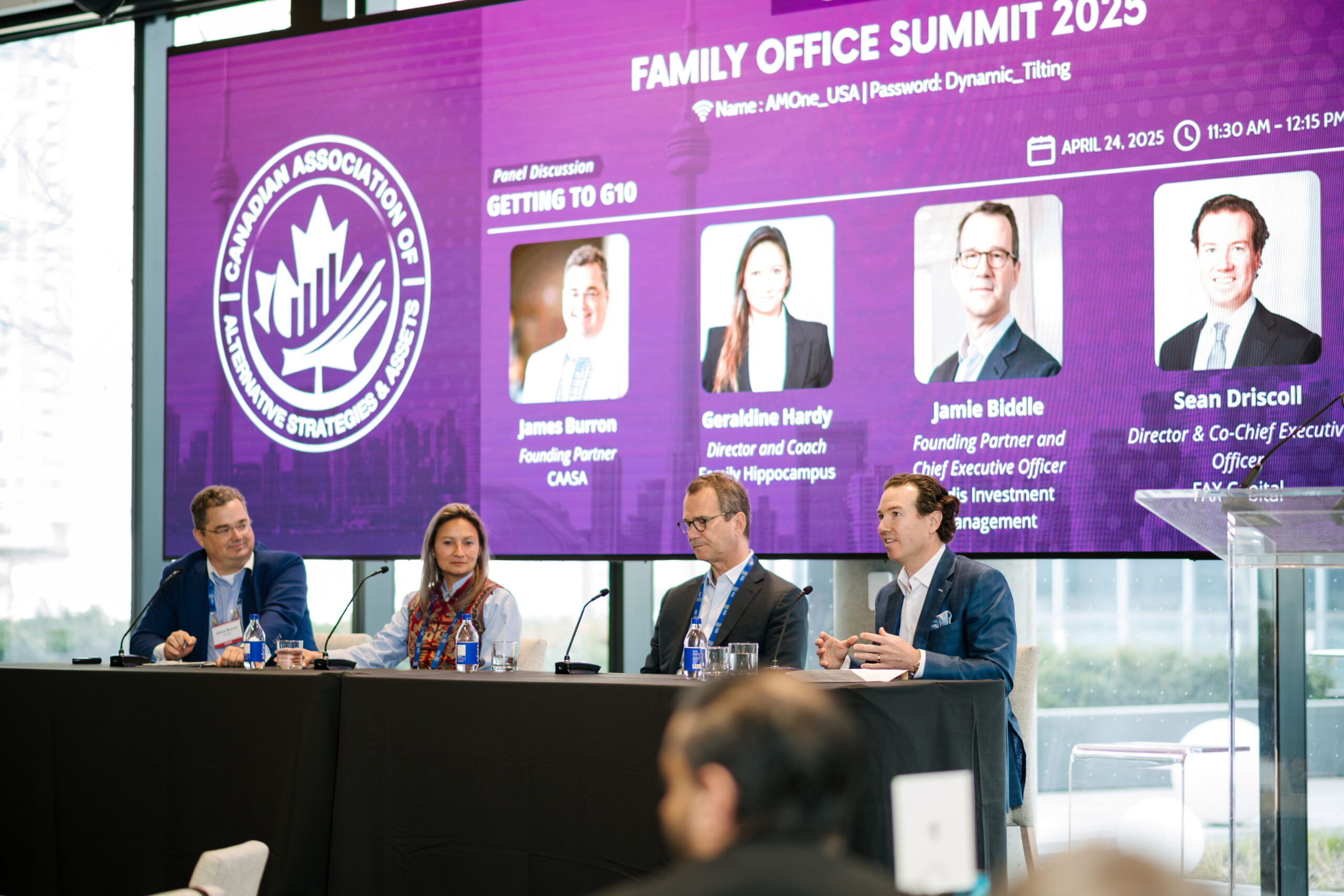
The 2025 discussion brought Driscoll together with Geraldine Hardy and Jamie Biddle, moderated by James Burron. Its subject was continuity across generations: how families organise themselves so that wealth and responsibility can pass beyond the people currently in charge. The event’s framing makes an investor’s usual time horizon look rather modest. Ten generations will not fit into a quarterly earnings call.
For Driscoll, participation connects his current work to a question already present in his career. He returned to a business his father had founded, helped operate it, left its executive leadership and moved into a different form of family investment. That is a sequence of changing responsibilities, rather than evidence of a single unchanging plan.
The question of staying power survives each of those changes. It concerns the business being built, the controls governing it, the capital available after a sale and the people who will eventually decide what to do with that capital. A surname can travel through all those chapters. Keeping an enterprise useful requires considerably more effort. The next generation, inconveniently, will have opinions of its own.