A click is a wonderfully flattering thing. It says that someone, somewhere, has given a brand a moment of attention. It says rather less about whether the product will arrive, whether the customer will return, or whether the business can afford the privilege of selling it. Christian Chopra’s career has moved steadily into those less photogenic questions. They are the questions that follow a good first impression, and they occupy an awkward space between the language of desire and the arithmetic of running a company.
Chopra now leads Foundry Brands, a collection of consumer businesses with names a shopper might encounter separately: Supply, Blu Atlas, Benevolence LA, and Craft & Kin. Razors and home fragrance do not naturally belong in the same conversation. They do, however, share an owner and a need to turn a distinctive proposition into dependable commerce. That is the assignment waiting behind his CEO title. His route to it runs through Lancôme, Henkel, and the founder-led grooming business Scotch Porter.
The education of a beauty operator
At L’Oréal, Chopra worked on product marketing for Lancôme skincare. Later, his Henkel responsibilities included sales strategy and marketing leadership in Germany, Canada, and the United States. Before joining Scotch Porter, he was general manager of Consumer Beauty at Henkel Canada Corporation. The geography matters because this was a career built across markets, as well as across functions. A product proposition has to travel through different commercial arrangements before it reaches someone’s shopping bag.
The 2022 account of his move to Scotch Porter credited him with directing Henkel Canada’s innovation strategy and contributing to distribution, sales, revenue, and market-share growth. Those are useful clues to the kind of executive being recruited. Product marketing places an executive near the promise a brand makes. Sales strategy places that executive near the conditions under which the promise can be sold. General management brings the pieces together and requires the numbers to agree.
His public educational record includes the University of Mannheim. More revealing for this story is the movement from an individual brand’s marketing to responsibility for an entire division. In the ordinary grammar of a résumé, these are job changes. Read as a career, they describe a widening field of responsibility: from what a product means to how a business works. There is considerably more to that journey than finding a nicer adjective for the packaging.
A founder’s business gets another pair of hands
In June 2022, Scotch Porter announced Chopra as its president. Calvin Quallis remained its founder and CEO. Chopra’s brief was practical: oversee operations and growth, and work across the company to introduce systems and processes. The distinction between those two roles is part of the story. He was joining a business with a founder, an existing point of view, and customers already choosing its products. The next task was to help that business carry more weight.
Scotch Porter had already expanded beyond direct sales through relationships with Target, Walmart, CVS, and Macy’s. Its $11 million Series B financing was also announced that year. These developments preceded the story of Chopra’s tenure and help explain the moment at which he arrived. More retail relationships mean more ways to reach a customer. They also mean that an organisation has more commitments to coordinate. An attractive bottle cannot keep a calendar.
His appointment placed brand development alongside responsibility for the company’s key functions and both revenue and profit growth. The surrounding team was expanding too. By October, Scotch Porter was announcing additional executive hires and Aleesha Worthington’s promotion to vice president of brand. It is a reminder that growth is performed by groups of people with different jobs, even when a company announcement puts one face beside the headline.
When his Foundry appointment was announced in 2025, the account of his Scotch Porter presidency credited him with helping reposition the business for a broader market, reaching profitability, and expanding national retail, Amazon, and direct-to-consumer sales. That description supplies a business outcome to the earlier operating brief. It also connects the two chapters: Foundry was hiring someone whose recent work had involved making a distinctive grooming brand function across several routes to the customer.
The names beneath the announcement
Chopra’s own public posts give the career a more human scale. In February 2023, he introduced Scotch Porter’s body wash launch, available in select Target stores and online. The launch included two scents: Sandalwood & Tobacco Musk, and Citrus & Crisp Woods. It was a move into another product category, expressed in the fairly ordinary language of getting something new onto a shelf.
Then came the thank-you list. He named Quallis, Brian Murray, Worthington, Christina Chalmers, Jay Norton, and Yannick Vidinhouede. This is a small detail, but a useful one. Corporate careers tend to be compressed into titles and outcomes. A list of colleagues restores some of the people who have vanished in that compression. The announcement becomes a record of shared work, rather than a product appearing by executive decree.
There is another glimpse from the Henkel years. In January 2022, marketing intern Nicole Kyamko publicly thanked Chopra, Jinny Im, and Makhlouf Mohamed among the mentors and managers who had supported her development during an eight-month placement. It is a colleague’s specific recollection of help received. Set beside the launch credits, it brings a different unit of measurement into view: a person finishing an internship, or a team finishing a product.
A contribution written into the sale
In September 2022, Chopra posted about the Scotch Porter Impact Fund. He described a plan to dedicate 2 percent of online product sales, combine that contribution with additional fundraising, and make donations amounting to more than 1 percent of total sales. The distinction between online sales and overall sales matters. The two percentages refer to different bases; they should not be casually added together.
The priorities he listed were education, job training, entrepreneurship, and recidivism. He credited Quallis with translating a commitment into action and thanked the wider team. For the purposes of understanding Chopra’s career, this episode adds something specific to the discussion of brands with a purpose. Here was a stated mechanism tied to transactions, with identified areas of support. It gives a reader something more concrete than a sentence about values.
Planned contribution, supplemented by fundraising. Chopra described a total donation target above 1% of overall sales.
It also places a commercial executive inside a decision about what a sale would help finance beyond the company. The post describes an announced commitment. Its significance here is the choice to make the mechanism public and to associate the business’s growth with named community priorities. Customers could understand the proposition without needing to translate a paragraph of corporate philosophy.
Four brands, four reasons to buy
Foundry launched in 2021 with $100 million in capital from LightBay Capital and Monogram Capital Partners. Its early proposition was to acquire and grow digital brands across several consumer categories. Chopra joined a company with that history already behind it. The capital raised at launch belongs to Foundry’s story; it is not a measure of his personal wealth or an accomplishment to transfer onto his résumé.
Supply entered the portfolio in 2022. Built by husband-and-wife founders Patrick and Jennifer Coddou, the shaving business had developed through crowdfunding and an appearance on Shark Tank. Blu Atlas followed in 2023, an acquisition that added another men’s grooming business. These are founder-created products with their own origins. The job of an incoming operator is therefore partly a job of continuity: deciding how to grow something without making its original reason for existing disappear.
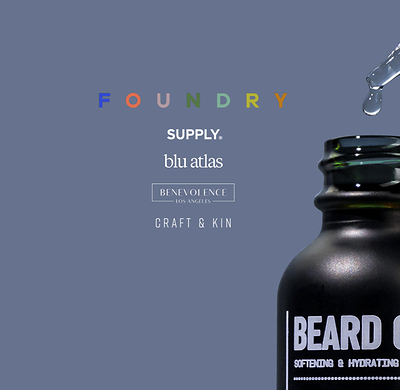
The CEO appointment announced on November 11, 2025 put Chopra in charge of that next phase. His stated interest was in brands that would “connect emotionally and perform commercially.” The pairing is revealing. A customer has a reason to care; an organisation has to make the relationship economically workable. The phrase gives equal space to both, which is sensible. A balance sheet has little use for charm it cannot collect.
Deciding who does the Amazon work
In March 2026, Foundry made a specific operating choice public. Cart.com would handle Amazon execution across four portfolio brands. Foundry would keep responsibility for brand direction, products, and financial performance. The agreement had grown from a relationship that began in late 2025. It made the allocation of work visible, rather than leaving the strategy at the level of a pleasing ambition.
“Amazon is a scale channel, not a place to experiment.”Christian Chopra · March 2026
That arrangement suggests a practical reading of his latest chapter: attention has to be assigned as carefully as money. Foundry remains answerable for what its brands stand for and how they perform, while a specialist handles a complex selling channel. The decision is an operating design, with responsibilities attached. Its success will depend on execution, as operating decisions usually do.
Across Chopra’s career, the recurring movement is toward that point where an idea acquires obligations. At Lancôme, a product needed a marketing proposition. At Henkel, a division needed direction. At Scotch Porter, a growing founder-led company needed systems and coordination. At Foundry, distinct businesses need an owner capable of keeping their character while arranging the work around them. The click remains a promising beginning. The customer’s next experience is where the executive’s job becomes real.