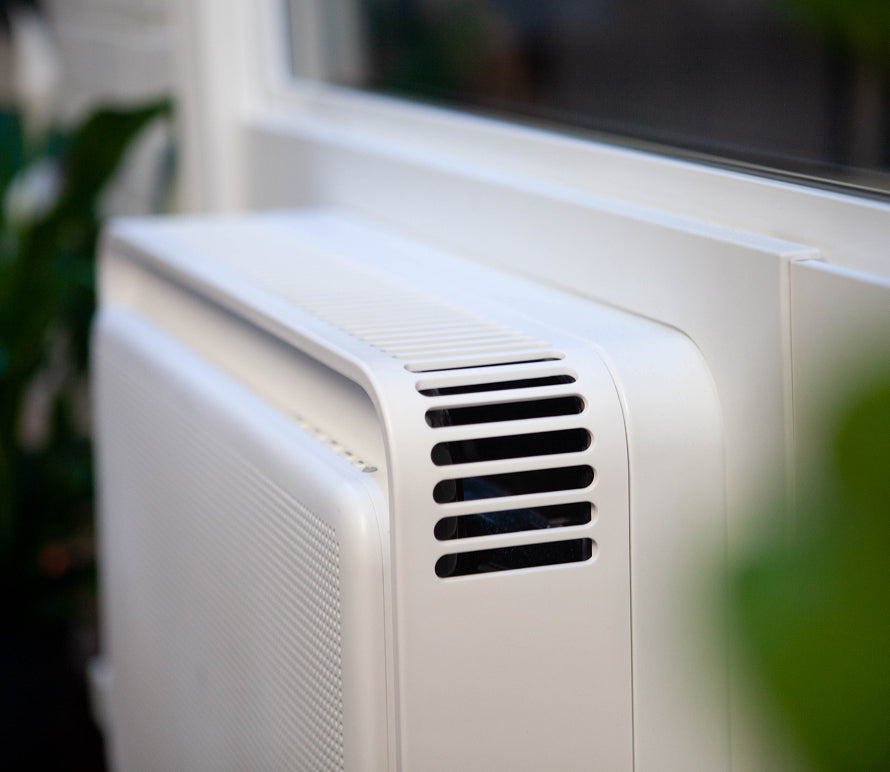
The least loved appliance in the apartment was the window air conditioner. Windmill decided that was a design problem worth fixing - and then kept going.
Walk into a Home Depot in the summer and you will find a wall of beige boxes, all promising to cool a room and none promising to look good doing it. Then there is the Windmill - front-facing vents, a clean matte shell, an app, and one small button instead of a panel that needs a manual. It is the same category, reimagined by people who treated it like a product worth obsessing over.
Windmill started with the window unit. Today it sells a full air care lineup: ACs, medical-grade HEPA purifiers, fans, and central air filters that show up by subscription before you remember to change them. The company has sold over 100,000 air conditioners, raised roughly $15 million, and put its products on shelves at Home Depot, Best Buy, Lowe's, and P.C. Richard & Son. Not bad for an object most people are embarrassed to own.
Air conditioning is one of the most widely used technologies in the world, and the window unit is its most stubborn form. For decades it changed very little: loud, boxy, blinking, and impossible to install without a small argument. Manufacturers competed on price and BTUs, which is to say they competed on almost nothing a person actually feels.
The Mayer brothers had a front-row seat. Their family had been in the air conditioning business in New York for roughly 60 years - three generations of servicing buildings and knowing exactly how the sausage gets cooled. They noticed something obvious in hindsight: the people buying these units cared about quiet, about looks, about not climbing a ladder. The industry had simply never asked.
The tension that runs through everything Windmill does sits right here: clean, comfortable air is a basic need, and the products delivering it were built as if no one would ever have to look at or live with them. Fix the looks and the noise and the install, and you have not just a nicer box - you have a category nobody thought to compete in.
In 2020, brothers Mike and Danny Mayer launched Windmill alongside Ryan Figlia, a third-generation air conditioning expert. The bet was that domain knowledge from the old business plus the standards of a modern consumer brand could turn an appliance into something people would choose, not just settle for. They sold the first unit more like a sneaker drop than a hardware launch - by waitlist.
Leads the brand and product vision, channeling the family's HVAC heritage into a consumer design company.
Co-runs the company with his brother, steering growth, retail, and the expansion into a full air care suite.
Third-generation air conditioning expert - the technical depth behind Windmill's WhisperTech engineering.
The flagship Windmill AC uses WhisperTech inverter technology to run about 35% more efficiently and as quiet as roughly 42 decibels - the volume of a library, not a leaf blower. It connects to an app and to voice assistants, dims its own LEDs at night, and points its air upward so it does not blast the person sitting under it. Then the company kept building.
WhisperTech inverter window AC in 6K, 8K, and 10K BTU. App and voice control, auto-dimming LEDs, optional TaskRabbit install.
3-in-1 HEPA, activated carbon, and pre-filter capturing 99.97% of allergens, smoke, and dust. Max covers up to 1,950 sq ft. From $299.
A quiet air circulator built to match the rest of the lineup, because nobody wants one nice appliance next to an ugly one.
Whole-home filters on an annual auto-refill subscription - the chore you forget, handled before you remember it.
A pretty product is a hypothesis. A pretty product on the shelf at Home Depot, sold 100,000 times, backed across three funding events, is something closer to a verdict. Windmill's traction shows up in two places that matter: distribution and dollars.
Cooling a room is, historically, a guilty pleasure - it eats energy and leans on refrigerants the planet would rather skip. Windmill's answer is to make the sustainable choice the default one. Its ACs and purifiers are Energy Star rated, use the more environmentally friendly R32 refrigerant, run on efficient DC fan motors, and ship in recyclable packaging. A partnership with EcoCart adds carbon offsets and eco-rewards at checkout, plus recycling and trade-in programs for the old box you are replacing.
The values the company names are plain on purpose: beauty, clean air, a calmer home, and support that actually answers. It is a family business at heart - three generations deep - now run with the standards of a consumer brand that expects you to keep its product in plain sight rather than hidden behind a curtain.
Summers are getting hotter and wildfire smoke now travels far enough that air quality is a household conversation, not a regional one. The unglamorous machines that cool and clean indoor air are quietly becoming some of the most-used objects in the home. Windmill's bet - that people will pay attention to those machines if the machines are worth paying attention to - looks less like a design indulgence every year.
So go back to that wall of beige boxes at Home Depot. The Windmill is still the one that looks like it was designed rather than assembled - but now it has company on the shelf: a purifier, a fan, a subscription that keeps the filters fresh. The window unit was the wedge. The real product is a home that breathes easier and, for once, does not make you hide the hardware. The least loved appliance in the apartment finally got someone to love it. Turns out a lot of people were waiting for that.
► Watch the product demos at windmillair.com