The tiny circle on the back of a smartphone looks like the sort of object a product team could finish before lunch. Ohsnap has spent years proving otherwise. A grip must hold a thousand-dollar slab without making it feel like camping equipment. It should become a stand, tolerate pockets, cooperate with magnets, avoid the camera bump and, ideally, not sabotage wireless charging. Then it has to survive the bored owner who opens and closes it 300 times during a meeting.
That puzzle became Dale Backus's second hardware act. At CES in 2017, he saw a company that had sold more than a million phone grips built around a simple elastic band. Backus had already founded SmallHD, a North Carolina maker of on-camera monitors that was acquired in 2014. He knew a large market hiding inside an ordinary object when he saw one. His conclusion was less "phone grips are hot" than "people are putting up with an awfully clumsy solution."
Nearly four years and hundreds of prototypes followed. Ohsnap, founded in 2019 in Apex, North Carolina, eventually packaged several chores into one thin mechanism: finger grip, rotating stand and magnetic mount. The company's pitch was cheeky. Its engineering problem was not. Making a handsome prototype is one task; producing tens of thousands at the right price and tolerance is another species of work.
2019
2020
2025
The campaign went right. The product went wrong.
The original 2019 Kickstarter asked for $10,000 and collected $466,820 from 13,958 backers. That is the screenshot most startup decks would frame. It is also where the useful story begins. After the grips went out, customers discovered a failure point and units began breaking. Ohsnap had shipped globally, so every defect came with an international postage bill attached.
A prototype can win applause. A replacement program reveals whether you built a company.
Backus has said the company could have gone dark. Instead, Ohsnap fixed the design, turned the replacement quickly and serviced every customer. The cost of that decision has not been disclosed, and guessing would cheapen the lesson. The bill included redesign, new production and worldwide reshipping - exactly the expenses founders forget when a campaign total is still climbing.
What failed first was physical. What changed the team's mind was operational: support stopped being a polite department downstream from engineering and became part of the product. Backus came from professional video equipment, where a monitor problem could interrupt an expensive film set. That background had trained him to see a fast, candid repair as more than damage control. A miserable first experience, handled well, can produce a customer who trusts the second version.
Three campaigns, one increasingly expensive education
Kickstarter totals, rounded. Crowdfunding is customer financing, demand research and a public deadline wearing the same trench coat.
The product is a vanishing act
The current Snap Grip is 3 millimeters thick and 58 millimeters across. Slide it open for one- or two-finger control, rotate it through 360 degrees, lock it as a stand or stick the phone to a metal surface. It snaps onto MagSafe phones and cases; an adhesive magnetic adapter brings many Android devices and other cases into the system. At a regular price of $39.99, it is not competing to be the cheapest circle on the internet.
Its argument is that the best grip is the one you stop noticing. PopSockets remains the obvious mass-market comparison, while ESR, MOFT, Peak Design, Spigen and Anker offer their own combinations of rings, stands, mounts and charging. Ohsnap's difference is the stack: grip, car mount, desk stand, wall mount, wallet, case, charger and power bank all orbit the same magnetic interface. The first sale buys utility. Compatibility tries to earn the second.
The limits matter. Ohsnap's own compatibility guidance says very narrow phones, silicone and heavily textured surfaces can be poor candidates. Magnetic strength depends on the phone or case. The latest Snap Grip guidance recommends removing the grip temporarily for wireless charging, a plainer promise than the charge-through claims associated with earlier models. Physics keeps sending edits to marketing.
Then a controller slid into the picture
Ohsnap's second act did not start in its own workshop. Josh King missed compact handhelds such as the Nintendo DS and Game Boy, and disliked the bulk of clamp-style phone controllers. He 3D-printed a MagSafe controller whose face slid upward to reveal the controls. A YouTube video made the idea viral. King left college, formed a company and pushed development until rising costs stalled the project.
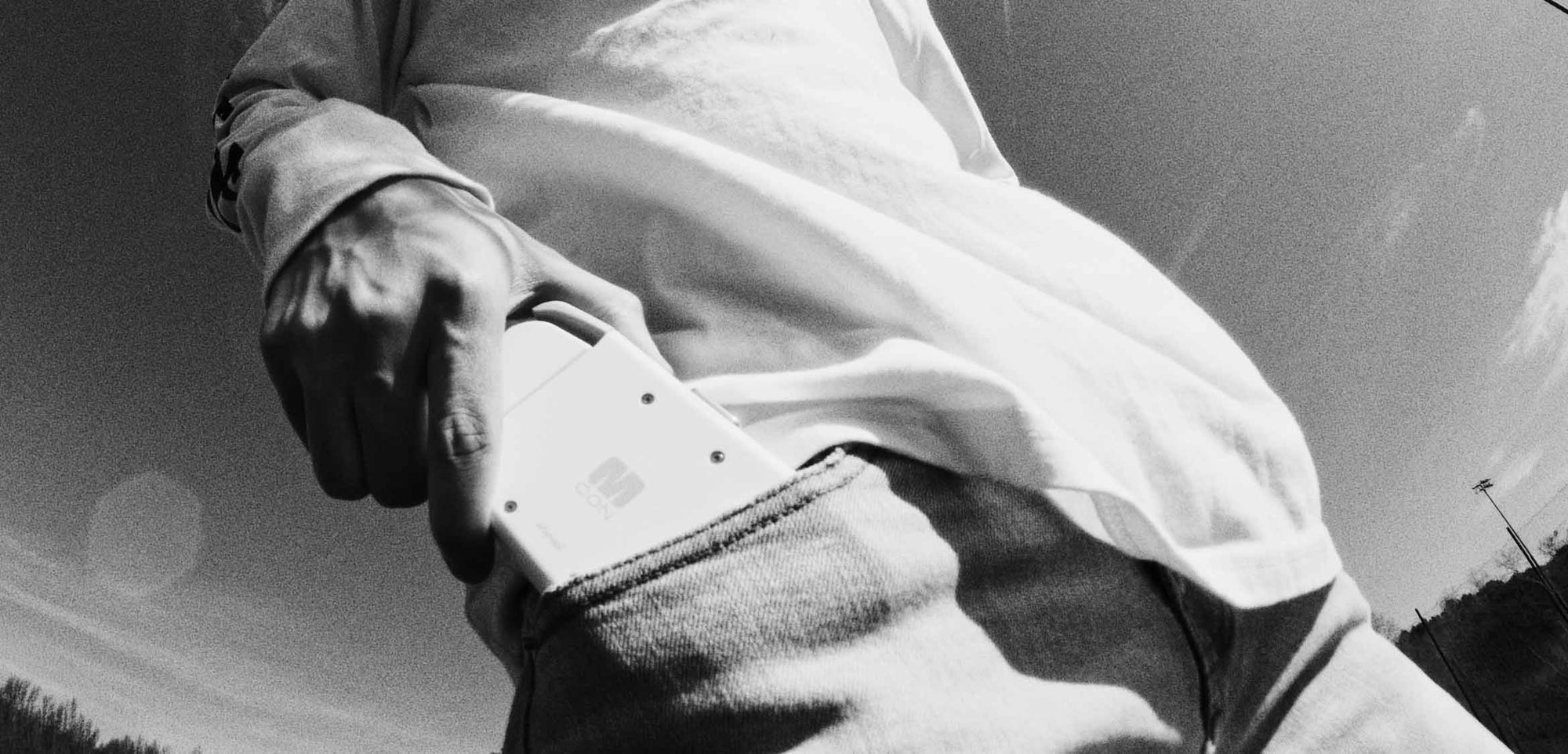
He approached Ohsnap with the thing it understood immediately: a clever magnetic object trapped between prototype and production. King supplied the concept and an audience. Ohsnap supplied the manufacturing scar tissue. The refined MCON attaches to iPhones magnetically and includes an adapter for other phones. It closes into a slab, then pops open with deployable hand grips, full-size TMR joysticks, Hall-effect triggers and a removable phone plate that becomes a tabletop stand.
The proposition is pocketability, not perfect imitation of a living-room controller. MCON weighs 197 grams, remembers up to three devices and claims up to nine hours of continuous play. It works with controller-compatible mobile games, streaming services and computers. The regular price is $149.99. That puts it above many clamp controllers and close enough to dedicated handheld territory that buyers must care about using the phone they already own.
At CES 2025, the mechanism produced exactly the kind of one-second demonstration trade shows reward. Engadget named it among the best products of the show. The Kickstarter asked for $25,000 and finished at $1,776,917 from 16,734 backers. Ohsnap later said social clips generated more than 30 million views. Here was the old playbook again: show a legible mechanical surprise, let backers size the market and use the order book to plan production.
And here was the old warning again. The controller missed its original 2025 delivery ambition while components, refinement and fulfillment took longer. General availability arrived in early 2026. Reviews praised the compact shape, centered balance and flexibility; some also found the small grip surfaces and lower-profile controls a compromise during longer sessions. Portability is not free. It sends an invoice to ergonomics.
What a founder can steal
First, pick a familiar object with visible compromises. Ohsnap did not need to teach people why phone grips or game controllers exist. It only had to demonstrate why this one disappears better. Second, make the advantage legible on camera. A grip sliding flat or a controller springing open compresses engineering into a gesture that travels on social video.
Third, treat crowdfunding as a forecasting instrument, not applause with a payment processor. Backus has argued that founders routinely underestimate the chasm between a prototype and mass production at the right cost, quality and schedule. Ohsnap could experiment longer because he brought supplier relationships from an earlier hardware company. Anyone copying the campaign without that preparation is copying the fireworks and skipping the wiring.
Fourth, turn defects into an input. The replacement program was expensive, but it supplied failure data, preserved trust and forced the next version to earn its number. Ohsnap says it has sold roughly seven iterations of its grip. That is not evidence that every version was perfect. It is evidence that a compact hardware product can become a recurring conversation with the customer.
Copy this when
The need already exists, the improvement is easy to demonstrate, suppliers are involved before launch and the budget includes testing, warranty inventory and replacements.
Do not copy this when
The product depends on unproven physics, margins collapse under global shipping, compatibility creates too many edge cases or virality would outrun your ability to communicate delays.
A loud brand built around quiet usefulness
Ohsnap's store talks like the funny person in a group chat. Colors include Boring Black, Diet Lime and Hazmat Honey. The company says it makes accessories that "don't suck." Behind the jokes is a stricter list of public values: obsess over details, stay original, make only products that create a "wow," do not launch something purely for revenue and favor the customer when interests conflict.
That combination explains where Ohsnap sits in the market. It is a small consumer-hardware brand using DTC language and Shopify speed to sell mechanically fussy products, with Best Buy and TikTok Shop widening distribution. Its expertise is not magnets alone. It is packaging several modest uses into one object while keeping the result thin enough to live on the device.
The honest payoff is not that every Ohsnap product will suit every hand, phone or charging setup. It is that the company found a repeatable way to search: notice a tolerated annoyance, prototype until the improvement becomes visual, ask a crowd to price the demand, then stay present when production exposes the lie in the prototype. The little circle only looks simple because the hard decisions have nowhere to hide.