The founding object was almost comically small: a charging cable pressed into the dimensions of a credit card. In 2012, before battery packs became a pocket staple and before USB-C simplified the drawer full of plugs, Noah Dentzel, Brian Hahn and Adam Miller put ChargeCard on Kickstarter. They asked for $50,000. Backers pledged $161,897. The object solved an ordinary nuisance - the cable you need is usually the cable you left somewhere else - and supplied the rule that still organizes Nomad: a useful tool should be close at hand, quiet in appearance and difficult to kill.
The company that grew from it does not make the phone, watch or earbuds at the center of modern life. It makes the things that touch them: cases, bands, charging stands, cables, wallets and trackers. This is a crowded, copyable business. The calendar belongs to device makers, the margins invite imitators, and a perfectly good case can become obsolete because a camera bump moved a few millimeters. Nomad's answer has been to give the surrounding object more character than the category usually permits.
A product that remembers you
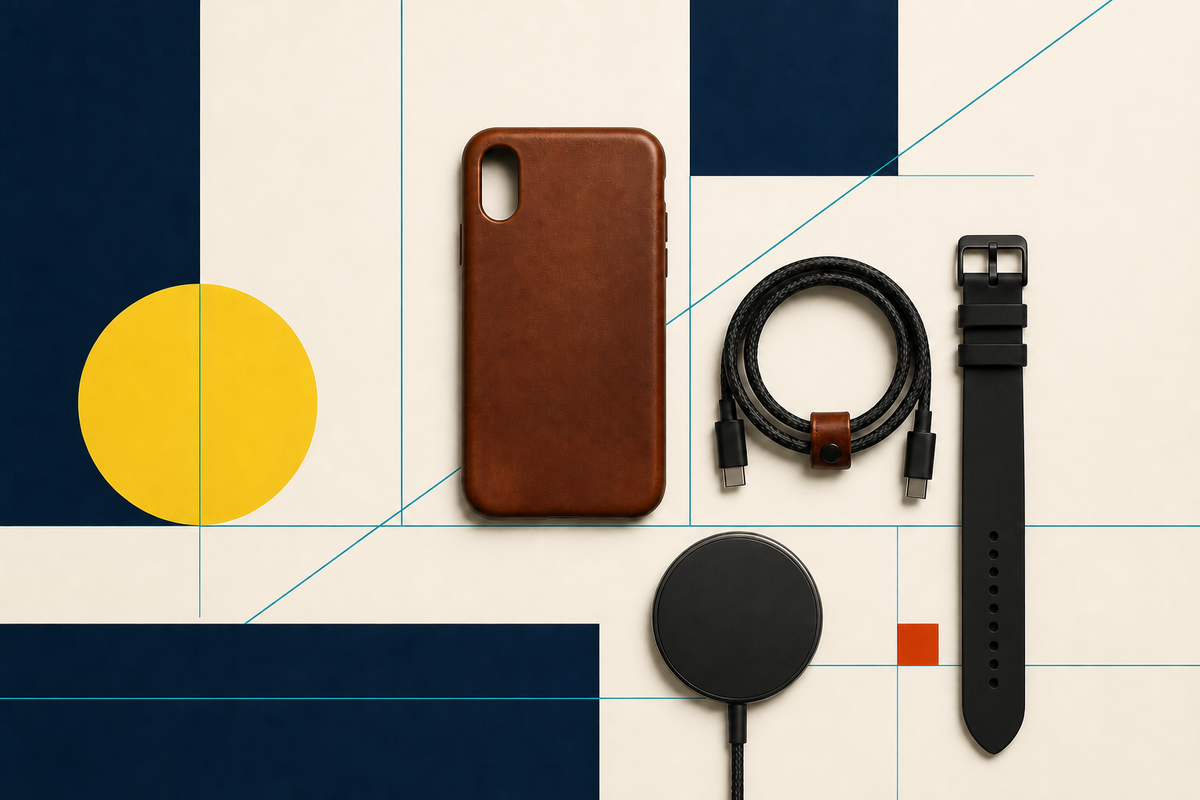
Consider the leather case. Mainstream electronics are sold as pristine surfaces, and their first scratch registers as loss. Nomad uses leather from Chicago's Horween Leather Company precisely because the surface changes. Oils from a hand darken it. Edges polish. Marks accumulate and blend into a patina. The case becomes less uniform and more specifically yours. That reframes wear from a defect into a record.
It is not merely an aesthetic trick. A case has to absorb a fall, expose the right controls, preserve wireless charging and survive being pulled from a pocket hundreds of times. Nomad's Modern Leather Case combines the leather exterior with a TPU bumper, aluminum buttons, MagSafe compatibility and an advertised eight feet of drop protection. The materials divide the work: the polymer takes impact, the metal sharpens the controls, and the leather supplies grip and memory.
“We’re still obsessing over materials, from Kevlar to titanium.”Noah Dentzel, co-founder
That material logic repeats across the catalog. Braided cables use Kevlar reinforcement where repeated bending tends to produce failure. Watch bands move between waterproof fluoroelastomer, steel and titanium depending on the job. Charging stands use enough metal, glass and weight to let a user lift a magnetically attached phone with one hand instead of taking the stand along for the ride. These are small decisions, but small decisions are the whole product in accessories.
The material vocabulary
Time becomes visible. Patina turns repeated handling into character rather than cosmetic damage.
Failure moves farther away. Reinforcement targets the flexing and pulling that ends an ordinary cable.
Precision can be felt. Titanium, steel and aluminum give bands, buttons and charging bases structure.
Built for the person between places
Nomad describes its customer as the modern nomad: someone who uses technology to blend work, life and adventure. Strip away the brand language and a clearer portrait appears. The customer is likely to own a premium smartphone or smartwatch, care about the objects carried every day, and pay more to avoid replacing the cheap version twice. Apple users are central, but the range also reaches Android phones, Garmin watches, headphones, passports, cars and desks.
The promise is practical compression. ChargeKey lives on a key ring. A Find My wallet attaches by MagSafe, holds one to four cards, runs for a claimed five months on a charge and can make a sound when it goes missing nearby. Stand One charges a phone upright while a second pad handles earbuds. A 100-watt slim adapter and one reinforced cable can replace several travel chargers. Nomad is at its best when it removes one object, one search or one minor panic from the day.
Those figures reveal the machinery behind the tasteful photographs. Nomad is a consumer-products company with a direct-to-consumer core. Its Shopify storefront handles launches, education and customer relationships; wholesale partners broaden discovery and international reach. The catalog creates repeat purchases because devices change, materials and colors invite coordination, and a customer who trusts the case can add a band, wallet or charger. Limited editions bring urgency without requiring the brand to become fashionable in the disposable sense.
The store also works like a compact piece of service design. Compatibility guides sort a thicket of phone generations, sizes and case materials. Product pages explain charging standards, drop ratings and battery life alongside photographs of surfaces and hardware. A two-year warranty reduces the risk of paying the premium. None of this is glamorous, but it addresses the most common failure in accessory shopping: buying a small object that almost works with the expensive object already in your hand. Clarity is part of the product when one misplaced model number can turn a case into packaging waste.
There is expertise hidden in that clarity. Nomad must translate standards such as Qi2, MagSafe, USB-C Power Delivery and Apple's Find My network into products that feel uncomplicated. It must tune magnets, heat, power, tolerances and radio constraints, then wrap the result in forms that do not resemble laboratory equipment. The 2026 Data Cable is a neat example: up to 20-gigabit-per-second transfer sounds like a specification for professionals, while the braided exterior and reinforced core answer the less technical question of whether it will survive the bottom of a bag.
The model has an unavoidable tension. Nomad argues for durable objects while serving an industry built on upgrade cycles. Its sustainability work does not erase that contradiction, but it addresses useful parts of it: inspected returns sold through an Open Box program, smaller packaging, fewer included power adapters, renewable electricity at the Santa Barbara office and support for climate and conservation programs. The company has also described itself as carbon neutral since 2020. Longevity is most persuasive here when it is literal - a cable that does not split and a case a customer wants to keep using until the phone changes.
The culture presented in public interviews follows the same product-first pattern. Dentzel has credited Hahn, the web and design teams, and colleagues across the company with shaping the storefront and the work. Earlier careers material described a relatively small Santa Barbara group with direct access to the founders. That proximity matters in a category where packaging, photography, support tickets and engineering all report on the same physical object. Customer feedback is not abstract analytics; it arrives as a magnet that slips, a card that catches or a button that feels wrong. The best response can travel quickly from support to the next revision.
The premium lane between polish and armor
In market terms, Nomad occupies the space between Apple's seamless ecosystem, Bellroy's soft-goods refinement and the overt protection of brands such as UAG, OtterBox or Mous. Spigen competes on breadth and price. Casetify turns the case into a graphic canvas. Peak Design builds a modular mobile system. Nomad's distinction is coherence: the same restrained palette and material hierarchy can move from a phone to a wrist, desk or travel bag without looking like a matching luggage set.
That positioning made Nomad an intelligible acquisition target. On April 29, 2026, Urban Armor Gear announced that it had bought the company for undisclosed terms, with financial sponsor HKW participating. The fit is almost diagrammatic. UAG brings operational systems and global distribution. Nomad brings premium product development, a strong direct channel and a brand that speaks to customers who do not want their protection to look tactical.
Brian Hahn, now identified as Nomad's COO, said the attraction was shared product-first thinking and UAG's administrative sophistication. Dentzel framed the deal as a stronger platform for the mission rather than an exit from it. The crucial word is platform. Acquisition can give a design company access to forecasting, sourcing, compliance and distribution that are difficult to build quietly. It can also encourage line extensions and efficiency that blur the original point of view. Nomad's next chapter will be judged by whether the useful machinery stays backstage.
Fourteen years, one stubborn brief
ChargeCard raises $161,897 on Kickstarter and makes the forgotten cable a design problem.
ChargeKey moves the same idea onto the key ring.
Horween leather gives cases, bands and wallets a recognizable surface that improves with wear.
The team redirects sourcing and logistics toward protective equipment during the pandemic.
Nomad reports a community of more than 2 million customers across 150-plus countries.
UAG acquires the company; Nomad follows with new high-speed data cables and fourth-generation chargers.
The early company lore remains pleasantly improvised. Dentzel says the ChargeKey emerged while he and Hahn drank cheap white wine on the deck of the boat Hahn lived on in Santa Barbara harbor. The phrase they used was keys, phone, wallet - the minimalist checklist for leaving home. Moving the cable onto the keys was less an invention of new technology than a better appointment for it. Put the tool where forgetfulness cannot easily separate you.
That is the lesson other builders can steal. Nomad did not need to make the most important device in the room. It chose the overlooked layer, gave it a clear job and found materials that communicate the job before the product copy begins. Leather says keep me. Kevlar says bend me. A weighted charger says use one hand. The brand is not immune to fashion, platform dependence or the churn of consumer electronics. It is simply unusually good at making those forces feel less disposable.
Fourteen years after ChargeCard, the original cable looks like an artifact from a messier port era. The brief still holds. People move, batteries empty, phones fall and wallets hide. Nomad sells a calmer relationship with those facts - one small, well-resolved object at a time.