Company Profile / Hardware / Made In USA
The Jersey Factory That Still Makes Its Own Light
For 50 years Princeton Tec has done the unfashionable thing: keep the whole flashlight - the plastic, the tooling, the assembly - under one New Jersey roof. Here is why a 40-person shop still bets on American-made light.
In 1975, in the back room of a dive shop in Princeton, New Jersey, a scuba enthusiast named Bill Stephens built a small gadget that told divers how long they had been underwater. He called it the Bottom Timer, and it was the industry's first automatic dive timer. It was a modest thing. It was also, in hindsight, the seed of a manufacturing company that would still be family-owned half a century later - one that makes headlamps for hikers and helmet strobes for Navy SEALs on the same American factory floor.
The company was originally called Princeton Tectonics. What Stephens really wanted was light he could take underwater, so from the timer he moved to a fully waterproof flashlight - and, crucially, one cheap enough that a recreational diver could actually afford it. That single decision, to make the light affordable rather than exotic, opened underwater lighting to a much wider audience and set the pattern for everything Princeton Tec would build next.
01What the company actually does
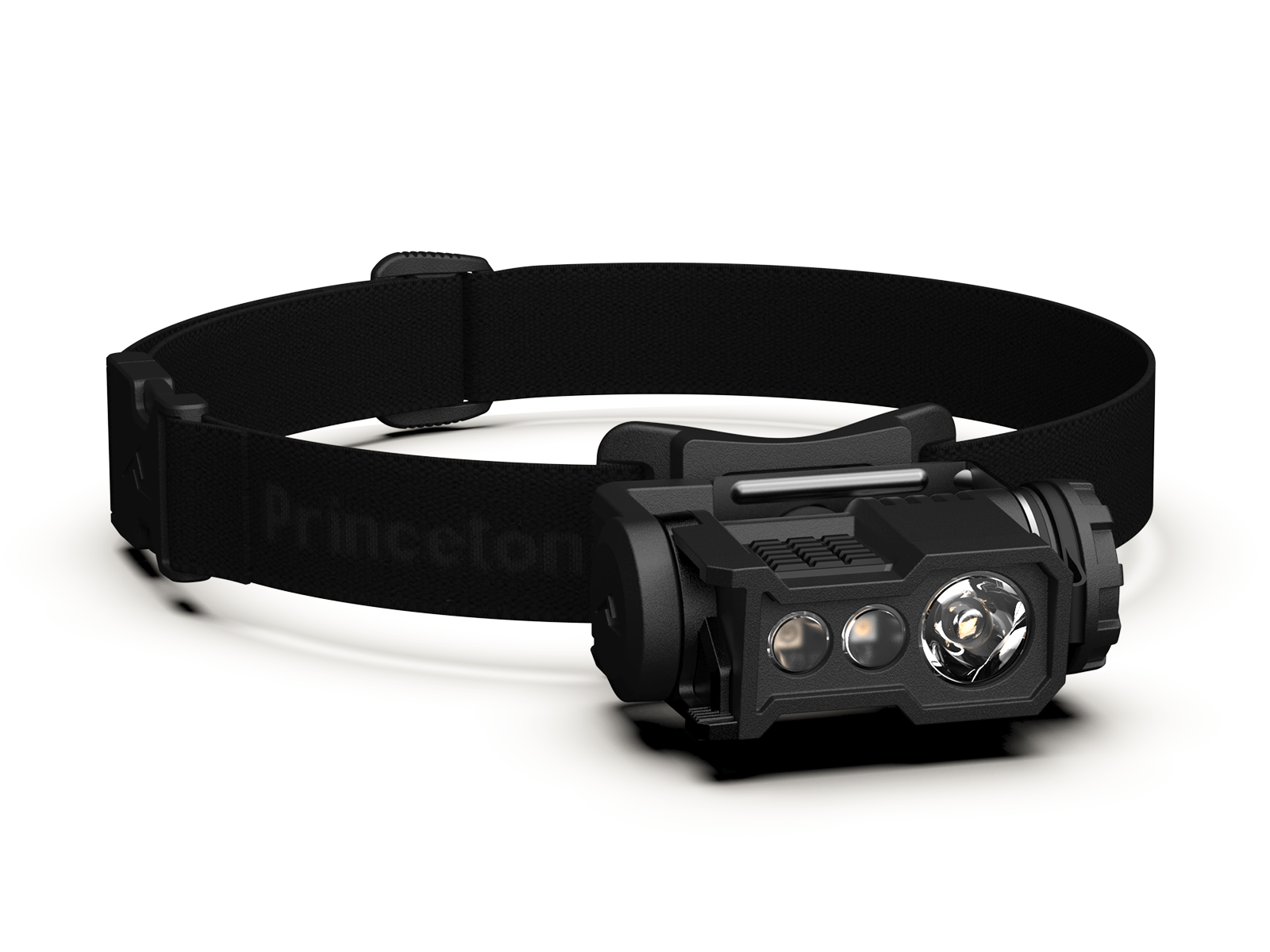
Princeton Tec designs and manufactures portable lighting: headlamps, handheld flashlights, lanterns, dive lights, marker and rescue strobes, and modular helmet lights. The catalog sorts roughly into three worlds - Adventure (headlamps for hiking, camping, running and paddling), Dive (the underwater heritage that started it all), and Tactical (military, law enforcement and first-responder gear) - with an industrial and safety line running alongside for construction, mining and fire work.
The common thread is not a beam pattern or a lumen count. It is dependability for people who cannot afford to have a light fail: a diver 60 feet down, a rescuer in a flooded basement, a soldier moving in the dark. Princeton Tec's stated mission is blunt about it - "to create light where there is darkness."
That framing shapes the catalog in small, telling ways. Many models are rated to survive full submersion, a habit carried straight over from the dive business. Others lean modular, so a headlamp body can be re-mounted on a helmet or a bike bar without a new purchase. The tactical products add red, green, blue and infrared output because the people using them care about preserving night vision and staying invisible to the wrong observer. None of this reads as flashy on a spec sheet. All of it reads as "built by people who have watched their gear get used hard."

02The unfashionable bet: keep the factory
Here is the part that makes Princeton Tec unusual. Almost every flashlight sold in America is made overseas. Princeton Tec makes its lights in New Jersey - and not just the final screwdriver-turn of assembly. It runs its own plastic injection molding and its own tool shop, which means the company controls the process from the concept sketch to the finished, boxed product.
It was not always a straight line. The company tried importing at one point, and the experiment did not stick. By its own account, Princeton Tec pulled production back home and expanded its New Jersey facilities to handle the capacity in-house.
"We have always been an American manufacturer. People are so used to everything in the marketplace being imported from Asia."
George Chevalier, Princeton TecThe reason this matters is not sentiment. Owning the tooling is a speed advantage. When you do not have an ocean and a three-month shipping schedule between your designers and your molding machines, you can change a part and have a corrected product within days. For customers whose needs shift - a military unit that wants a different mount, a rescue team that needs a specific color of light - that responsiveness is the whole pitch. It is also, quietly, why a domestic manufacturer can win tactical contracts that an importer cannot touch.
03From dive shop to Navy SEALs
The tactical business grew out of the company returning to its underwater roots. Princeton Tec began supplying strobe lights to Navy SEALs, and the response from military users pulled the company into engineering a broader line of personal lighting for the armed forces - helmet lights, marker beacons, infrared strobes and the modular MPLS (Modular Personal Lighting System) that clips onto combat helmets.
It is a genuinely strange product journey: a gadget invented to count minutes underwater becoming standard-issue gear for special operators. But the logic holds. A brand that learned early how to make a light survive salt water and pressure already knew most of what it takes to make a light survive a battlefield.

04Who buys it
The customer list reads like a directory of people who work or play in the dark. On the consumer side: hikers, campers, trail runners, cyclists, kayakers and scuba divers. On the professional side: military branches, law enforcement, search-and-rescue teams, firefighters, and industrial workers in construction, mining and safety roles. The lights reach them through outdoor and tactical retailers, paddlesport shops, the company's own online store, and direct B2B and government contracts.
05How it is different
Princeton Tec competes in a crowded field. Petzl and Black Diamond own a lot of the outdoor headlamp mindshare; Streamlight and Fenix are heavyweights in tactical and everyday-carry flashlights; Nitecore, Coast and Ledlenser fill in the rest. Most of them make excellent products, and most of them make those products abroad.
Princeton Tec's differentiation is not that it claims to be the brightest. It is the vertical integration - the fact that design, tooling, molding and assembly all live in one building - and the roughly 40-year supplier relationships built around American-made components. That gives it two things competitors struggle to copy: the ability to iterate fast, and legitimate access to "made in USA" government and tactical channels that require domestic production.
There is also a service dimension that is easy to overlook. When a company builds its own product from raw plastic, the person who answers a warranty question is standing near the machine that made the part. Princeton Tec leans on that - direct human support and repairability instead of a disposable, throw-it-away model. In a category where a lot of lights are effectively sealed consumables, being fixable is its own kind of feature, and it is a natural byproduct of never letting go of the factory.
What a founder could actually steal from this
- Own your tooling. Controlling injection molds turned a slow, outsourced supply chain into a days-not-months iteration loop.
- Reshore when it makes you faster, not just patriotic. The importing experiment failed on responsiveness, so they brought it home.
- Let one hard capability open a new market. Waterproofing for divers became the credibility that unlocked military lighting.
- Sell access, not hype. "Affordable and it survives" beat "exotic and expensive" - twice, 40 years apart.
06The business, and its limits
This is not a venture-backed rocket ship, and it does not pretend to be. Princeton Tec is a privately held, family-run manufacturer - founder Bill Stephens has retired, but his son and grandson remain involved. Third-party estimates put annual revenue in the low millions. It is a small company by headcount, and the picture is a little fuzzy from the outside: company interviews have described around 200 workers across its New Jersey operation, while professional-network listings show a much smaller figure. Treat any single number as approximate.
The honest caveat is that the strategy is not a universal template. Domestic manufacturing carries higher labor and material costs, and it works here partly because Princeton Tec sells into premium, failure-averse markets - tactical, dive, rescue - where buyers will pay for reliability and origin. A brand competing purely on the lowest shelf price would have a much harder time keeping the factory at home.
07Fifty years, one roof

Where Princeton Tec fits in the market is a niche it more or less built for itself: the American-made lighting brand that outdoor buyers, dive shops and tactical procurement officers can all reach for. It is not the biggest name on the trailhead, and it is not trying to be. It is one of the last flashlight companies that can point at the machine that molded the housing and say it is standing in the same building. Fifty years in, that is the whole story - and the whole strategy.