The Kids Watch That Blocks the Internet - and Topped Amazon Anyway
Russell York built a kids smartwatch that deliberately can't browse the web, can't open TikTok, and wants to be the last device parents buy before the smartphone talk. Then he sold enough of them to top Amazon's charts.
Most hardware companies win by cramming in one more feature. Cosmo Technologies did the opposite. Its flagship product, the JrTrack kids smartwatch, cannot open a web browser. It cannot install a random app. It cannot show a child a single frame of social media. Cosmo took the most valuable capabilities of a modern connected device and, on purpose, threw them out. Parents responded by making it, according to the company, the best-selling 4G kids smartwatch on Amazon.
That is the whole trick, and it is a good one. Cosmo is a Denver-based, venture-backed family-tech company that sells a wrist device for children roughly ages 6 to 12. It does the four things a nervous parent actually wants - call, text, locate, alert - and almost nothing else. The pitch is not "your kid gets a computer." The pitch is "your kid gets to be a kid a little longer, and you get to know where they are."
01 / The ideaA question asked at a kitchen table
Cosmo began in 2020, during the strangest year to start anything. Founder and CEO Russell York says the company started at his kitchen table with a single question: what if technology actually served the real needs of kids and families, instead of pulling them apart? York did not come from consumer gadgets. Earlier in his career he worked as a civilian advisor to the commanding general in Kabul, then spent years around American cybersecurity companies translating threat intelligence into plain English. Security-first was not a marketing slogan he picked up later. It was the job.
That background shows up in the product philosophy. Cosmo frames its values as four verbs - start smart, build better, protect kids, empower parents - and insists on engineering its watches from the ground up rather than white-labeling a generic tracker and slapping a logo on it. The stated mission is plain: bring families closer together, and reclaim a bit of the 1990s childhood where kids roamed and parents did not panic.
02 / The productA device designed to be outgrown
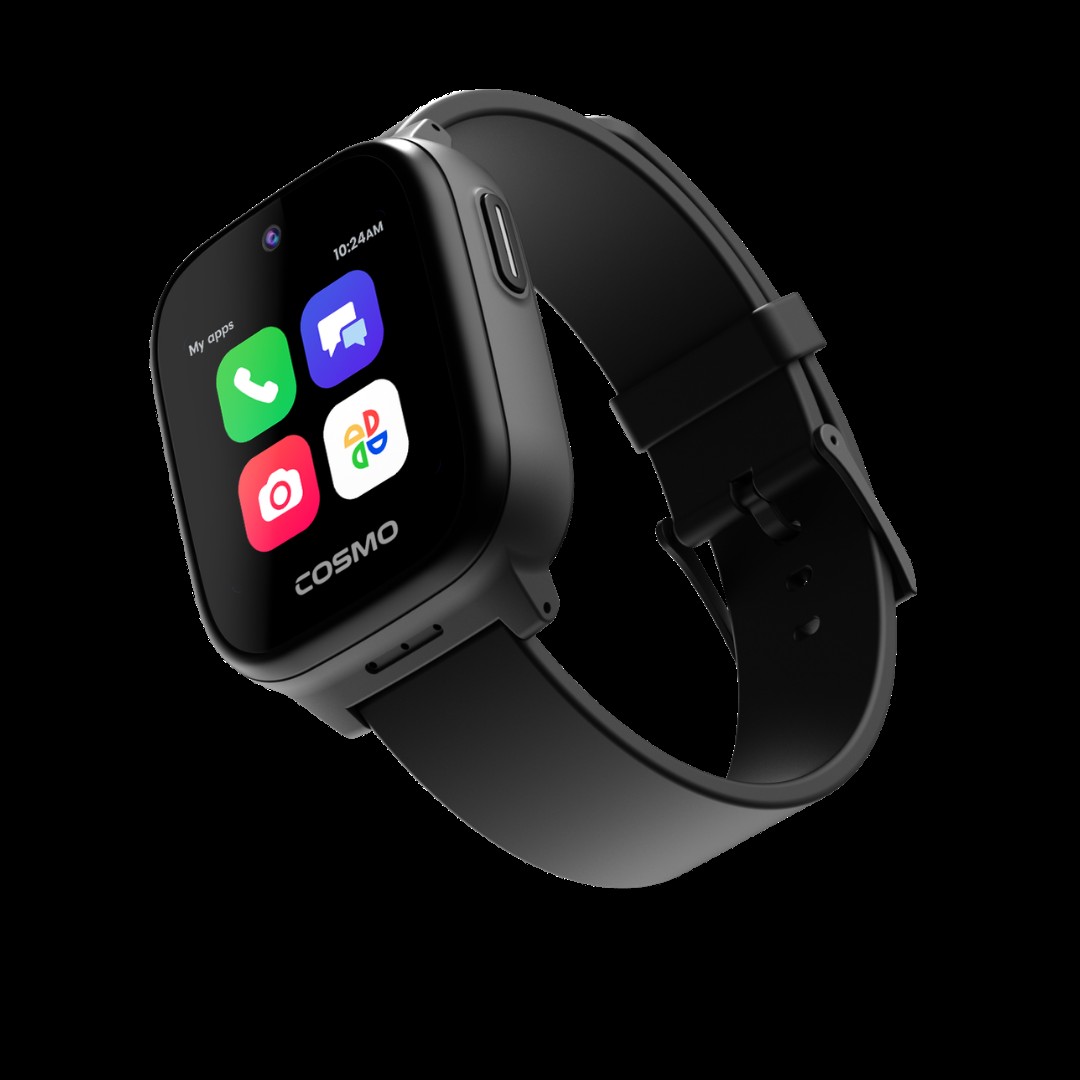
The JrTrack is a standalone 4G smartwatch. It carries its own SIM (an eSIM on the newest models) and its own phone number, so it works without a paired parent phone nearby. It handles calling, messaging, GPS tracking, activity tracking, alarms and reminders. What it will not do is the entire reason it exists: it is firewalled against internet browsing and social media, and it only connects to contacts a parent has approved.
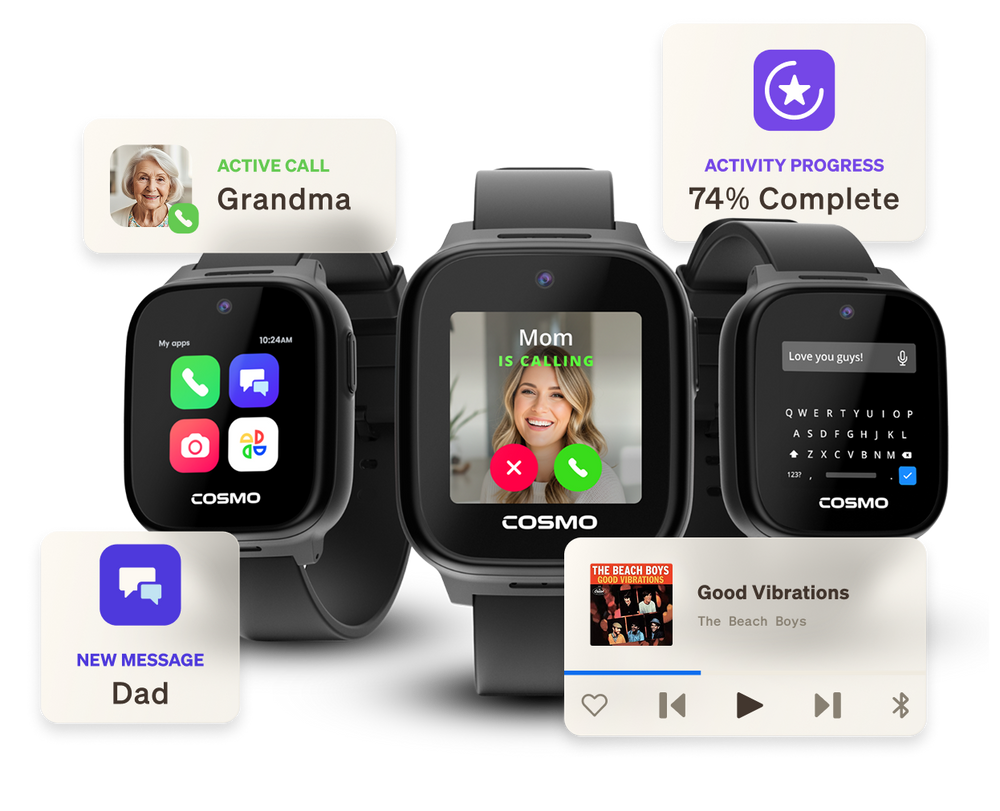
The line has iterated fast - JrTrack 2, 3, 4 and now 5 - and each version added capability without adding distraction. The JrTrack 5, which reached Amazon and Cosmo's own store in July 2025, leans hard into the thing families said they cared about most: location. Cosmo's HaloGPS is advertised as locking a position about 92% faster than the prior generation, with roughly five-foot accuracy, plus an Active Tracking mode for real-time updates. A new Parent Insights Dashboard pulls device usage, call logs, text oversight and plan management into one screen. There is a Focus Mode that can lock the watch fully or partly during class or at night, and IP68 water resistance for the kids who will absolutely test it.
Safety is bundled as a stack Cosmo calls SafeCore: SOS alerts, GPS SafeZone geofences that ping a parent when a child leaves a set area, location history, and optional emergency 9-1-1 calling. It is the sort of feature list you would write if you sat down and asked worried parents exactly what would let them say yes.
03 / The modelSell the watch, then sell the SIM
Here is the part investors like. Cosmo is not only a hardware company. It runs its own connectivity brand, Cosmo Mobile, and sells service plans that range from a roughly $9.99 prepaid equivalent up to $17.99 a month for unlimited talk, text and data. The watch gets a family in the door; the plan keeps them. It is the razor-and-blades structure, rebuilt for parenting - a one-time device sale followed by recurring monthly revenue for as long as the kid wears it.
Where the money comes from
It also explains the distribution strategy. Cosmo sells direct through its own Shopify storefront and hard on Amazon, where it claims the top spot for 4G kids smartwatches. And the best marketing channel for a kids product turned out to be other parents: Cosmo leans into TikTok reviews, affiliate codes and giveaways rather than expensive brand advertising, letting the recommendation come from someone who already trusts the person recommending it.
04 / The wedgeNot competing with the phone - competing with buying one too early
Cosmo's real competitor is not another gadget. It is the moment a parent gives in and hands over a smartphone. Cosmo positions the JrTrack as the device that buys a few more years before that happens. Against direct rivals - the Apple Watch SE in kid mode, Gabb, Bark, Verizon's GizmoWatch, Garmin Bounce, Fitbit Ace, TickTalk and Angel Watch - Cosmo's differentiator is that it built a wrist device from scratch to never be able to become a phone, instead of shrinking a phone down onto a wrist.

No browser, no app store, no social media. The firewall is the feature, not a limitation.
Kids can only reach people a parent has added - so "who is texting my child" has a fixed answer.
Parents can switch on curated extras like Spotify or a news feed, one toggle at a time.
Usage, call logs, SafeZones and plan management live in one screen instead of five settings menus.
05 / The betsNews before browsers, and a built-in expiry date
Two decisions capture how Cosmo thinks. First: in May 2025 it partnered with The Week Junior to put the first-ever news app on a kids smartwatch - weekly current events, polls and facts for ages 8 to 14, free to opted-in families. A company that refuses to add a browser chose to add curated news. That is a point of view about what children should read, delivered as a product spec.
Second, and stranger for a growth company: Cosmo openly sells a device meant to be outgrown. Buy it at 6, retire it at 12, move on. Most startups fear churn. Cosmo built its identity around a graduation date. The counter-bet is that a brand parents trust for the awkward pre-phone years earns the right to sell them whatever comes next - and that a younger sibling is usually right behind the first customer.
06 / The recordFrom one table to the top of a category
The funding history is lean and early: Cosmo closed an undisclosed pre-seed round in June 2021, backed by Free Radical Ventures, to accelerate its product line and grow the team. The company now runs at roughly 44 employees. It has not published revenue or a valuation, and the honest read is that the loudest proof point is the Amazon ranking Cosmo cites for itself. But the trajectory - kitchen table in 2020 to a four-generation product line and a category-leading claim by 2025 - is real, and it was built on subtraction rather than the usual pile-on of features.
For anyone building hardware, the copyable lesson is not the GPS chip. It is the framing. Cosmo found a group of buyers - anxious parents - who were already sold on a belief (delay the smartphone) and simply built the device that let them act on it. The product removes rather than adds, charges monthly rather than once, and treats trust as the actual feature. It works precisely because it is narrow. Hand the same watch to a teenager who wants apps and games and a browser, and the whole thesis falls apart. That is the point.