Company Profile / Consumer Hardware / Audio
The Austin Startup That Put a Real Subwoofer in a Lunchbox
Brane Audio spent nine years and 100-plus prototypes trying to break a century-old rule of acoustics. The result is a portable speaker that reviewers keep describing as impossible.
There is a rule in acoustics old enough to have a name and a body count. Speaker designers call it Hofmann's Iron Law, and it says you get to pick two of three things: a small box, low power draw, or deep bass. Want a subwoofer's rumble from something you can carry? Physics sends its regrets. For most of a century, the industry accepted the terms and got very good at hiding the compromise. Then a group of engineers in Austin - most of whom had never designed a speaker - decided the law was more of a suggestion.
That group is Brane Audio, a consumer-electronics company founded in 2015 and headquartered in Austin, Texas. Its pitch is easy to say and hard to believe: subwoofer-sized bass from a box you hold in one hand. The proof is a portable smart speaker called the Brane X, which sells for around $499, weighs a deliberate 7.7 pounds, and reaches down to roughly 27 Hz - lower than a lot of the furniture-grade subwoofers sitting in living rooms. In 2024, TIME put it on the Best Inventions list. Reviewers reached for words like "impossible" and mostly meant it as a compliment.
01 / The trickCancel the air, not the argument
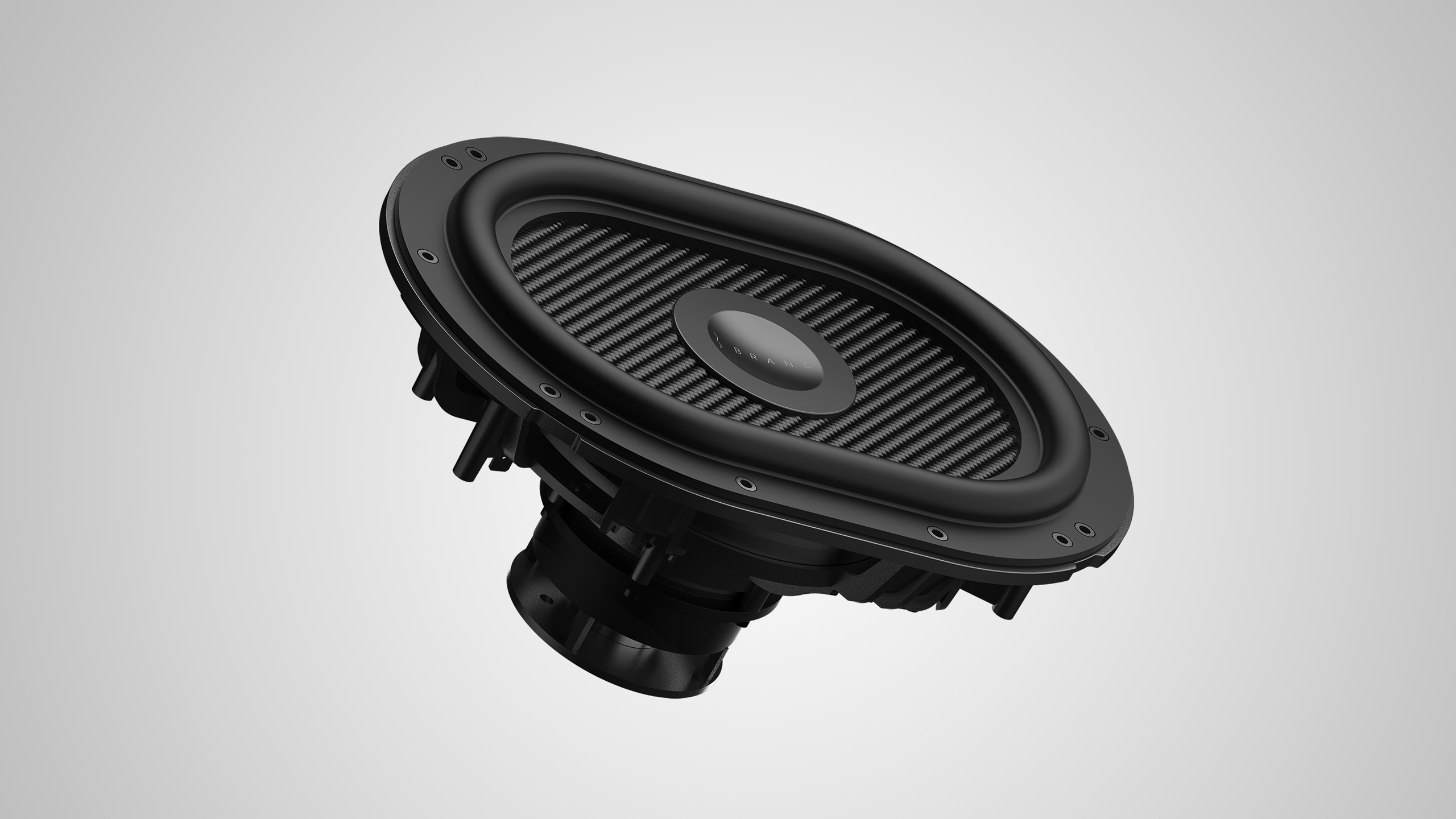
The heart of the company is not the speaker. It is a driver called the RAD - Repel-Attract Driver - and it is the reason there is a company at all. In a small sealed enclosure, the enemy of deep bass is not really the driver; it is the trapped air. Push a woofer inward and the air compresses and shoves back; pull it outward and the air resists again. That pressure acts like a stiff spring, and stiff springs kill low frequencies. Bigger boxes give the air more room, which is why real subwoofers are the size of nightstands.
Brane's answer is to fight the air with magnets. The RAD uses arrays of stationary and moving permanent magnets arranged in a push-pull configuration, tuned so their forces cancel the pressure the air is exerting. Engineers sometimes describe it as a "negative-spring woofer": instead of fighting the trapped air, the magnetic system offsets it, so the driver can move a lot of air inside a small enclosure without the usual penalty. Chief executive Joe Pinkerton puts the mechanism plainly.
"By setting up the magnetic fields in a balanced, push-pull configuration, we could generate significant force, moving a lot of air in a much smaller enclosure." Joe Pinkerton, Co-Founder & CEO
The efficiency numbers are the part that makes audio engineers squint. Brane says the RAD is roughly 100 times more efficient in the subwoofer range than a conventional driver - delivering far more sub-bass while drawing a fraction of the power. That is not a tweak on the margins; it is the difference that lets a battery-powered speaker behave like something plugged into a wall and bolted to the floor. The company holds four-plus US patents on the design, issued in June 2024, which is the moat it is actually building.
Lower is deeper. Figures are company and reviewer-reported; sub-bass below ~30 Hz is felt as much as heard.
02 / The foundersFrom 15,000-pound flywheels to woofers
The reason Brane approached speakers sideways is that its founders did not come from speakers. Pinkerton is a serial inventor with a long trail of patents; before Brane he built magnetic-bearing flywheels for energy storage - 15,000-pound machines that spin to bank electricity - and took that company, Active Power, public on the NASDAQ in 2000. Co-founder and CTO Dr. William Lackowski was a chief scientist at UT Austin's nanotechnology center, with stops at Sandia National Laboratories. Co-founder and VP of engineering David Badger is named on 40-plus patents and worked alongside Pinkerton at Active Power.
Even the name gives away the origin story. "Brane" is short for "membrane." The company began as a graphene-membrane research shop - part of Pinkerton's Clean Energy Labs - and only later realized the physics it was chasing pointed at audio. When your founding team thinks in magnetic fields and moving mass rather than crossovers and cabinets, "you can't beat trapped air" reads less like a law and more like an unsolved problem.
"It is a factor of roughly 100 times more efficient in the subwoofer range." Joe Pinkerton, on the RAD driver
03 / The productWhat the Brane X actually is
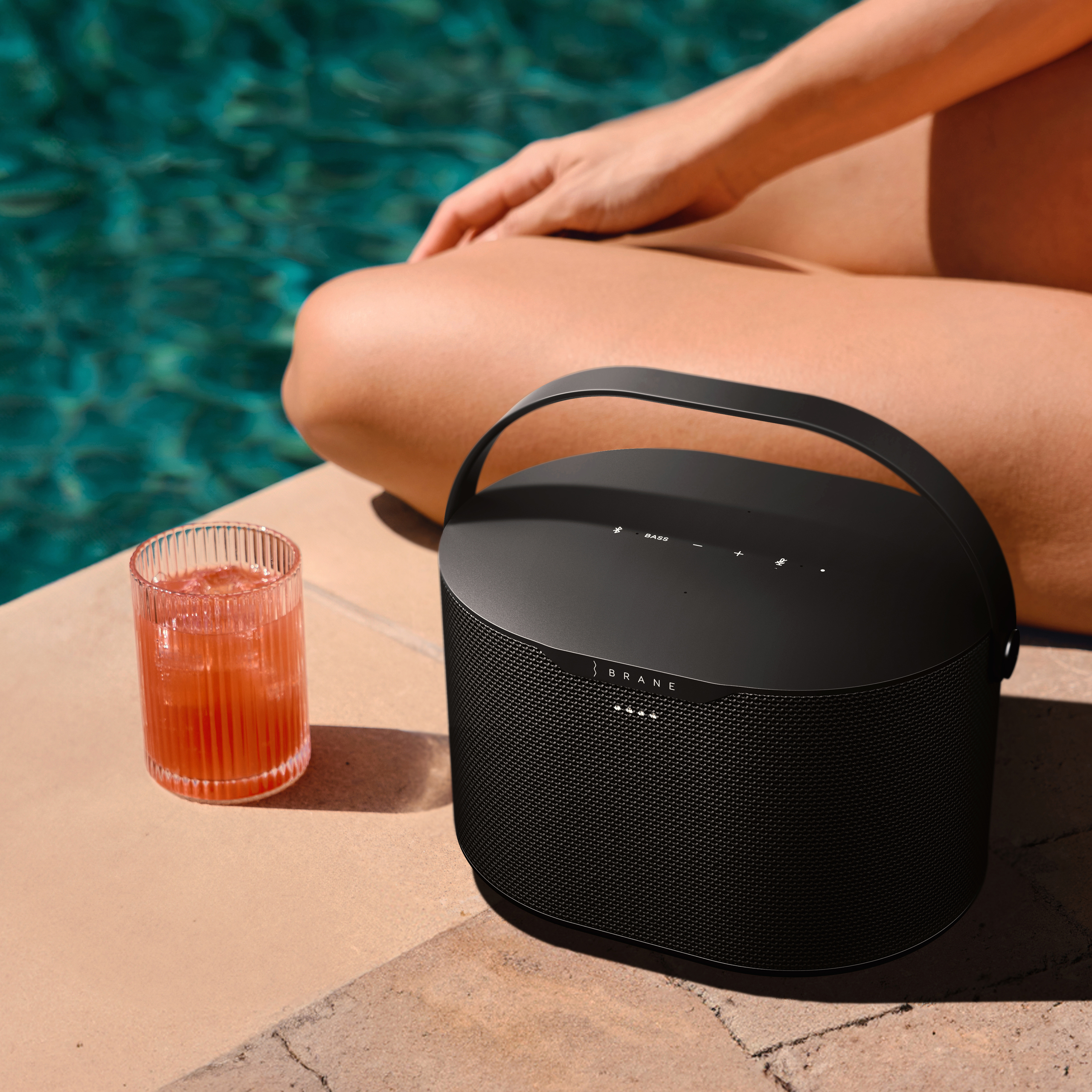
Around that driver, Brane wrapped a genuinely modern smart speaker. The Brane X pairs the RAD subwoofer with two mid-range drivers and two dome tweeters. It streams over Wi-Fi and Bluetooth 5.1, has Alexa built in and Spotify Connect, and carries an IP57 waterproof rating - the kind you can leave by a pool without flinching. Battery life lands around 12 hours at moderate volume. A companion app adds a five-band equalizer and lets you group multiple units for multi-room sound.
It launched at CES in January 2023, made its official debut at SXSW that March at $599, and has since settled around $499, including on Amazon. Reviewers have been unusually consistent, which is its own kind of endorsement. They agree on the win - the bass is genuinely unmatched for the size - and they agree on the costs.
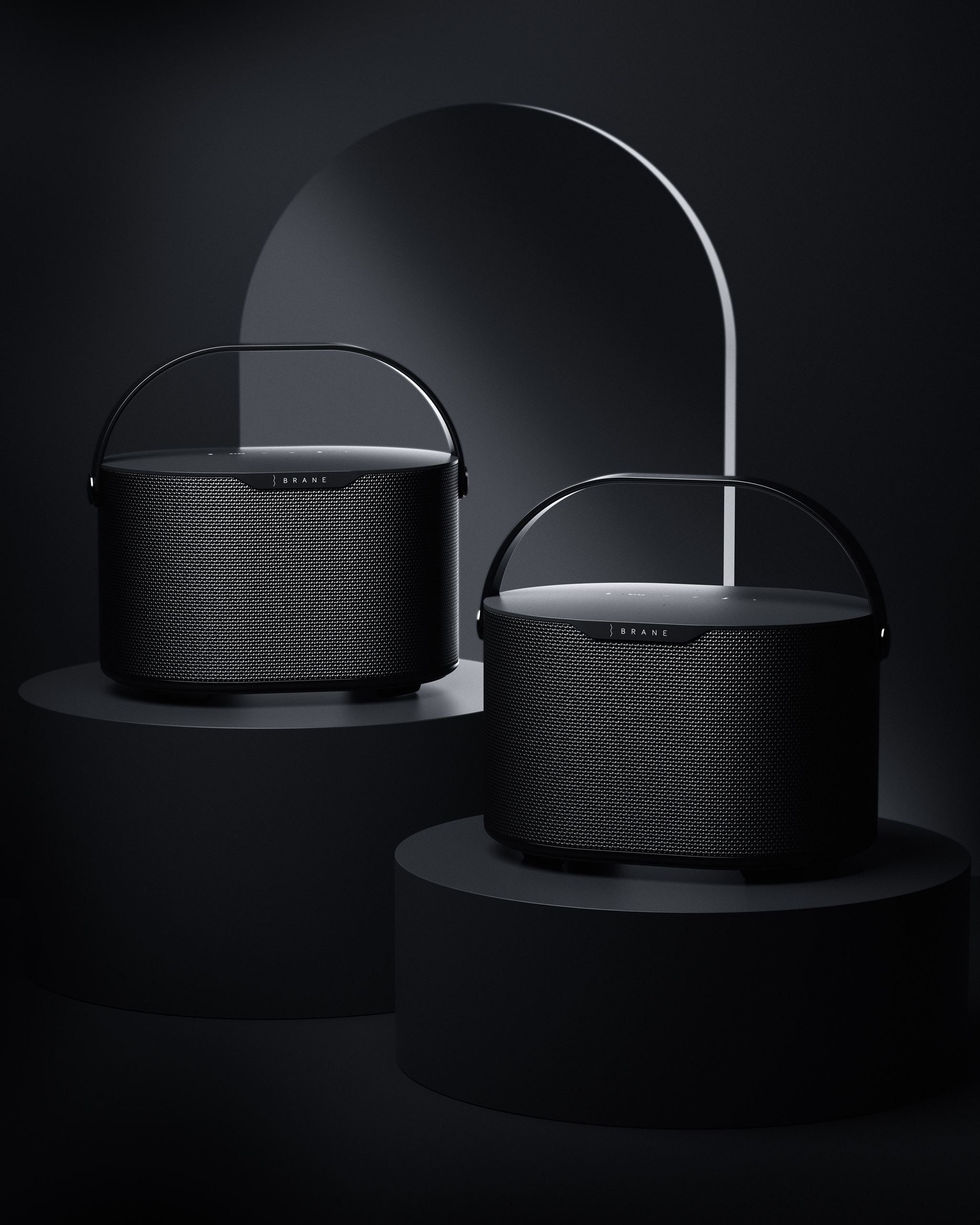
The honest verdict, distilled from SoundGuys, TechRadar, Gizmodo and others: the low end is startling, sometimes physical; the trade-offs are the 7.7-pound heft, the premium price, fairly basic onboard controls, and AC-only charging with no USB-C. TechRadar wrote that it "crushes anything by Sonos with its astonishing bass." Gizmodo called it "The Final Boss of Bass." None of them pretended the weight wasn't real - because the weight is the subwoofer.
04 / The lawTwo of three, unless you don't accept it
enclosure
efficient
bass
Conventional design forces a choice between any two corners. Brane's claim is that force cancellation lets the RAD chase all three at once - the entire reason the company exists.
This is the framing that makes Brane interesting beyond audiophile forums. Nearly everyone in consumer audio competes on the same axis - thinner, lighter, cheaper, one more hour of battery. Brane did not compete on that axis. It questioned an assumption the whole category had internalized, then spent years and more than 100 prototypes turning the objection into a product. The moat is not brand or marketing spend. It is a patented piece of physics that a competitor cannot simply match with a better supply chain.
05 / The businessSell a speaker, license a driver
Brane sells the Brane X direct through its own site and Shopify store, an Austin flagship location, Amazon, and specialty retailers such as Crutchfield - a direct-to-consumer-plus-retail model aimed at a specific buyer: someone bass-hungry enough to accept the weight and the price. In early 2026 it began expanding into the EU, starting with France and Germany, and added a limited-edition white colorway. The company employs somewhere in the 11-to-50 range and has kept its funding details private; no verified round sizes or investor names are public.
But the speaker may be the demo, not the destination. Pinkerton has been open about a hybrid ambition: license the RAD driver into markets Brane won't chase directly. The technology, he says, scales "from earbuds all the way to festival-sized sound systems." That reframes the whole company. The Brane X exists to prove the driver works in the wild - and to give the patents a track record before they show up in someone else's earbuds, car, or PA rig.
"RAD2 isn't just a product upgrade; it's an industry changer. It's the flat-screen TV moment for audio." Joe Pinkerton, CES 2026
At CES 2026, Brane pushed the physics further with RAD2, a second-generation driver it says carries a 30x deep-bass advantage over conventional drivers - up from the roughly 10x of the original - and reaches as low as 20 Hz with lower moving mass. Its first home is the Brane Party Pro, a high-output speaker with two exposed RAD2 drivers, slated for US release in 2026. The pattern is the tell: prove the tech in one product, improve the driver, scale it into the next category.
06 / The takeawayWhat a founder can actually steal
Strip away the magnets and Brane Audio is a case study in a specific move: find a constraint an entire industry treats as fixed, confirm it is really just an unsolved engineering problem, and attack it with people who don't share the industry's reflexes. The founders' outsider background wasn't a liability to overcome - it was the whole edge. They didn't know they were supposed to accept Hofmann's Law, so they didn't.
Where would the approach fail? The same place all hard-tech bets get tested: cost, weight, and patience. The Brane X is heavy and expensive precisely because doing the hard thing has a physical bill, and a licensing strategy only pays off if the patents hold and a big partner bites. But as a piece of positioning, Brane's is rare in consumer electronics - a company whose main competitor is not another brand, but a century-old assumption. So far the assumption is losing.
Explore Brane Audio
Watch & demo: the SXSW 2023 Brane X demo, a hands-on "impossible bass" review, and "I tested the speaker that claims to break physics".