At Sparks, an events company, being employee of the quarter came with $500 and a prime parking spot. A tidy arrangement, provided the right people got noticed. According to the company’s account of adopting Nectar, the award tended to favor employees facing clients. People doing less conspicuous work were easier to overlook.
That is an awkward flaw in a prize meant to celebrate a workforce. The reward had value. The method of finding its recipients had a blind spot. Nectar’s answer was to let colleagues recognize one another throughout the day. Suddenly, the receptionist could appear in the company’s stream of appreciation too.
- The job: turn everyday contributions into visible recognition and redeemable rewards.
- The buyer: HR and People teams trying to reach office, remote and frontline staff.
- The expansion: communications, surveys and automated employee journeys beside the recognition feed.
- The useful lesson: examine who receives thanks, as carefully as how much you spend on it.
The interesting question is who has permission to notice. A manager sees one slice of a company. A colleague sees another. The person who covers a shift, fixes a troublesome handoff or explains an unfamiliar process may have a witness without having an audience. Nectar sells employers a way to make those witnesses heard.
A parking-lot education in perks
Nectar’s founder story begins with actual cars. In his account for Utah Business, Trevor Larson describes moving to Utah with $300 in his bank account and starting a mobile detailing business. He washed cars for employees at local companies and eventually took a sales job at Qualtrics.
There he saw the attraction of software: a business could serve customers far away without its founder kneeling beside their wheels. He also spotted employee discount pages that people scarcely knew existed. Benefits were available; finding and using them was another matter.
Larson and eventual co-founder Andrew Hollis began pursuing an application. A coding boot camp persuaded Larson that he would need years to build it himself. They hired junior engineers instead. A $4,000 student competition win at Utah Valley University brought him into contact with HireVue founder Mark Newman, who became an early angel investor. Jackson Horne is the third co-founder.
There is a sensible habit buried in this origin. Start by watching an existing transaction misfire. An employer offers something; an employee never discovers it. That gap is small enough to investigate and large enough to support a product. The company’s later recognition business addresses a related gap: useful contributions happen, but appreciation fails to reach their authors.

The thank-you gets a receipt
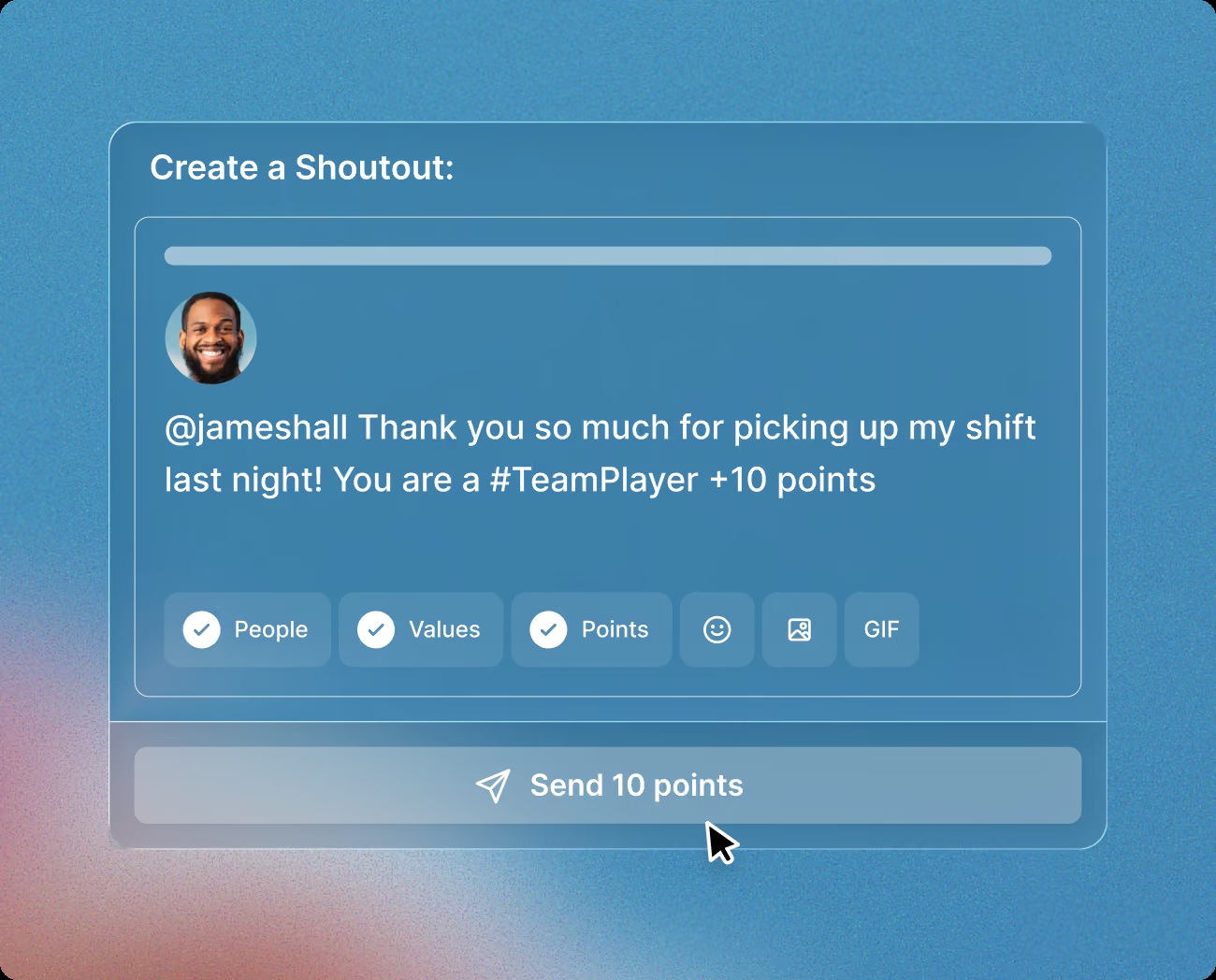
In Nectar’s employee guide, sending a shoutout is a compact operation: select a teammate, choose points, tag a company value and write an appreciative message. The post joins a social feed where colleagues can react or comment. The employer invites users into the system and configures the program.
That structure asks the sender to connect a person with a behavior. A value such as teamwork can acquire a concrete example: someone picked up a shift. A colleague reading the feed can see what the company means by a word that might otherwise spend its life on a wall.
Points give the thanks a practical destination. Nectar offers gift cards, Amazon items, company merchandise and custom rewards. An employer can make a perk such as extra time off part of its own catalog. The employee’s available choices depend on the employer’s setup. Variety matters because a reward chosen for everyone is often a reward chosen particularly well for no one.
There are other routes into the program. Challenges can reward participation in learning or wellness activities. Nominations let employers run formal awards and collect peer suggestions. Birthdays and work anniversaries can trigger celebrations automatically, with messages and reward levels set for the occasion. The company still chooses what deserves attention.
The number behind the cheerful feed
At Accra, a Minnesota home healthcare organization, the bottleneck was administration. Nectar’s case study describes a manual process consuming up to two HR days each month. Nominations, birthdays and anniversaries accumulated into a backlog. The new system allowed colleagues to recognize one another without routing every instance through HR approval.
The published results are specific. Accra reported that 97% of corporate users had received recognition by 2024, along with 16 hours saved each month. Its employee engagement figure rose from 50% in 2021 to 68% in 2023 and 72% in 2024.
+22 percentage points from 2021 to 2024. Vendor-published customer results; the chart does not establish causation.
The case study calls that a 44% increase. The arithmetic is correct: 22 divided by the starting 50 is 44%. Readers should keep the units attached. Engagement rose by 22 percentage points. These are customer-reported outcomes across several years, during which other things could also have changed. The time saving is the more direct operational claim: fewer hours spent administering celebrations.
The person who sees the work is not always the person who signs the award.An observation from the Sparks case
A thank-you acquires neighbors
Nectar’s current ambition extends beyond the rewards feed. Comms helps HR create and distribute internal messages through channels including email, Slack, Microsoft Teams and text. Engage supplies surveys, eNPS and SafeTalk, an anonymous two-way conversation after feedback. Flows connects timed messages, surveys and awards into employee lifecycle sequences.
A public Flows demonstration gives the proposition some welcome specificity. A hire date starts an onboarding sequence. An email goes out before the first day; a separate notification reaches the manager. Later, a first-week award can appear in the recognition feed. The practical gain comes from putting a recurring sequence somewhere other than a busy person’s memory.
By October 2026, the website presents this broader direction as Nectar One. It includes Kudoboard group celebrations and engagement benchmarking using Mercer data. Nectar Signals adds employee and team health scores derived from activity within the platform. The site labels Agents as coming in fall 2026 and Perform as coming soon. Those labels matter when a buyer compares a sales promise with what a team can use today.
The suite strategy makes sense as a reading of HR’s workday. Recognition, announcements and feedback frequently concern the same people. Connecting them can reduce the number of lists and tools an administrator maintains. Whether that improves an employee’s experience depends on the quality of the messages and the response to feedback.
What the buyer is actually buying
Nectar sells subscriptions to employers. Its current pricing page asks prospective customers to request a quote and shows product bundles rather than a universal public per-seat rate. A buyer should establish the subscription scope, the reward budget and the work needed to connect employee records. A charming catalog does not settle those questions.
The company occupies the employee experience layer around HR systems. Its integrations include ADP, UKG, Workday, Rippling, Slack and Teams. Those connections matter when a workforce changes: new employees need access, departures need updating and anniversaries need accurate dates. Nectar’s expertise is in coordinating recognition and engagement programs around that workforce.
Alternatives include Awardco, Workhuman, Bonusly and WorkTango, as well as whatever recognition tools an employer already owns. Nectar’s case for itself rests on bringing frequent peer recognition together with rewards and adjacent HR tasks. At Sparks, integration, merchandise options and pricing helped determine the choice. A good comparison starts with the workflow a buyer needs to improve.
There is financial backing for the expansion. In April 2024, Nectar announced $40 million in committed Series B funding with PeakSpan Capital to develop recognition and additional culture products. Inc. ranked the company No. 87 on its 2024 Inc. 5000 and No. 599 in 2025. SHRM uses Nectar internally and has a recognition partnership with the company, with a stated member subscription discount.
Copy the attention, then the automation
The lesson a reader can borrow is pleasantly unglamorous. Examine the last several awards or public thank-yous. Count the departments and roles represented. Ask who did helpful work without appearing. Then make it easy for the people who witnessed that work to describe it. Recognition needs a wider field of vision before it needs more elaborate prizes.
Automate the repeatable chores after that: birthdays, anniversary dates, invitations and routine reminders. Keep the description of a contribution specific. Nectar publishes internal values including Selfless, Scrappy, Owner Mentality and Assume the Best. Any employer adopting values-based recognition has the same task: demonstrate what its chosen words mean in ordinary work.
Access and interpretation remain conditions for success. A program available only where office staff spend their day may miss frontline colleagues. A recognition network can inherit existing social habits. And a low activity score can reflect many things besides dissatisfaction. Nectar’s own Signals FAQ says it does not predict who will quit. Its patterns give a manager a reason to inquire.
Reward points also cannot resolve an unanswered concern raised in a survey. Someone must act on it. The software can make a contribution visible, remember a date and deliver a message. The employer supplies the attention that makes those acts worth receiving. Even the best parking spot has a limited view.
Follow the work
Explore Nectar’s platform, its pricing options and culture blog. Find Nectar on LinkedIn, X, Instagram and Facebook.
Watch the employee overview video, try the Flows product walkthrough, browse the official YouTube channel, or listen to Trevor Larson on Phoenix Founders. Read the funding announcement and Larson’s founder account.