The funniest thing about WorkTango is that it was acquired, and then its buyer took its name. In April 2022, Austin-based Kazoo bought the Toronto employee-listening startup. Five months later, the combined business retired “Kazoo + WorkTango” and relaunched simply as WorkTango. The smaller brand had survived the transaction. In July 2026, BI WORLDWIDE bought WorkTango and announced that the name, team and identity would survive again.
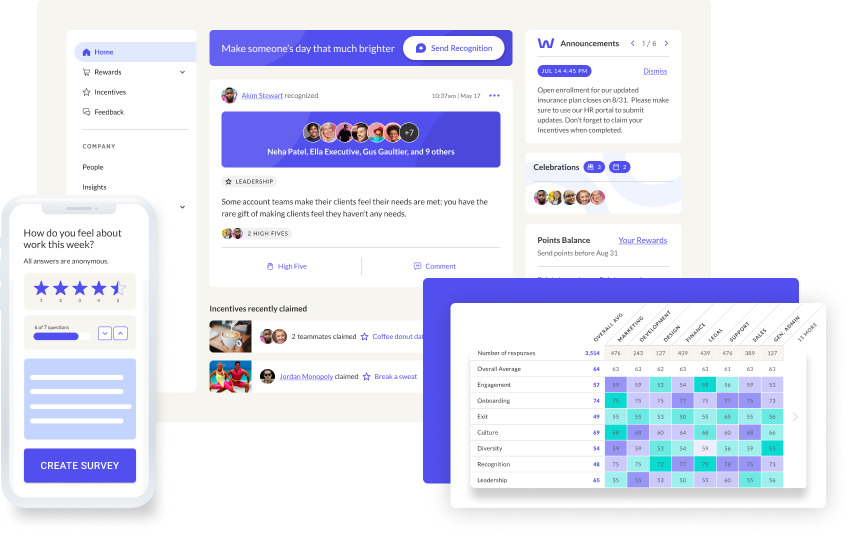
That corporate family tree could fill a whiteboard. Yet the product underneath it is easy to grasp. WorkTango gives employers two connected systems: Surveys & Insights for hearing what employees think, and Recognition & Rewards for reinforcing what the company wants repeated. Customers can buy either one or bundle both. Around them sit analytics, HRIS connections, leadership tools and a catalog where points become gift cards, merchandise, experiences or charitable giving.
The buyer is usually an HR or People team. The users are everybody else - executives checking sentiment, managers reading team results, employees answering an anonymous pulse survey or thanking a colleague in a public feed. WorkTango plays in the crowded territory between Culture Amp and Qualtrics on one side, and Awardco, Achievers and Bonusly on the other. Its argument is that listening and recognition should not live as estranged cousins in separate browser tabs.
01 / The real productThe five-minute gap after “Thanks for your feedback”
Employee surveys rarely fail because companies cannot ask a question. They fail after the answers arrive. HR exports the data, cleans it, builds slides, briefs managers and drafts action plans. Weeks pass. Employees conclude that the survey was theater. Managers, dependent on an overworked HR business partner to interpret the numbers, quietly return to their calendars.
WorkTango has spent its recent releases attacking that delay. Its original listening product offered configurable surveys, anonymity, natural-language analysis and real-time dashboards. In April 2026, the company launched WorkTango Coach, an AI survey analyst that accepts plain-language questions, proposes manager-specific plans, assigns ownership and tracks follow-through. The point is not a clever summary. It is keeping employee attention alive long enough for a visible decision.
Listen
Run lifecycle, pulse or engagement surveys.
Read
Find sentiment, themes and differences between teams.
Act
Give managers a plan, an owner and a deadline.
Repeat
Recognize the behaviors and check whether sentiment moved.
Then came Constellation, announced on July 22, 2026 - two days after the BI WORLDWIDE deal. It is a standalone AI-moderated listening product for a group session lasting 30 to 45 minutes. The moderator asks adaptive follow-up questions, lets people react to ideas, and returns a ranked list of proposed solutions with an owner attached to each. Think less annual survey, more structured town hall where the quiet person gets the same doorway into the conversation as the loud one.
“What gets recognized, gets repeated.”Scott Halstead, American Eagle Financial Credit Union
02 / The originA bootstrapped company runs out of road, not cash
Rob Catalano came to employee experience after watching people at recognizable companies dread going to work. A marketer by training and an early Achievers employee, he wondered why companies studied customers obsessively but understood employees so poorly. In 2015 he co-founded WorkTango with Nadir Ebrahim and Bjarke Jungberg Grouleff in Toronto. Their passion statement was deliberately not a mission: “Improve (work) lives.” Missions end, Catalano liked to say; passion does not.
The first version focused on surveys and insights. The founders bootstrapped it - Catalano said there was no financing and no outside investor. By 2022, that discipline had also become a constraint. Building the broader platform and reaching more workplaces required pushing the gas. The thing that failed first was not the listening engine. It was the assumption that a small independent company could distribute the full vision at the desired speed.
Kazoo supplied the missing pieces. The Austin company itself came from the 2019 combination of YouEarnedIt, a recognition-and-rewards business founded by Autumn Manning and Kenny Tomlin, and HighGround, a performance-management platform. Kazoo approached WorkTango with software that could celebrate and reward behavior; WorkTango brought serious employee listening and people analytics.
What changed the founders’ minds was partly scale and partly an unusually literal culture match. Kazoo said “Make work better.” WorkTango said “Improve (work) lives.” Both groups, Catalano recalled, lit up over the same ideas. The acquisition price was not disclosed. That is the honest answer to what it cost. The more revealing price was autonomy: WorkTango traded independence for reach, then somehow supplied the name for the whole enterprise.
The listening startup
WorkTango begins in Toronto and grows without outside capital.
The unlikely name swap
Kazoo acquires WorkTango; the combined company adopts the WorkTango brand five months later.
A new operator
Monique McDonough becomes CEO; UKG joins the integration ecosystem.
AI, then another owner
Coach and Constellation launch around WorkTango’s acquisition by BI WORLDWIDE.
03 / Proof in behaviorWhen reward points become more reward points
Company case studies always arrive dressed for picture day, so treat the numbers as reported outcomes, not controlled experiments. Even so, WorkTango’s examples show what implementation looks like when it has teeth. At AMain Hobbies, 94 percent of employees used the recognition tools, while participation in safety, learning and team-building programs reached 70 percent. The company used “Behavior Bonuses” to connect points to specific acts rather than handing out generic applause.
OneStream offers the more charming result. Its People Operations team renamed points “Streamies,” put leaders into the platform early, mentioned recognition in newsletters and company meetings, and kept the program visible on the intranet. In the first 90 days, 52 percent of employees logged in to send recognition. Later, 71.1 percent of redemptions were for additional recognition points. People used their winnings to acquire the ability to thank somebody else.
BraunAbility faced a less glamorous access problem: manufacturing employees were not necessarily sitting at a company laptop. QR codes let them answer surveys on personal devices. Real-time results went to managers, making the response less dependent on a central HR team. Recognition engagement scores rose five percent. Again, the useful feature was not novelty. It was removing a small piece of friction exactly where participation had been failing.
04 / PositioningNot another dashboard - a closed loop, if you use it properly
The business model is familiar enterprise SaaS: quote-based subscriptions sold to mid-market and large employers, with Surveys & Insights and Recognition & Rewards available separately or together. Public list prices are not posted. The 2026 acquisition fills in a different economic layer. BI WORLDWIDE operates across more than 40 locations and supports reward participants in more than 200 countries. WorkTango plans to move core fulfillment onto that global marketplace, expanding rewards, milestone awards, experiences and events without becoming a logistics company itself.
The integration list explains the rest of the strategy. UKG can synchronize employee records and automate provisioning. Microsoft Teams and Slack bring recognition into the flow of work. Axomo lets an employee redeem points for branded Nike or North Face merchandise shipped from a regional hub, sparing HR the bulk order, customs bill and legendary cupboard of leftover medium T-shirts. Surveys support 30 languages. Each move removes a reason for the program to sit untouched.
The part worth stealing
- Put senior leaders into the system before the broad launch. Their behavior sets permission.
- Name the currency and rituals for the company. “Streamies” beats “points” because it belongs somewhere.
- Place recognition and survey prompts inside tools employees already open.
- Return findings quickly, assign one owner to each response, and show what changed.
- Measure participation and cross-team behavior, not merely how many licenses were purchased.
This playbook has conditions. Anonymous listening is weak when teams are so small that comments identify their authors. Recognition becomes expensive confetti when points are detached from values or managers play favorites. AI summaries can compress nuance, inherit biased wording or recommend an action that sounds neat and fits nobody. And no platform can rescue leaders who ask for candor and punish it.
The software works best in companies large enough to need structure, distributed enough to need a shared channel, and serious enough to act in public. It works poorly when the survey is a compliance ritual, the reward budget is opaque, or leadership expects the vendor to manufacture trust. WorkTango can shorten the distance between voice and action. It cannot walk that distance for the customer.
05 / The second dealThe brand survives because the promise is legible
BI WORLDWIDE’s July 2026 acquisition is almost a mirror image of the first. In 2022, WorkTango’s listening technology completed Kazoo’s software suite. In 2026, BI WORLDWIDE’s reward infrastructure completes WorkTango’s fulfillment reach. BIW historically served large multinationals; WorkTango gives it a mid-market doorway. WorkTango keeps its whole team, brand and identity as a subsidiary. The sale price, again, was not disclosed.
The company now serves a broad customer set that has included Kia North America, Rexall, the Brooklyn Nets, Bluetooth, OneStream, BraunAbility, AMain Hobbies and DealerSocket. At the time of the 2022 merger, the two companies said they supported more than 1,000 customers. WorkTango later collected G2 recognition for employee engagement, recognition and return on investment, plus a 2024 TalentCulture HR Technology Award and a 2025 Inspiring Workplaces Top Work Tech Vendor designation. Those badges matter in a purchasing category where every homepage promises happier humans.
But WorkTango’s most persuasive distinction is still the strange journey of its own name. “Work” states the problem. “Tango” implies two parties adjusting to each other. Leaders listen; employees respond; the organization moves. The metaphor only works if both sides participate. That was true in a Toronto coffee shop when the founders reportedly chose the name over their placeholder, “Butter Chicken Pasta.” It remains true after two acquisitions, several product generations and one very busy July.