The most useful sentence in Achievers' history came from a customer who did not want another coffee mug. In its first life, the Toronto startup was called I Love Rewards. It sold branded merchandise meant to motivate employees. The merchandise moved; motivation did not. Founder Razor Suleman later recalled ING Bank's verdict: “No one works harder because they get coffee mugs.” Few strategy sessions are that efficient.
Achievers did not abandon rewards. It moved them down the stack. The company began building software around the human event that comes before a reward: somebody notices a useful act, describes it, connects it to a shared value, and lets other people see it. The points, gift card, trip, or branded hoodie can follow. The recognition is the engine.
That distinction turned a modest ecommerce idea into enterprise software. Today Achievers sells a platform to companies with scattered offices, frontline workers, multiple languages, awkward payroll rules, and HR systems that do not enjoy speaking to one another. Its customers include General Motors, Workday, Meijer, Kellanova, Air Canada, Scotiabank, Samsung, and CVS Health. In late 2025, the company said it engaged nearly five million employees across more than 600 organizations and over 190 countries.
The product is a habit, not a prize
Open Achievers and the surface resembles an internal social feed. An employee can praise a peer with or without money, add points, link the moment to a company value, nominate a person or team for an award, comment, react, or “boost” someone else's recognition. Managers get dashboards and prompts. Administrators get templates, bulk tools, reports, budgets, campaigns, and automation for onboarding, birthdays, service anniversaries, and other milestones.
Behind that feed sits Reward, a marketplace advertising more than three million choices in roughly 190 countries: gift cards, merchandise, travel, experiences, charitable giving, company swag, and reloadable cash options. Achievers says it adds no product markup and charges no shipping fee. That breadth matters less because everyone dreams of three million prizes than because a global employer cannot send the same thing to a nurse in Toronto, a plant worker in Melbourne, and an engineer in Manchester and pretend the experience is equal.
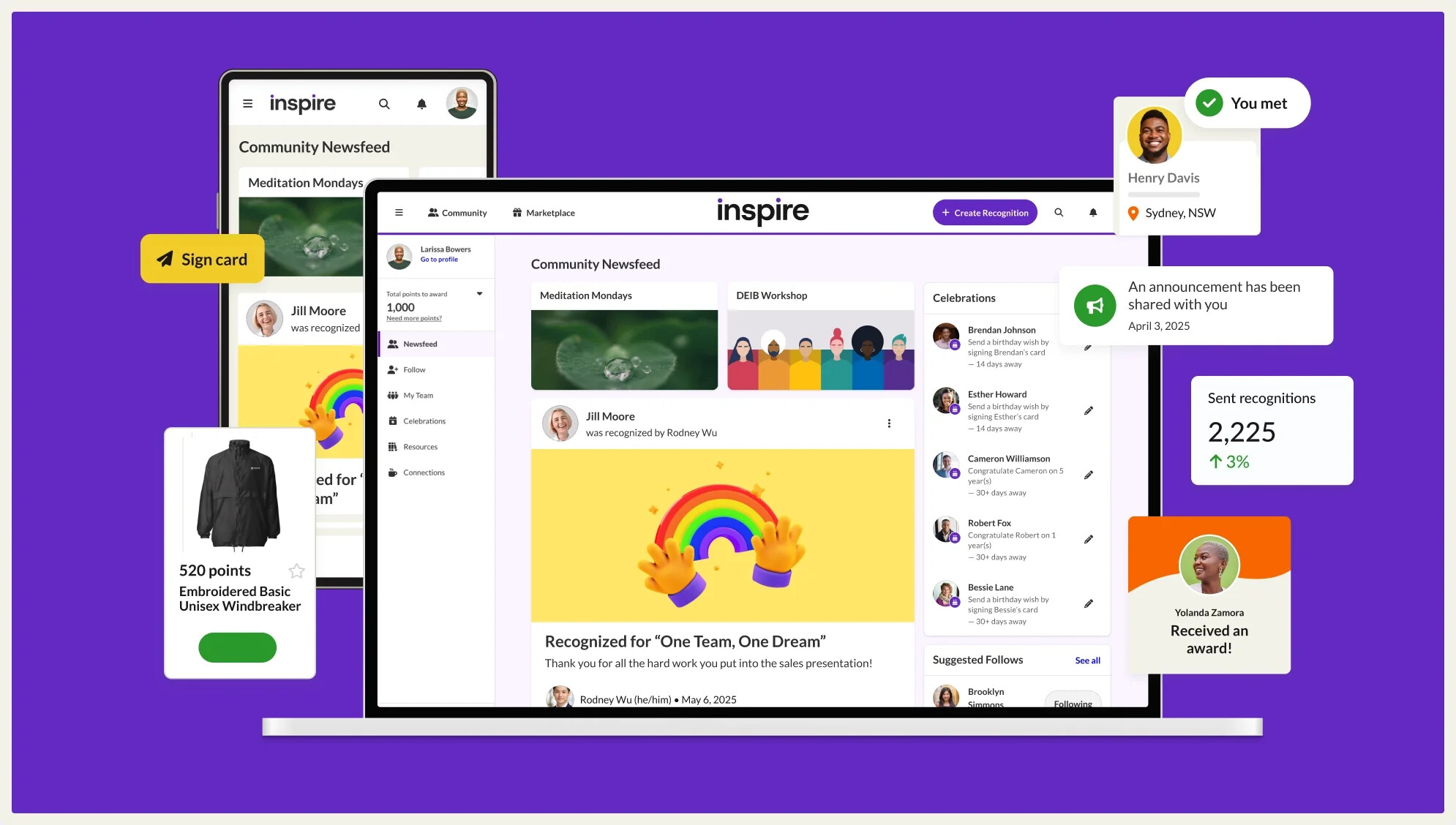
The platform also stretches beyond praise. Celebrate handles milestones. Communications publishes announcements. Employee Connections supports buddy chats, mentoring, and resource groups. Voice of Employee and pulse surveys collect feedback. External Recognition can turn a patient's or customer's compliment into an internal moment. Achievers Intelligence uses AI to help write recognition, answer questions about program data, surface behavioral patterns, infer skills, and flag signals such as slipping participation or possible attrition risk.
The trick is frequency. A once-a-year service pin is a ceremony; a useful thank-you delivered in the week the work happened can shape behavior. Achievers claims its platform is used twice as often as competitors. Treat that as a vendor claim, but the product logic is sound: a recognition system that employees must hunt for becomes shelfware. Achievers works on phones, desktops, tablets, kiosks, QR codes, and physical cards, then appears inside Teams, Slack, Outlook, Zoom, and HR systems.
“No one works harder because they get coffee mugs.”Customer feedback from ING Bank, as recalled by founder Razor Suleman
The less glamorous moat: plumbing
Competitors such as Workhuman, Awardco, O.C. Tanner, Bonusly, Kudos, and Nectar can all make praise visible and distribute rewards. Achievers' sharper enterprise argument is integration. Its Workday relationship reaches core employee records, one-time payment processing, learning, Peakon surveys, Skills Cloud, and Anytime Feedback. Recognition can flow into a performance conversation; feedback can flow back as recognition. In a 2026 example, General Motors synced 134,911 recognitions into Workday during a two-week review campaign, compared with 88,559 recognitions during the entire prior year.
That is a meaningful shift. A compliment stops being a pleasant post that disappears down a feed and becomes evidence a manager can retrieve. Telstra has used a similar Workday connection since 2019; Achievers says employees there favorite 24 percent of recognitions for later use in feedback. Scotiabank saw about 10 percent of recognition activity pass through Microsoft Teams in the first month after enabling that integration. The moat is not confetti. It is data moving through systems that enterprises already paid for.
Achievers makes money like enterprise software usually does: custom subscription pricing based on headcount, geography, and selected modules, plus implementation and program services. Customers also fund rewards. There is no reliable public sticker price. The company itself advises buyers to separate software, services, reward, and ongoing administration costs. That is good advice because “points” sound weightless until finance, tax, fulfillment, and unredeemed balances enter the room.
The price we can name is historical. Blackhawk Network acquired Achievers in June 2015. Its SEC filing records $103.5 million in cash purchase consideration. After Blackhawk went private, Achievers eventually became an independent company again in 2020. Along the way it bought TemboSocial, adding surveys, forms, quizzes, and polls; that deal's price was not disclosed. Scott Landers replaced Jeff Cates as chief executive in October 2024.
What changed their mind
The coffee-mug line exposed the first product's category error. I Love Rewards treated motivation as a fulfillment problem: choose an object, deliver it, hope behavior changes. The customer saw motivation as a management problem. People want to know which contribution mattered, who noticed, and whether the organization will remember. Achievers kept the enjoyable part of the old business but built recurring software around the missing context.
That move also changed the economics. Merchandise produces a transaction. Software creates a workflow, a dataset, and a renewal decision. Every recognition becomes a behavioral signal. At sufficient scale, those signals can show which values are alive, which teams rarely receive praise, who connects across silos, and where managers are absent. The 2025 debut of Achievers Intelligence made that latent proposition explicit.
Five things a reader can steal
Name the behavior. “Great job” expires on contact. “You caught the inventory mismatch before shipping” tells everyone what to repeat.
Lower the distance to action. Put recognition inside the chat, email, meeting, or HR tool people already use. Every extra login taxes goodwill.
Let peers see the work. Managers miss plenty. Peer recognition finds quiet contributions and makes collaboration legible across a company.
Separate praise from spending. Make non-monetary recognition normal, then reserve points for moments where money adds meaning. Otherwise the feed becomes a vending machine.
Measure the managers. Track participation by team and level. If leaders do not model the ritual, a launch campaign will create a spike followed by silence.
A small company can copy this without buying a platform. Run a 30-day experiment in an existing chat channel. Require each note to name the action and its effect. Ask leaders to participate twice a week. Count unique givers and receivers, not raw post volume. At the end, interview the people who were never recognized. That last group will teach you more than the leaderboard.
Where the machine jams
Recognition software does not work when it is asked to camouflage a bad bargain. If pay is unfair, schedules are punishing, promotions are arbitrary, or managers behave badly, points can feel insulting. It also struggles when praise is generic, budgets favor already visible teams, the catalog is locally irrelevant, frontline workers cannot access the system, or HR measures activity while ignoring whether anyone feels valued.
Gamification creates its own weather. Employees can trade empty praise, managers can hit quotas with copy-paste messages, and a busy newsfeed can produce the illusion of culture. AI writing assistance raises the stakes: it may help a rushed manager find specific language, but appreciation drafted at industrial speed can acquire the emotional temperature of a parking receipt. The tool should help a person notice; it should not impersonate noticing.
Achievers is strongest under narrower conditions: a large or distributed employer, visible executive participation, reliable employee access, flexible reward choice, clean HR data, local tax and fulfillment support, and managers willing to act on patterns rather than admire dashboards. The platform can make a healthy behavior easier and more measurable. It cannot supply the intent.
The gift card is optional. The repeated behavior is the point.The practical lesson inside Achievers' pivot
That is why the old coffee mug still belongs in the story. The mug was not useless because it was cheap or ordinary. It failed because the company had confused the souvenir with the reason someone would care. Achievers built its second act by putting the human signal first, then wrapping it in enterprise software, global logistics, and increasingly ambitious analytics. HR leaders can copy the signal. They should be more cautious with the machine.