The employee who saves the project may never hold the microphone. Sometimes the important contribution arrives as a clean spreadsheet, a calm customer call, or the small correction that prevents a large mistake. Useful work can be remarkably easy to miss. Chris Fudge has spent enough time in enough parts of a company to know how that happens.
His career began in 1995 at Fujifilm Canada, where he moved from marketing analyst to product manager. At Hewlett Packard, he climbed through segment marketing, category marketing, sales operations, retail sales, and vice president roles in the Personal Systems Group. At Intuit, a planned next chapter became nine years across sales, business development, the accountant business, and customer success. Versapay followed. Then came Achievers, first in sales leadership and, since 2023, as chief marketing officer.
The list is long, but the shape is clean. Product work taught him to translate features into usefulness. Sales put him in the room with objections. Customer care showed him what a promise feels like after the contract is signed. Coaching made development personal. Marketing now asks him to join all those perspectives and create awareness, preference, and demand for a platform built around recognition.
Don’t leave your people in the shadows.Chris Fudge, writing about overlooked contributors
A career built downstream
Many executive biographies read as a march toward one specialty. Fudge's reads more like a tour of everything that happens after a company makes a claim. He has marketed the product, sold it, supported the customer, helped the customer succeed, and led the people doing each job. That sequence gives his current work an unusual tension: a marketer may create the sentence, but an operator knows somebody else has to make the sentence true.
At Intuit, his responsibilities ranged from selling and business development to leading the accountant business unit and customer success across Canada, Brazil, and Mexico. A 2014 guide to cloud accounting carried his welcome to Canadian ProAdvisors. Its job was practical: help accountants explain an unfamiliar technology in language their clients could use. The analogies were ordinary, the prompts concrete, and the objective less about performing expertise than making a decision easier.
That is an early glimpse of the approach visible in his later work. Begin with the person across the table. Ask what gets in the way. Translate an abstract idea into a familiar action. The subject can change from cloud software to employee recognition, but the operating habit survives.
The Fudge operating stack
A visual map of recurring disciplines, not a performance score. The point is range: each role added another view of the same customer-to-colleague system.
The sentence beneath the software
Achievers sells employee recognition and experience software. Fudge's version of the problem, in public, often starts before the platform. It starts with attention. In one post, he described “shadow contributors,” employees who deliver consistently but rarely receive recognition. He worried about the ease with which busy, distracted people can overlook contribution even without intending to.
His invitation was telling. He did not ask readers to praise a star performer in the abstract. He asked them to tag a “guiding light,” someone who had seen their effort, surfaced their contribution, or given them credit. Then he ended with a question: “Who helped you shine?”
That question carries more management theory than it first appears to. Recognition is a message about a person, but it is also a message to the organization. It tells everyone what was valuable, which behavior mattered, and how one person's work connected to a shared result. Done well, it turns a private contribution into public information. Done poorly, as a generic compliment or ritual, it becomes office wallpaper.
Name the action. Name the effect. Connect it to the team. If the praise could be pasted onto anyone's work, it is not specific enough yet.
This is why Fudge pushes against the idea that recognition belongs only to quotas and finish lines. In a short “MythBusters” series he shared, the correction was direct: effort and values-based behavior can shape culture long before a target is reached. A specific observation is more useful than applause, especially when it arrives close enough to the work that the recipient can connect behavior and consequence.
The coach behind the CMO
In 2021, as his Intuit chapter ended, Fudge founded Lightstation Coaching. He completed an accredited coach training program through Teleos Leadership Institute in 2022 and earned the International Coaching Federation's Professional Certified Coach credential in January 2026. For a time, he also taught in Conestoga College's School of Workforce Development.
Those side projects explain the texture of his executive work. Coaching begins with attention, a useful question, and enough patience for another person to see the choice in front of them, rather than with a polished answer. Former clients describe his approach as supportive and challenging at once. One credited the process with uncovering new ways to work with a leadership team and helping prepare for a promotion.
The overlap with marketing is easy to miss. Both practices fail when the speaker becomes more interested in sounding clever than understanding the listener. Both work when language creates a useful next step. A coach helps someone see an option. A marketer helps an audience see relevance. A manager helps a colleague see progress. The material changes. The quality of attention does not.
Recognition + learning = stronger skills, stronger teams.Chris Fudge on the Achievers and Workday Learn & Recognize launch
That connection became explicit in 2025 when Fudge shared the launch of Learn & Recognize, an Achievers app built with Workday. The premise tied skills development to recognition: identify gaps, encourage learning, and make progress visible. It was a product announcement, but it also fit his longer arc. Learning accelerates when people can see what changed and why it mattered.
A classroom visits the culture business
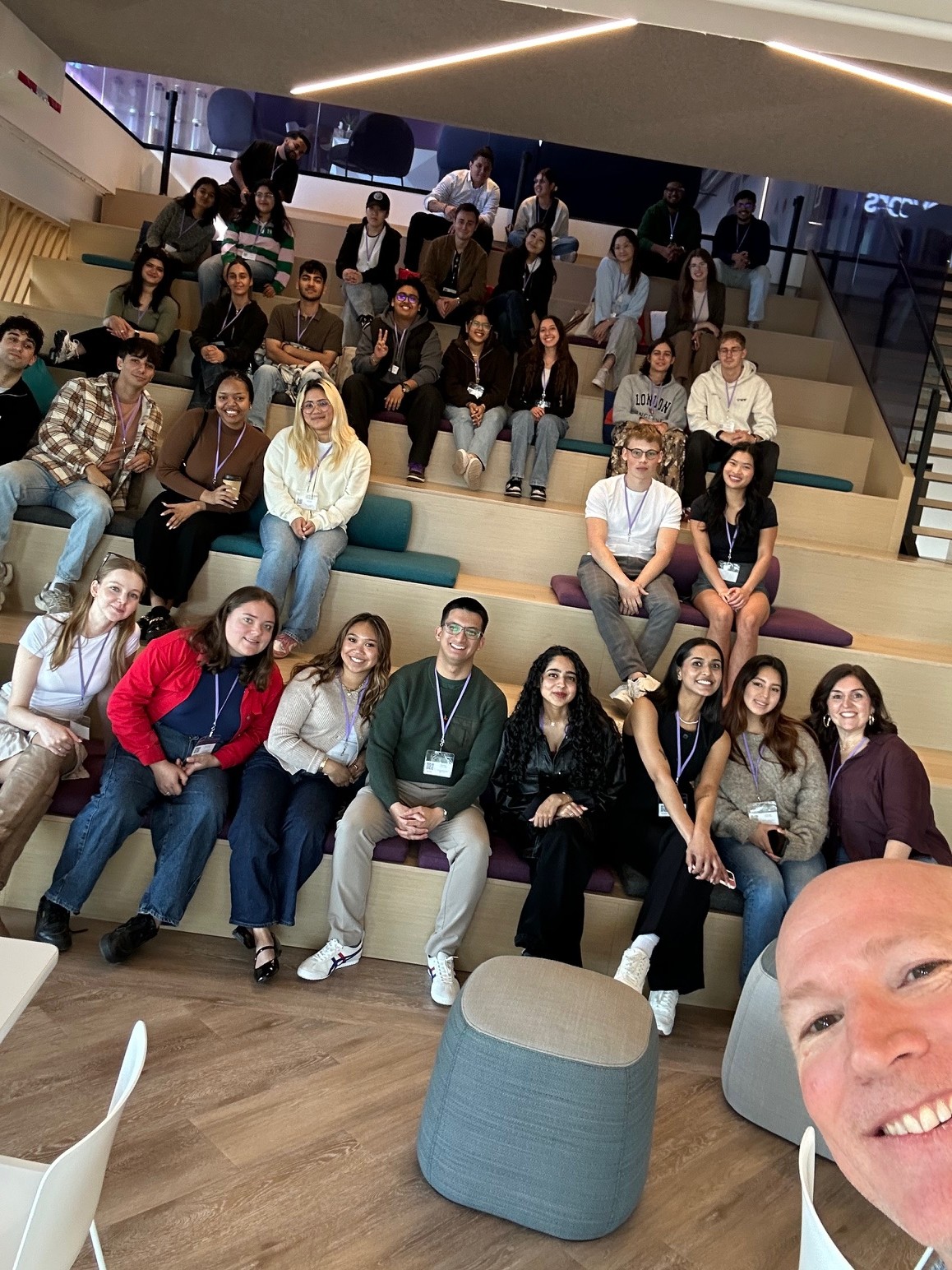
In October 2025, a Humber Polytechnic product management class visited Achievers' Toronto office. Fudge hosted the group and walked students through the platform. He organized the discussion around three pillars: productivity, engagement, and recognition. Students heard the argument that recognition has business consequences, then discussed how AI might help personalize the experience without sanding away the human part.
The scene is a tidy summary of his career. A former product manager explains a software platform. A former sales leader frames business value. A customer-success operator links features to outcomes. A teacher makes the system legible. A coach keeps the human being in view. Then everyone gathers on stepped seating while Fudge leans into the corner of a group selfie, close enough to the lens that the executive hierarchy dissolves into the room.
It is tempting to treat culture as a grand object, something announced at an all-hands meeting and preserved in a deck. Fudge's work points toward a smaller mechanism. Culture travels through repeated signals. A manager notices careful preparation. A peer thanks the person who kept the handoff clean. A team names the behavior it wants to repeat. Each act says: this counted.
There is a marketing lesson inside that mechanism too. Attention is usually discussed as something companies acquire. Fudge's career suggests the other half. Attention is also something leaders give. They give it to customers by listening closely enough to understand an objection. They give it to employees by seeing the work beneath the result. They give it to an organization by making the useful behavior legible.
The work of seeing
Fudge's stated passion is growing people and businesses. At Achievers, that sits beside the company's mission “to change the way the world works.” The phrase is broad. His contribution to it is more concrete: build awareness and demand for a platform that helps organizations notice, understand, and repeat the work they value.
His own path makes the pitch credible without making it tidy. It runs through film products, personal computers, accounting software, payment technology, classrooms, coaching conversations, and HR software. The common thread is the work of translating between a system and the person expected to use it.
Range can look inefficient on a résumé because it resists a single label. In practice, it can make a leader harder to fool. The sales number cannot erase a poor handoff. A clever campaign cannot outrun a weak customer experience. A recognition program cannot create belonging if managers use it mechanically. Fudge has occupied enough seats to see those seams. He keeps the functions distinct while asking each team to understand the promise it owes the next.
That may be the most useful thing to borrow from Chris Fudge. Before asking how to motivate a team, inspect what the team can see. Before announcing a value, find the behavior that proves it. Before praising the outcome, name the quiet contribution that allowed it to happen. Ornate language matters far less than truth, timing, and specificity.
I saw what you did. Here is why it mattered. Five seconds of language can carry a surprising amount of culture.