The first version of Bucketlist was not employee software. It was a consumer place to write down life goals, share them, and watch other people dream in public. According to co-founder Jason Lindstrom, hundreds of people joined each day, then thousands; the network eventually passed one million users. This is the sort of metric that makes founders laminate a chart. It was also pointing at the wrong customer.
Businesses kept arriving with a different request: could Bucketlist help them reward employees with experiences that meant more than a generic plaque? Lindstrom has said he first treated the messages as one-offs. By roughly the tenth request - one came from 1-800-GOT-JUNK? - the pattern was difficult to ignore. In 2015, he and longtime business partner Bart Wisniowski turned the idea into Bucketlist Rewards and Recognition, a Vancouver company selling recognition infrastructure to employers.
A consumer bucket-list network
Big audience, social sharing, plenty of visible activity - but the public record offers no equally clear account of a durable payer.
Employers asked to pay
Repeated inbound requests supplied a buyer, a budget, and a recurring problem: make appreciation consistent across a workforce.
What failed first? Not user growth. The consumer product's weakness was strategic: attention was plentiful, while the sharper commercial pull came from businesses. The useful lesson is less romantic than “follow your passion.” Count unsolicited requests. Notice when they arrive from people with purchasing authority. A pivot can be rational even when the original product looks popular.
01 / The actual productA thank-you note with plumbing
Bucketlist's everyday interaction is deliberately small. An employee chooses a person or team, writes what happened and why it mattered, attaches a company value, and can add points. The recognition lands in a social-style feed where coworkers may react and comment. Managers can boost praise. Administrators can see who gives recognition, who receives it, which teams participate, and whether the program reaches beyond the same familiar stars.
Around that loop sits the enterprise machinery: automated birthdays and service anniversaries; nomination programs; safety, training, performance, and referral awards; approval rules; budgets; audit logs; mobile apps; single sign-on; and employee-data synchronization. Slack, Microsoft Teams, Gmail, Outlook, HR systems, and frontline tools bring the action closer to where work already happens. External Recognition goes one step further, letting patients, customers, or vendors submit appreciation through a link or QR code without creating an account.
Clicks, not a committee
Bucketlist markets recognition as a four-step act. That speed is not decorative. Praise has a half-life: the annual review is a poor delivery vehicle for Tuesday's quiet rescue.
Points move into a localized marketplace of gift cards, physical goods, donations, experiences, swag, and employer-created rewards. The latter can be the memorable ones: extra paid time off, lunch with a leader, local merchandise, or an experience peculiar to the team. Bucketlist currently advertises thousands of global reward choices; the exact catalog varies by region and currency.
“Some people hardly used Bucketlist last year, and this year they've given out over 100 recognitions.”Anne, UT Federal Credit Union, in a Bucketlist customer case study02 / Who buys it
The farther apart the team, the sharper the problem
The buyer is usually in HR, People, Total Rewards, or operations. The daily users are everyone else. Bucketlist's strongest pitch is to organizations where appreciation does not naturally travel: hospitals with night shifts, nursing groups with dozens of facilities, banks with branches, retailers with store floors, manufacturers, construction crews, field services, and remote companies.
Its public customer material names organizations including RBC, Chick-fil-A, Orlando Magic, First Bank, Home Instead, Lakewood Health System, Ely-Bloomenson Community Hospital, Highlight Technologies, and ClearView Healthcare Management. The company says more than 500 businesses use it; its homepage now also speaks of more than 1,000 HR leaders across frontline industries. Those are company-reported scales, not an audited customer count.
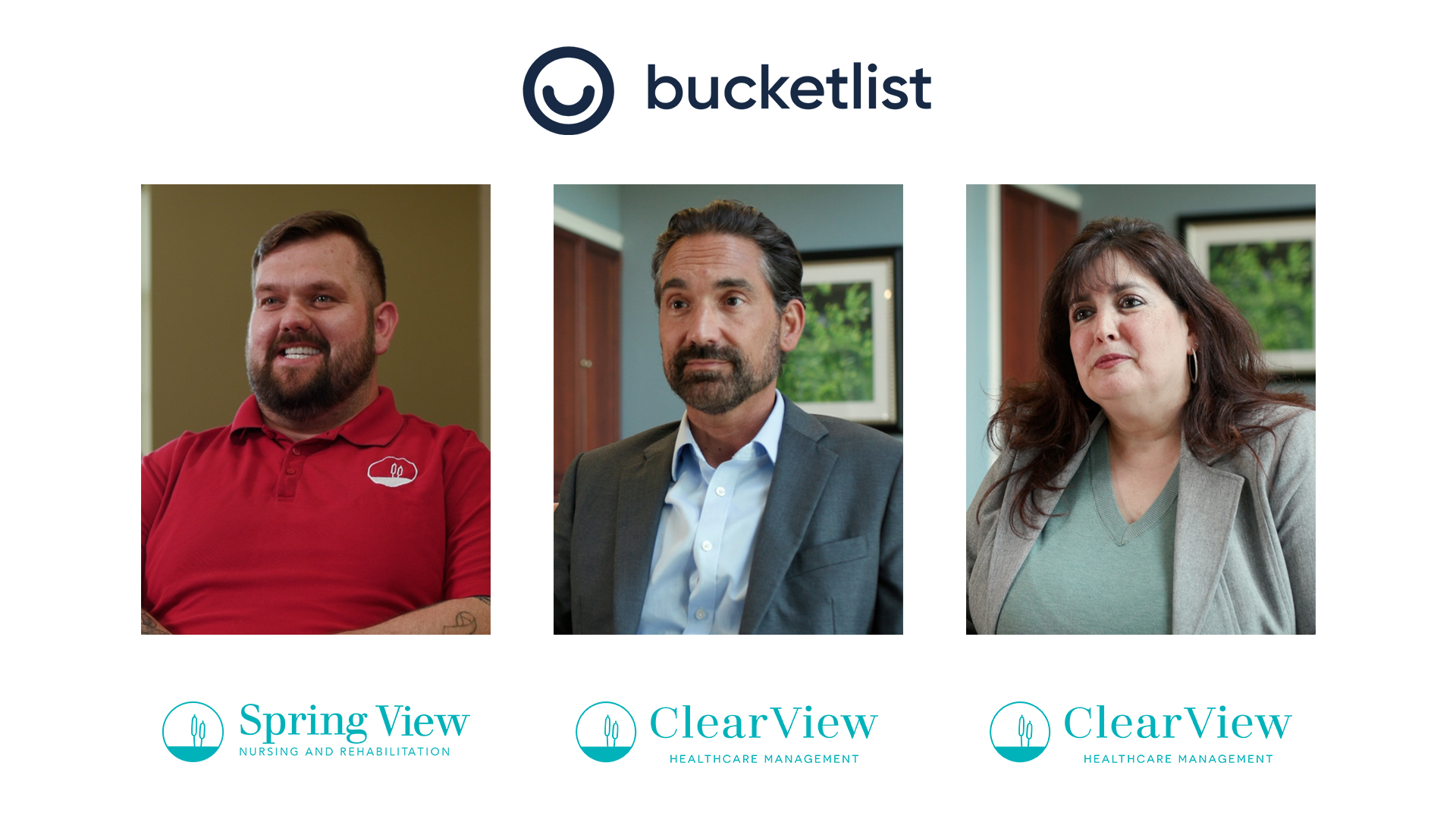
ClearView offers the cleanest explanation of what people can do with the product. The operator runs 34 nursing and rehabilitation centers. After COVID-era workforce losses, it piloted Bucketlist at one site, saw participation rise, and expanded. A nursing assistant could thank a nurse from a phone; a dietary aide could recognize someone covering a shift; the company could tailor awards to resident care, emergency teamwork, and deficiency-free surveys.
One-year signals at ClearView
Customer-reported changes after rollout; these are associated outcomes, not proof that software alone caused them.
The reported first-year changes were a 20 percent increase in retention, an 18 percent reduction in overtime costs, and a 50 percent reduction in agency staffing use. Those numbers belong to the customer's broader turnaround, not to a controlled experiment. Still, the rollout method is worth copying: pilot at one facility, remove friction for deskless workers, let peers recognize peers, recruit local leaders, and make categories sound like the work people actually do.
03 / The billWhat it costs - and what the quote hides
Bucketlist does not publish dollar rates. It offers Starter, Professional, and Enterprise configurations and asks buyers to speak with sales. Its public pricing page does explain the mechanics: a one-time setup fee, then an annual subscription calculated from a per-employee monthly rate. Multi-year agreements may receive discounts. Rewards are billed separately at their base cost, such as the face value of a gift card.
Setup
Implementation, configuration, and launch carry a one-time fee.
Subscription
An annual contract based on a per-employee monthly rate; exact rates are quoted.
Reward float
Redemptions draw from a separate funded balance at the reward's base value.
That split is important. Software cost is visible as software cost; reward money remains reward money. Finance pre-funds a rewards float, receives low-balance alerts, and sees redemptions deduct from it. Employer-fulfilled perks such as internal swag or extra PTO do not draw from the same float. Before signing, buyers should ask for the complete rate, setup scope, included integrations, tax handling, unused-balance terms, and a realistic annual reward budget. “Talk to sales” is not a number.
04 / The marketThe catalog is not the moat
Bucketlist competes with Achievers, Awardco, Bonusly, Motivosity, Nectar, Workhuman, Reward Gateway, Guusto, Matter, and the old bundle of spreadsheets, chat messages, gift-card vendors, and HRIS add-ons. Most serious competitors can offer points, milestones, integrations, and plenty of things to buy. A fat catalog is useful, but catalog size is copyable.
Bucketlist's distinction is the combination of customization, frontline access, experience-oriented rewards, program design, and hands-on implementation. Its own customer stories repeatedly emphasize ease, service, and adaptation to local programs. The company is selling less administration to HR and more participation from employees. The measurable object is not happiness itself; it is the trail around happiness - recognitions sent, teams reached, values cited, rewards chosen, and patterns over time.
What a reader can copy without buying the software
- Require praise to name the behavior, not merely the person.
- Attach every recognition to one operating value.
- Give peers a route to recognize peers; do not reserve appreciation for managers.
- Automate predictable dates, but keep everyday messages human.
- Pilot with one willing team and publish good examples.
- Measure recognition coverage: who is never seen, not only who wins.
Bucketlist applies the philosophy internally with unusual literalness. The fully remote company publishes four values - get it done, care for customers and each other, raise the bar, and achieve life goals - and says each employee receives $500 plus a paid day each year to complete something on a personal bucket list. It has been Great Place to Work Certified since 2021 and was named a 2024 University of Victoria Co-op Employer of the Year after hiring 15 students over two years. For a company selling culture, the proof should start at home.

Software cannot outvote a bad manager
Recognition platforms are vulnerable to the problem they are built to solve: insincerity. If every birthday produces the same automated sentence, if points become a substitute for fair pay, or if the boss praises “teamwork” while rewarding exhaustion, the feed turns into payroll with confetti. A slick interface can make a hollow ritual happen faster.
Managers do not model specific, timely recognition.
Frontline staff cannot reliably log in during real work.
Rewards are irrelevant, unavailable, or trivial in a region.
Recognition is asked to conceal problems with pay, workload, safety, or management.
It will also underperform when the program has no owner, the point economy is confusing, budgets are too small to feel meaningful, or leaders treat launch day as the finish line. UT Federal Credit Union worried that its low-value points would take too long to become rewards; the program gained use anyway, but the concern is sound. Recognition can be nonmonetary. A reward system, once introduced, will still be judged as an economy.
The company did not invent gratitude. It operationalized the conditions under which gratitude travels: fast enough to be remembered, specific enough to teach, public enough to spread, flexible enough to fit different workers, and measurable enough to defend in a budget meeting. That is the payoff in the Bucketlist pivot. A million people saying what they wanted to do someday became employers paying to notice what their people did today.