At Exeter, a thank-you could run out of money. Employees using the company’s previous recognition platform had a points allowance. Once it was spent, they could no longer send recognition. A colleague might still have done something worth celebrating. The software’s answer, effectively, was to wait for the budget.
- Fond combines employee praise, redeemable rewards and corporate discounts.
- Its useful distinction: recognition can carry points, or carry no monetary value at all.
- Employers subscribe; employees use the program and choose rewards.
- Reward Gateway acquired Fond in 2023 and now handles its demo inquiries.
A thank-you with an expiry date
“One would have to be very strategic about how their points were disseminated,” said Exeter’s Lareese Pike in Fond’s customer case study. That is an oddly financial way to think about gratitude. Yet it follows perfectly from the design. Put every expression of appreciation behind a payment, and people must decide which colleague deserves the remaining balance.
Exeter wanted recognition with or without money attached. Fond supplied that option, alongside rewards and perks in one place. The case study reported 90% program adoption, roughly 5,000 recognitions a month and about 400 monthly perk redemptions. Those are vendor-reported usage figures, rather than proof that the software caused happier employees or lower turnover. Still, the design problem is clear enough to be useful to anyone managing a team.
Praise should not have to wait for the next budget.The practical lesson from Exeter’s program
Fond’s business sits inside that mundane obstacle. People intend to acknowledge good work. HR teams intend to run thoughtful programs. Between the intention and the employee lie points allowances, catalogs, administration and the easy possibility of doing nothing.
The perk had become too small a promise
Founded in 2012, Fond began as AnyPerk and joined Y Combinator’s winter batch. Taro Fukuyama and Sunny Tsang are the founders listed in YC’s current profile; early launch reporting also identified Atsuhiro Takahashi. The original name put the offer plainly: give employers a way to bring useful perks to their employees.

Discounts have an obvious appeal. They turn an employer’s buying reach into something a worker can use outside the office. But a discount available to everybody cannot tell one person that their contribution was noticed. In April 2015, AnyPerk announced a rewards beta: a manager could write a note, attach credits and send an immediate expression of thanks. Early participants included nWay and Virgin America.
By April 2017, the company was calling itself Fond. Its announcement described expanded recognition capabilities and a free, six-question engagement survey called EngagementIQ. Fukuyama argued that culture could be measured. The company was now selling a way to acknowledge employees and inspect participation, with discounts as one part of the offer.
The name change had taken nine months, according to marketing executive Michael Stapleton’s account. The working group included people from data, business development, sales, product and the founders. Naming specialist Anthony Shore led the renaming; Prophet worked on the identity. Fond was a short word with an emotional meaning. A perks list had acquired a vocabulary for affection.
Three jobs, one platform
Fond belongs in the employee recognition and engagement corner of HR software. Its buyer is the employer, often through HR or a people team. Its everyday users are employees and managers. YC describes the proposition in practical terms: recognize colleagues, redeem rewards, use discounts and measure success, while reducing the time HR spends managing programs.
the work.
a chosen reward.
everyday life cheaper.
The distinctions matter. Recognition identifies an action or achievement. A reward adds something redeemable. A perk offers a discount an employee can choose to use. An employer can deploy the three together without pretending they are interchangeable. A work anniversary and a gym discount make different promises.
Fond’s Android listing shows how the pieces reach employees: send recognition, attach reward points, browse a social feed, like or comment on recognitions, and redeem rewards or discounts. The reward choices include gift cards, experiences, merchandise and charitable donations. Notifications announce new recognition. Employees can save rewards and perks for later.
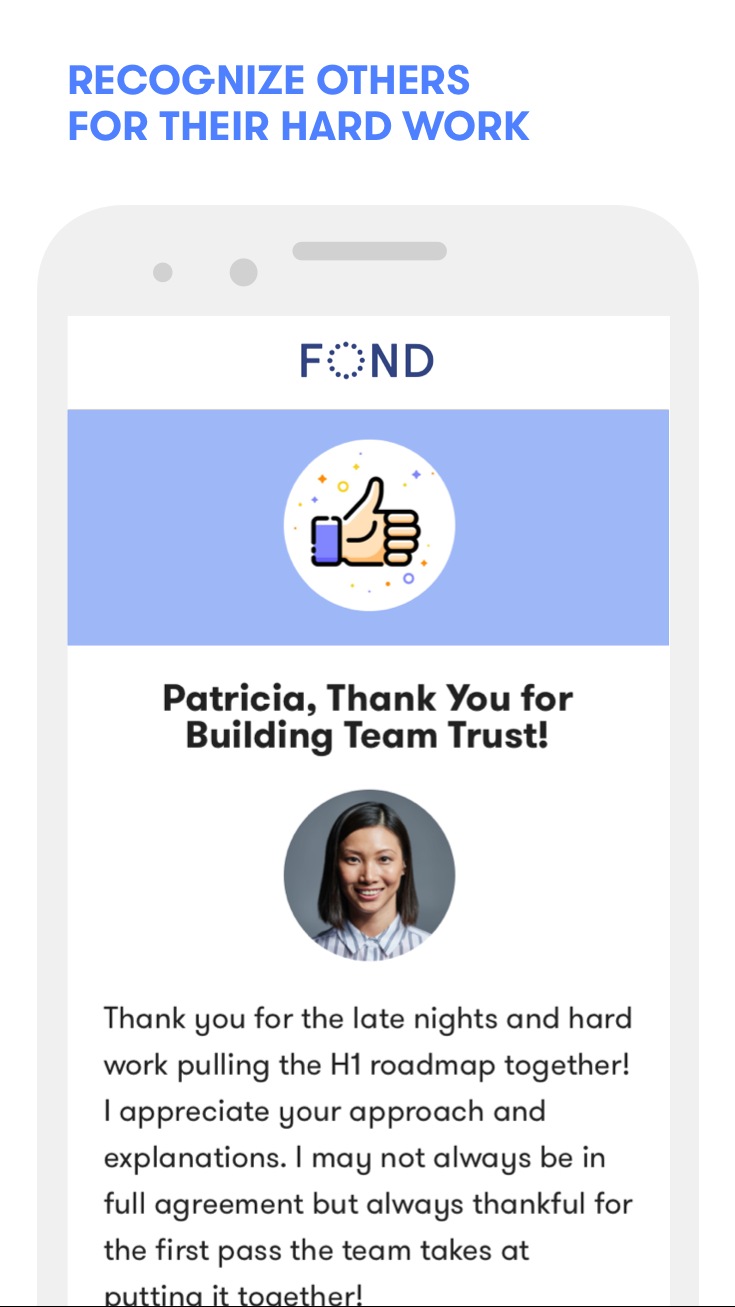
The same listing limits access to employees whose companies have purchased a subscription. This is enterprise software delivered through a familiar consumer interface. It is not an open rewards club that anyone can join. Behind the employee’s feed, administrators need program rules, reward choices and reporting.
The price of making appreciation routine
The economics start with an employer-paid software subscription. Monetary rewards also require a program budget. Buyers should distinguish paying for the platform from funding the gifts: the ability to send a recognition message does not make a gift card free. Fond’s current demo route leads to a Reward Gateway sales conversation, so a purchasing decision belongs with a current proposal.
Building the business required capital, too. AnyPerk announced an $8.5 million Series A in February 2015, led by DCM Ventures with participation from Digital Garage. Its September 2016 announcement described another $11.5 million as Series A-1, with the round having closed that July. The company reported $24.5 million raised in total.
Capital raised to build the business.
Not the cost of an employee program.
The stated priorities were engineering, customer success and expansion of products and services, including mobile technology. Those choices fit a product with two audiences. Employees need easy redemption. Administrators need a program that does not consume their working day. A reward nobody can conveniently claim is an invitation to contact HR.
Choose the reward. Keep the meaning.
Fond’s expertise is the combination of software administration and reward selection. Employers can customize recognition around their goals, while employees choose something relevant to them. The historical brochure described discounts across travel, health, entertainment and shopping. The breadth has a practical purpose: a workforce will contain people with rather different definitions of a treat.
Fond also experimented with that premise internally. In a 2018 essay, Fukuyama described giving employees $300 toward an experience at their two-year anniversary and $1,000 toward a trip at three years. These were established milestone rewards, outside individual department budgets. The arrangement made the occasion predictable while leaving space for personal choice.
A useful comparison is with the manual alternative: selecting gifts, distributing them and fielding questions yourself. Other recognition vendors also offer software and catalogs. Fond’s combination of discounts, monetary rewards and non-monetary praise is therefore a product configuration buyers can evaluate, rather than a claim that nobody else understands appreciation. The important question is how well that configuration serves the actual workforce.
A bigger home for a small word
Reward Gateway acquired Fond in February 2023. The acquisition announcement named Salesforce, Weight Watchers and MAPCO among Fond’s enterprise customers. Fukuyama presented the deal as an opportunity to advance the company’s mission on a global scale. Reward Gateway already offered a broader engagement suite spanning recognition, wellbeing, surveys, benefits and discounts.
Another transaction followed. In May 2023, Edenred announced it was acquiring Reward Gateway for £1.15 billion. That price belonged to the purchase of Reward Gateway. It should not be attached to Fond’s earlier sale. Today Fond’s old homepage redirects to Reward Gateway, and its branded demo landing page invites buyers to request a Reward Gateway demo.
Steal the habit before buying the software
The lesson a manager can copy is small and inexpensive: keep the ability to acknowledge work independent of the ability to fund a reward. Make the message specific. Deliver it while the contribution is still fresh. When there is a gift, let the recipient’s preferences influence the choice. Then check who is participating and who is being overlooked.
These are operating suggestions, not a guarantee of retention. A program depends on people using it with judgment. Unused discounts, confusing redemption or praise confined to a favored circle can weaken the experience. Nor does a public thank-you settle a disagreement about pay or workload. Fond’s contribution is a mechanism for appreciation. The people running it still have to mean what they say.