At Setu, there was already a place to say thank you. The fintech infrastructure company had a thank-you corner in its weekly all-hands meeting. Colleagues could acknowledge the people who had helped them. It was pleasant, familiar and apparently quite serviceable. It also required gratitude to wait for an appointment.
That is the small, revealing problem at the centre of Springworks. Work happens continuously. The systems for acknowledging it, checking it or asking how it feels often operate on a schedule of their own. A colleague fixes a bug on Tuesday; the applause arrives later. A candidate accepts an offer; the paperwork takes its time. Somewhere between the event and the response, momentum leaks away.
- SpringVerify handles employee background checks.
- EngageWith brings recognition and feedback into Slack and Teams.
- Springworks now also promotes Goodfit for AI-assisted hiring.
- The useful idea: shorten the distance between an action and a response.
The thank-you that missed its moment
Setu’s published customer account describes a company that wanted employees to recognize one another without waiting for a meeting or obtaining management approval. It introduced EngageWith at an all-hands, gave people monthly point allowances and connected recognition to company values. The rollout reportedly took less than an hour.
In the first month, more than 75% of users had given at least one recognition, and close to 80% had received one. These are figures from a vendor-published case study, rather than an independent experiment. Still, the mechanism is instructive. Setu did not have to persuade its employees that gratitude was desirable. It gave an existing habit a quicker route.
The distinction matters to anyone buying workplace software. A product can make a willing action easier. Turning an unwilling organization into a generous one is a rather larger commission.
Participation in recognition, not a measured change in retention.
A shorter route from effort to applause
Springworks’ EngageWith lets colleagues send Kudos or Shoutouts, attach company values and award points that recipients can redeem. It also offers pulse surveys, employee Net Promoter Score, celebrations and anonymous feedback. The placement is part of the proposition: these interactions can happen in Slack or Microsoft Teams, alongside the conversations already taking place.
In Arcana’s account, the earlier system consisted of weekly stand-ups, emails and personal chats. Its chief operating officer, Ajay Shetty, said the wider team could miss the context and quickly forget the contribution. Private appreciation had an audience problem. Public recognition made the work legible to more people.
“As everything happens inside Slack, there is no extra effort needed.”Ajay Shetty, COO, Arcana · customer interview
Polygon’s HR manager, Ankita Kumari, described a related benefit: small wins could be recognized immediately, while linking them to values helped explain why the contribution mattered. The result is a kind of practical annotation. Instead of asking employees to admire an abstract principle, the company points to somebody doing something that expresses it.
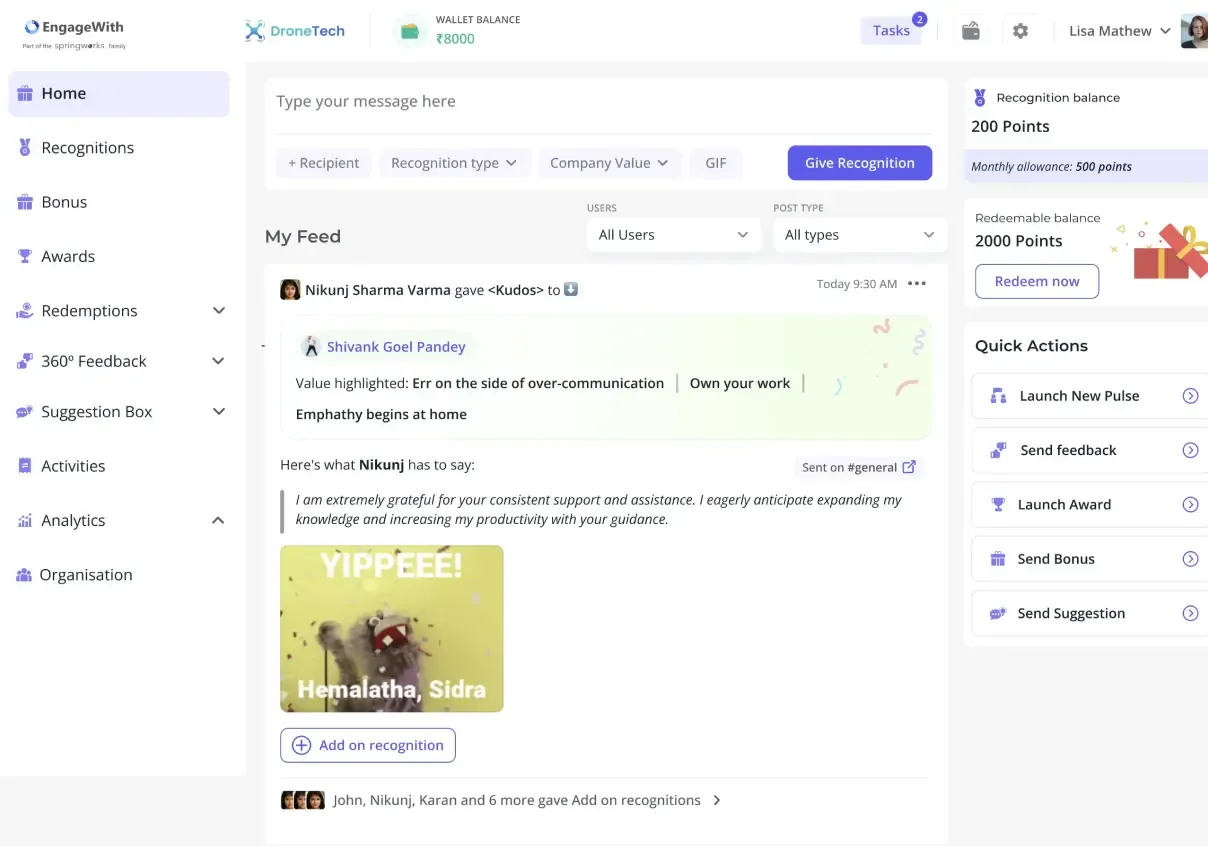
The audience includes HR departments, people managers and founders running distributed teams. Published examples range from fintech to blockchain businesses and consulting firms. Their common problem is less an industry than a distance: between departments, between colleagues, or between an employee’s experience and the person who can improve it.
Before the first day, another queue
The company began in 2014 under founder and CEO Kartik Mandaville. Its earlier SpringRole story concerned verified professional profiles and blockchain-backed attestations. Contemporary 2018 reporting recorded a $1.3 million private token sale. The problem was credibility: how could an employer know that a professional claim deserved belief?

Today, SpringVerify addresses that question through background screening. Its menu includes identity, address, employment, education, court-record and reference checks. Candidate consent and connections to existing HR systems are part of the workflow. Its expertise sits at the intersection of verification operations and software: collecting information, initiating checks and making the process easier for the hiring team to follow.
That explains why a verification service belongs beside a recognition product. One reduces friction before someone joins; the other reduces friction once that person is working. The current Springworks website also promotes Goodfit, which offers AI voice interviews, assessments, proctoring and applicant tracking. Candidates can use phone, WhatsApp or the web, while hiring teams review scorecards.
The change in emphasis is visible. An early professional-profile proposition has become a collection of tools for particular HR tasks. The historical lineup included Trivia for team games and SpringRecruit for applicant tracking. The present homepage leads with SpringVerify, EngageWith and Goodfit. That is a documented change in merchandising; it does not, by itself, establish why every earlier product moved out of the spotlight.
Interviews & assessments
Background checks
Appreciation & feedback
The price of fewer interruptions
Springworks sells to businesses. Its recognition software uses per-user pricing; enterprise buyers are directed to a quote. The India pricing page lists EngageWith Standard at ₹150 per user per month for teams of 36 to 499. For 100 employees, that implies ₹15,000 monthly for the listed subscription, before any applicable extras. A rewards program also needs a deliberate funding policy; the subscription figure alone does not describe its entire budget.
Goodfit advertises ₹100 per assessment credit, a minimum purchase of 200 credits and 20 free assessments to start. Purchased credits do not expire, according to its site. This prices a unit of hiring activity rather than a recruiter’s seat. Buyers should distinguish one assessment from an entire candidate journey: combining several tests can involve several assessments.
EngageWith competes in a recognition market containing Bonusly, Nectar, Empuls and Awardco. Its practical appeal is the combination of appreciation and feedback inside familiar collaboration tools. The less glamorous competitors are formidable too: an existing Slack channel, a spreadsheet, a Google Form, or a manager who reliably notices people.
Leadle’s customer account makes that last comparison concrete. Its HR business partner described the burden of creating forms, chasing replies and collating answers. Moving pulse surveys into the working platform reduced the detour. The interesting benefit was the removal of an administrative chore, rather than the invention of a new question.
A remote promise with receipts
Springworks announced its remote-first future on May 6, 2020. For a company selling ways to connect fragmented teams, this gives its own workplace unusual relevance. It experiences the arrangement its products are intended to support.

The public handbook uploaded in 2023 puts numbers behind the philosophy. It records ₹50,000 for a full-time employee’s home setup, split between joining and six months; a ₹3,000 monthly lifestyle spending account; and a ₹25,000 workation budget. These are dated policy examples, not a promise about every current employment contract.
They make a useful distinction visible. Removing an office does not remove the need for a workable environment. Someone must still pay for equipment, connectivity and opportunities to meet. A culture statement becomes more interesting when it contains an allowance and a process.
Borrow the habit, then choose the tool
The lesson a reader can copy begins before a purchase. Find a useful action that arrives too late. Give it a clear destination. Make it easy to perform at the moment it matters. Explain the contribution being recognized, rather than sending a decorative compliment. For feedback, decide who will respond and what employees will hear afterward.
This approach has conditions. A chat-based recognition program needs people who use the platform and trust the process. A survey needs a manager willing to act on uncomfortable answers. An AI interview needs review criteria and people who can question a scorecard. Faster delivery cannot supply those judgments.
Springworks occupies a practical corner of HR technology: tools that reduce the work required to hire, check, appreciate and listen. Its most persuasive customer stories begin with something modest that was already happening. The company’s opportunity is to make that thing happen sooner, in front of the right people. Gratitude, it turns out, benefits from good distribution.