Five dollars was a convenient amount of money to lose. That was part of Micha Kaufman’s reasoning. A customer could spend it on a coffee, dislike the coffee, and get on with the day. Asking that customer to risk the same amount on a stranger’s skills seemed plausible. Asking the stranger to turn those skills into something worth buying was the more interesting experiment.
In 2010, Kaufman and Shai Wininger launched Fiverr around that proposition. The name did much of the explaining. Years later, Kaufman would call the original price a gimmick. It was an effective one: small enough to encourage a first purchase, specific enough to pass along in a sentence. A business could order a defined piece of work without first conducting a miniature recruitment campaign.
Sixteen years on, Kaufman is still working on the transaction between a person who needs something and a person who knows how to do it. The five-dollar rule has gone. The question has grown more difficult. Software can now produce some of the things people once hired other people to make. The founder who simplified the purchase has to explain the value of the person.
Before the price tag, the lawyer
Kaufman came to entrepreneurship by a route that involved rather more paperwork. He earned a law degree at the University of Haifa and practiced intellectual property law. His work included patents, trademarks, infringement disputes and technology transactions. Before Fiverr, he had already built several technology companies. The apparently simple marketplace followed years of experience trying to turn ideas into businesses.
His family’s journey also appears in his account of how he learned to approach risk. His parents moved from Argentina to Israel; in a 2024 conversation, he discussed their experience as part of his upbringing. The story he tells about becoming a founder is a sequence of decisions and experiments, rather than a childhood revelation with a conveniently chosen destination.
By late 2009, he was discussing new ventures with a group of friends and entrepreneurs. Their informal think tank included Wininger, alcohol and, in Kaufman’s recollection, plenty of nonsense. Wininger brought up the idea that became Fiverr. They finished talking; the idea lingered. For all the subsequent talk of the future of work, the beginning involved people looking for something worthwhile to build together.
There is a useful modesty in that detail. A founding story can acquire the polished inevitability of an airport business book. Kaufman’s version leaves room for an unproductive evening. Even entrepreneurs occasionally need to say something useless before saying something useful.
The awkward business of selling a skill
The practical problem was familiar from his earlier companies: hiring freelance help took effort. A product came with a description and a price. A service often began with a conversation, followed by another conversation about what the first conversation had meant. Fiverr tried putting the description and price in front of the purchase.
“When you build a product, you want people to love it,” Kaufman said in 2017. He was applying product thinking to something stubbornly variable. A freelancer had to make an offer comprehensible to a buyer who might know very little about the work. The platform’s promise depended on making that encounter feel ordinary.
An editorial diagram of the service-as-product idea.
The constraint helped give the idea a shape. Sellers could offer a small unit of a service, then charge for additions. Customers could begin with a manageable commitment. Premium options provided a way to spend more when more work was required. A neat price had given the marketplace its entrance; the service itself needed room to expand.
By 2017, Fiverr Pro was part of the conversation. In a marketplace interview published in 2026, Kaufman acknowledged how difficult it had been to move beyond five dollars once that amount was embedded in the brand. A catchy name is an economical marketing employee. It is also remarkably reluctant to accept a new assignment.
“When you build a product, you want people to love it.”
Micha Kaufman · 2017
A balcony full of freelancers
On June 13, 2019, Fiverr reached the New York Stock Exchange. The ticker was FVRR. The celebration included freelancers, bringing some of the people doing the work into the room where the marketplace’s ownership was being sold to investors. It was a public-company milestone with a group of independent businesses in the picture.
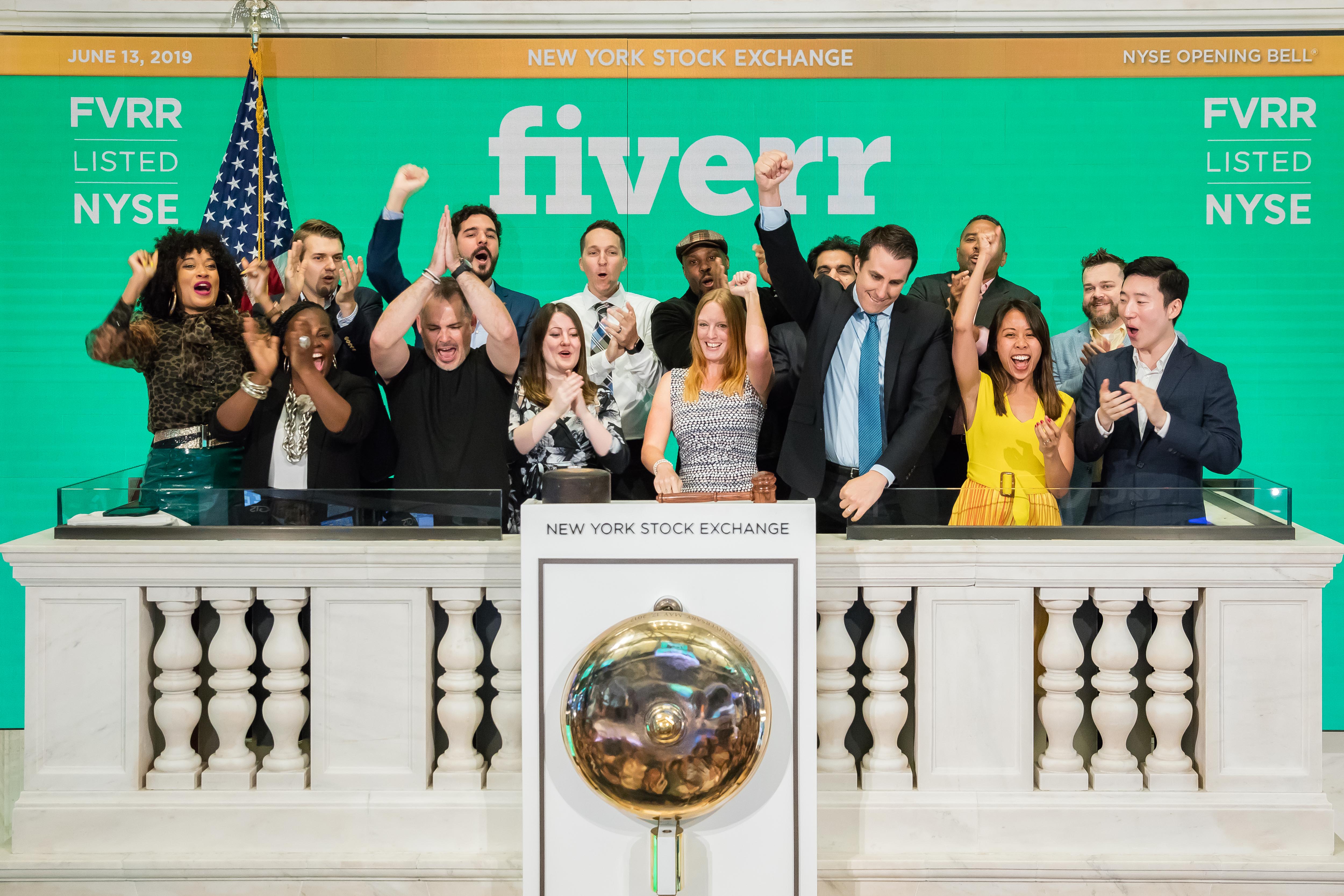
For someone selling creative work, a public listing was hardly the only milestone that mattered. A first customer, a repeat order or the ability to charge more could change the business taking place on the other side of the screen. Fiverr’s corporate progress depended on those smaller acts of confidence continuing to happen.
In February 2020, Kaufman’s tenth-anniversary letter supplied another measure of the platform’s life: freelancers had earned more than a billion dollars helping over 5.5 million businesses. Those were cumulative figures, recorded at that anniversary. They gave the five-dollar origin a different scale without requiring anyone to pretend that every freelancer had shared equally in the proceeds.
earned by freelancers on the platform
That letter was warmer than the public remarks that would later make Kaufman conspicuous in the AI debate. He wrote about people working across borders and building businesses with skills they could suddenly reach. The aspiration was geographical as much as technological: a buyer and a capable person should be able to find each other without sharing an office or a country.
The patent lawyer meets the machine
Artificial intelligence brought an uncomfortable new participant into that arrangement. Kaufman’s legal background gives the change a particular edge. His earlier profession dealt with ownership of ideas and inventions. His marketplace depended on people being paid for what they could create. Generative tools made both subjects harder to discuss in a single reassuring sentence.
In August 2023, he publicly backed the principle that human authorship mattered for copyright protection, supporting a US ruling concerning work generated without human involvement. His argument placed human contribution at the center of creative value. The position also spoke to a commercial concern: buyers commissioning work needed to understand the role of the person delivering it.
Fiverr Go, introduced in February 2025, gave that argument a product form. At launch, its personal creation models were designed to train on an individual creator’s own work. Creators could configure their models, set prices and retain ownership. A separate assistant used a freelancer’s previous interactions and preferences to help handle customer communication and routine business tasks.
“We built Fiverr Go to ensure creators remain at the center of the creative economy,” Kaufman said. The promise placed the freelancer in charge of an automated extension of the business. It also raised a demanding practical question: would using these tools help someone sell more valuable work, or simply make more output available?
Startup mode has a headcount
Kaufman’s public language became sharper during 2025. In conversations about AI, he argued that professionals needed to take responsibility for learning new tools. His June appearance with Harry Stebbings made little attempt to soften the message. Adaptation was an expectation. So was using automation to find more valuable ways to spend a working day.
His own organization was subject to the same argument. On September 15, Fiverr announced a restructuring affecting approximately 250 employees. Kaufman wanted fewer management layers, a smaller team and an infrastructure built around AI. He described the change as a return to startup mode. The phrase had a concrete consequence for people whose jobs were being removed.
That decision belongs beside the language about opportunity. The platform offers people a way to sell their work; the company operating it also seeks to do more with fewer employees. Both are part of Kaufman’s record. A profile that kept only the uplifting half would make the business easier to admire and harder to understand.
By December, he was describing a broader ambition: a system that could help businesses coordinate complex projects as well as find individual specialists. He discussed output per unit of time and quality per unit of output as measures of AI’s usefulness. The vocabulary was becoming less about a tiny transaction and more about organizing the work around it.
The next price is harder to name
The July 2026 results showed the strain. Second-quarter revenue was $97.8 million, down 10% from a year earlier. At the same time, clients completing projects of at least $1,000 increased 13% on a trailing-twelve-month basis. Fiverr was losing ground in routine transactions while finding some progress in larger assignments. Kaufman described the repositioning as a process that would take several quarters.
Quarterly revenue
Q2 2026 versus Q2 2025
Clients completing $1,000+ projects
Trailing twelve months, year over year
Different measures and periods. Together, they show the pressure behind the move toward larger work.
That leaves his original idea in an unfamiliar position. Making services easy to purchase once meant reducing a job to a clearly described offer. More complex work requires coordination, judgment and someone willing to be accountable for the result. The transaction can remain simple for the buyer even when the work behind it becomes considerably less so.
Kaufman has spent much of his career trying to make another person’s ability legible to a customer. First came a small price, then room for larger services, then a public company, and now a marketplace being reshaped by machines that can perform some of its tasks. The coffee-sized risk has become a larger wager on what human expertise will be worth.
The next chapter depends on the people who have to make that proposition work: the customer with an unfinished project, the freelancer assembling an offer, and the founder still trying to make the two meet. Five dollars was a wonderfully concise opening line. The rest of the conversation has taken sixteen years.
Keep the conversation going
KAUFMAN ONLINE
READ & WATCH
- The early idea, in Kaufman’s words · 2019
- Watch: The Startup Playbook conversation · 2024
- Watch: Kaufman with Harry Stebbings · 2025
- The ambition for more complex work · December 2025
- The September 2025 company update
- Fiverr’s second-quarter 2026 results
- Kaufman’s tenth-anniversary letter · 2020
- The launch of Fiverr Go · 2025
- Risk, virality and the ideas before Fiverr · 2024
- A conversation about packaging services · 2017
- Kaufman’s statement on human authorship · 2023