Four Morgan State University students arrived at Propel Center’s national AI competition with an idea about a familiar college problem: talking to other people can be hard. Their answer, SocialSense AI, was a prototype designed to help users practice communication and understand social interactions. In April 2026, the team won the challenge in Austin and a $35,000 grand prize. The students had something more persuasive than an interest in technology. They had work to show.
That is a useful place to begin with Propel, an Atlanta-based education initiative serving Historically Black Colleges and Universities. Its language can run large: innovation, economic equity, the future of work. Its most legible activities are smaller and more concrete. Assemble a team. Learn the tools. Build a project. Explain it to someone who might one day employ you.
For colleges, the proposition is shared access to resources and professional networks. For students, it is a chance to try on a career before committing to it. For employers, it is an introduction to people whose ability may be much easier to recognize in a demonstration than in a stack of applications.
A national stage for a student idea
The 2026 Future of Tech Innovation Challenge attracted roughly 1,100 applicants across 89 HBCUs. Seventy finalists representing 17 institutions reached the national showcase, held April 15-17. The announced pool of scholarships and prizes totaled $125,000. Those numbers describe a selective opportunity within a much wider invitation; they should not be mistaken for 1,100 completed projects or job offers.
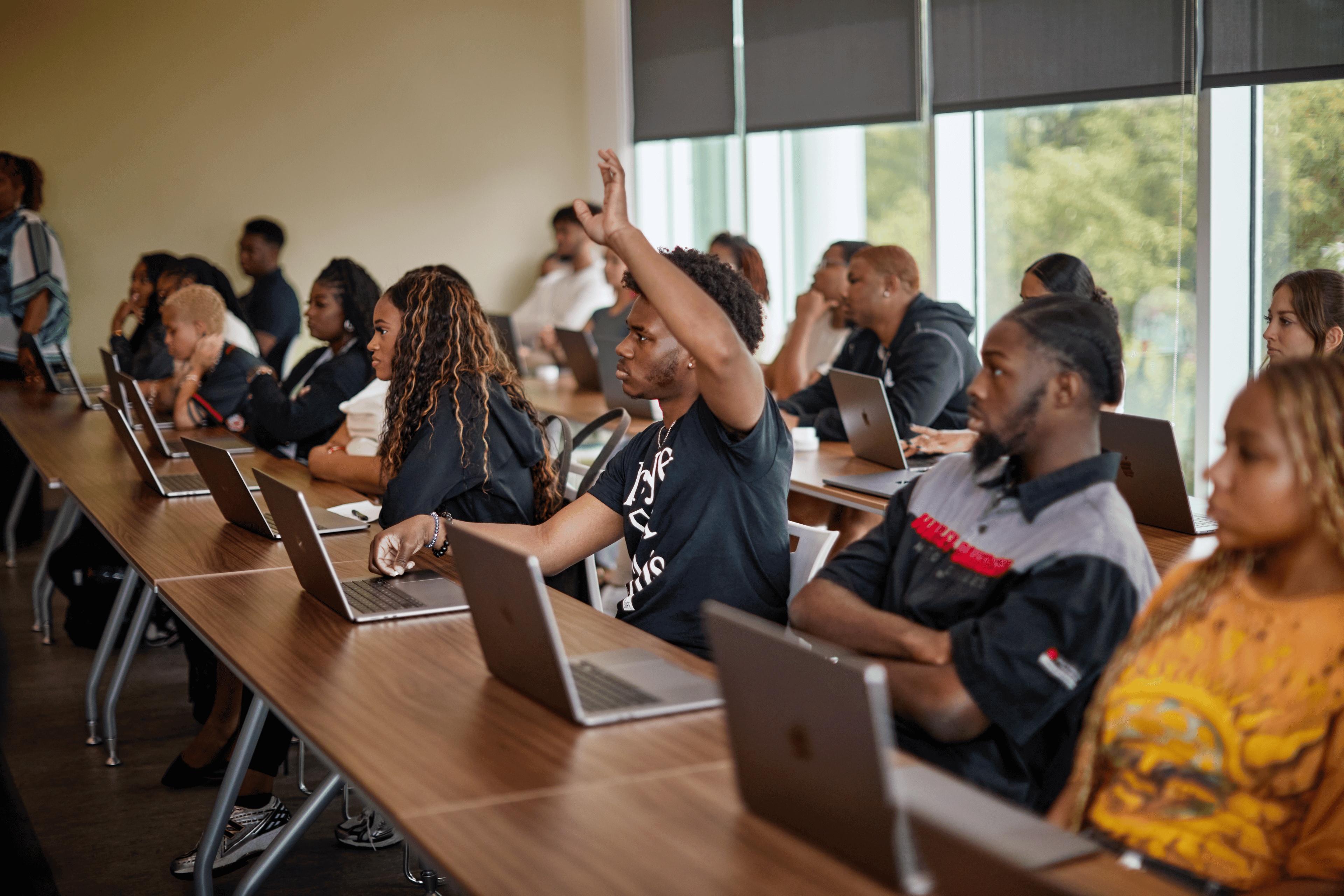
The entry format made room for students outside computer science. Teams of three to five from the same HBCU took short lessons in AI, storytelling and problem-solving, then developed a concept using Apple products. A pitch deck and short video made the idea presentable. The application page explicitly said coding was not required. A good problem, clearly explained, could be the starting point.
Morgan State’s HAX Lab team went further, developing a working prototype. Its SocialSense AI concept used an Apple-device environment and an on-device approach to sensitive information. The university described the project as intended to help people build confidence in social situations. It was a student competition entry, with ambitions that extend beyond the contest.
Team member Fikewa Akindolire told interviewers that taking a product from idea through prototype and pitch reinforced her interest in product management. That is a particularly useful outcome of an applied program: discovering which part of the work you want to keep doing. A prize celebrates one afternoon. A clearer career choice can shape the years after it.
The $50 million opening move
Propel’s roots lie in Ed Farm, the education organization associated with founder Anthony Oni. Propel dates the original concept to 2019 and its formal launch to January 2021. Apple and the Southern Company Foundation each committed $25 million. The money backed a plan spanning digital learning, activity at participating HBCUs and a proposed physical center in Atlanta.
These were philanthropic commitments. Reading them as a venture-capital round would give the enterprise the wrong financial storyline. Propel’s public proposition is to support education and career access. Its beneficiaries are students and faculty; its corporate collaborators supply money, expertise and relationships. A scholarship is support for a learner, not sales revenue.
Two founding commitments. $50 million combined.
Funding pledged at launch, not an annual operating budget.
Apple’s initial role included helping develop curricula, mentoring and creating internship opportunities. Southern Company connected the undertaking to its support for HBCUs and workforce preparation. The design treated the colleges as a network: resources developed with one set of partners could become useful to students spread across many institutions.
That network explains why the word “Center” can be misleading if it conjures only a building. Propel’s story also unfolds on partner campuses, in online courses and at industry workplaces. Its own timeline records $3 million in institutional impact grants in 2021 and a digital app launch in 2023. The education work has multiple addresses.
Homework with a recording session attached
The arts accelerator supplies a vivid example. In summer 2024, 50 students from 19 HBCUs took part in a ten-day immersion at Tennessee State University and Clark Atlanta University. In Nashville, they encountered professionals at Apple Music and worked on creative projects with a commercial brief.
Teams had to record a single, devise a marketing plan, shoot a visual campaign and pitch the package to industry judges. That assignment forced different ambitions into the same room. A singer needed collaborators who understood presentation, images and audiences. The finished song depended on decisions that a listener might never notice.
“Subject-matter experts are everything along this journey,” Lisa Herring, then Propel’s president, said in Apple’s account of the program. The relevant detail is proximity. Students could ask practitioners about the work while attempting it themselves. A question asked during production is likely to be more specific than one asked at a general career panel.
“Subject-matter experts are everything along this journey.”Lisa Herring / then Propel president / 2024
There is a lesson here for any organization commissioning student work: make the assignment substantial enough to require cooperation. A project with creative, technical and commercial components lets participants discover both their strengths and their dependencies. It also gives mentors something concrete to discuss. “Improve this pitch” is a more usable instruction than “be ready for industry.”
The professor is part of the product
Propel also invests in the people who will teach the next class. In July 2024, it celebrated 37 participants in its HBCU Faculty Fellows Academy, representing 25 institutions. Their year-long program covered teaching practice, leadership, Apple technology and learning through challenges. A concluding showcase in Austin gave faculty a place to demonstrate their plans.
The program reported that all fellows had expanded their professional networks and were preparing to integrate Apple technology into their classrooms. Those are participant reports and intentions. Their practical significance is the chance to carry new methods back to a campus, where a professor can use and refine them with successive groups of students.
Cheyney University’s account of biology professor Ezekiel Crenshaw’s later fellowship makes the institutional logic tangible. It describes opportunities to combine science, technology and creativity and exchange teaching approaches with colleagues. The university is already home to the students and their courses. A visiting program can add resources without asking that institution to stop being itself.
For a smaller campus, the model has an obvious attraction: share the cost and effort of connecting faculty with outside expertise. Its usefulness still depends on local time, equipment and curricular room. A teaching idea has to survive the ordinary demands of a semester before it becomes a durable improvement.
From digital courses to industry-specific work
PROPEL Learn launched in August 2023. Propel’s current student page directs learners to PROPEL U, described as its online learning and micro-credentialing platform. Alongside that digital offer sit applied programs in fields including cybersecurity and health technology. The structure gives students several possible entry points, depending on their interests and the programs available.
- LearnCourses and micro-credentials
- MakeChallenges and team projects
- MeetMentors and industry audiences
In April 2024, Propel and Southern Company announced an HBCU Cybersecurity Consortium. Its purpose was to connect academia, industry and government and help education remain responsive to the skills cybersecurity work requires. That is a different task from simply recording another lecture: it asks organizations to keep talking as the subject changes.
Disney joined in 2022 as a lead sponsor across arts, media, entertainment and hospitality. Its announced contributions included curriculum development, guest speakers, mentors and internship placements. The initial emphasis on technology and hospitality was revealing. An entertainment company needs people who make the machinery and service experience work, as well as people who appear on screen.
Entrepreneurship gets its own treatment. In 2024, Propel introduced a course featuring Tawan Davis, CEO and founding partner of the Steinbridge Group. Students participated in a filmed discussion with Davis, faculty and Propel leadership. The format connected a business subject to an actual operator, giving learners a person to question as well as material to study.
Access is the offer. Outcomes are the test.
Propel reports engagement with 80 percent of HBCUs, more than 7,000 micro-credentials and badges earned, and over $5 million in grants, scholarships and learning support. These figures establish activity and reach. A credential count is a different measure from the number of individual learners, and neither automatically measures a career result.
Within the education market, Propel overlaps with campus career centers, employer internships and online course providers. Its distinctive combination is an HBCU focus, institutional collaboration and industry involvement in the learning itself. The attraction is strongest for someone who wants to connect academic knowledge to a project, a practitioner or a particular field.
The approach asks something of every participant. Students need time to complete the work. Faculty need room to adapt it. Corporate partners need to contribute working expertise. If those contributions shrink, the experience becomes thinner. A course can introduce a subject; sustained practice and useful feedback determine how far a learner can take it.
The part others can copy is the assignment design: recruit an industry collaborator, set a clear brief, teach the necessary tools and give students an audience for the result. Propel’s winning AI team and its music-making cohorts show why that sequence is worth examining. Students leave with something specific to explain when the next person asks, “What can you do?”
Step into the program
Explore student opportunities, faculty programs and the Propel newsroom. Follow LinkedIn, X, Instagram or Facebook.
Watch the 2024 arts accelerator recap or Lisa Herring’s 2024 interview with theGrio. Read Morgan State’s winning-team story and Apple’s account of the Nashville immersion. Start at the Propel website for current opportunities.