Before Thumbtack could make it easier to hire anybody, Marco Zappacosta had to buy a word. His girlfriend, now his wife, had suggested the name. The owner of thumbtack.com wanted $40,000. They negotiated it down to $35,000, which still seemed an alarming amount to spend on a business that had yet to prove much of anything. So they arranged installments, with interest. Even the company’s name had a payment plan.
There is something pleasingly domestic about that beginning. The future chief executive of a home services marketplace was already confronting a familiar homeowner’s problem: a desirable thing, an uncomfortable price, and the need to work out a practical arrangement. The grand vision would have to coexist with the bill.
Thumbtack began in 2008. By April 2026, the company described a network of 300,000 local service businesses and more than 15 million five-star projects. Zappacosta was still its co-founder and CEO. Yet the business was announcing another redesign of how people find help. Eighteen years is a long time to spend making an introduction. It is also enough time to discover how much an introduction contains.
A household with a different clock
Zappacosta grew up in Silicon Valley, with entrepreneurship available for inspection at close range. His father, Pierluigi Zappacosta, co-founded Logitech. His mother was on its early founding team and later became a founding engineering leader at another startup. Building a company was something his parents actually did, with all the work that the phrase tends to conceal.
The inheritance he emphasizes is a sense of duration. His father spent 20 years building and running Logitech; his mother spent 17 years at another startup. Those examples gave him permission to try, and a realistic calendar. In a culture fond of sudden arrivals, he had watched the years before the arrival.
He graduated from Columbia in 2007 with a political science degree. During college he worked on Students for Saving Social Security, alongside future co-founder Jonathan Swanson. Pension reform is an unusual extracurricular interest. It does, however, suggest an early appetite for problems whose solution will take longer than a semester.
The two discovered that they liked creating an organization more than operating within Washington’s constraints. Technology offered them a way to build something and see whether people wanted it. The question became what to build. They chose a complaint so ordinary that it can disappear into the wallpaper: why should finding someone to fix the house require so much work?
“Our homeowners and the pros we serve couldn’t care less who my parents are or what they taught me.”
Marco Zappacosta
The first customer needed a customer
Buying things online had become convenient. Hiring local help still meant finding names, making calls, repeating the same explanation and hoping someone was available. An online directory could make the list longer without making the afternoon shorter. A plumber’s telephone number is useful. It leaves a remarkable amount of plumbing administration to the person with the broken sink.
The founders faced a more immediate difficulty. Professionals needed customers; customers needed professionals. A new marketplace had neither. Thumbtack offered pros a free tool for creating a profile and republishing it on Craigslist, complete with pictures and reviews. A business owner could get something useful before Thumbtack had delivered a single customer.
That small bargain mattered. People signed up because the tool helped them with work they were already doing. Their profiles, in turn, gave Thumbtack material that could attract search traffic. The company could begin making the connections it had originally promised. Before it could assemble a marketplace, it had to earn a place in someone’s working day.
Early company life was suitably improvised. The team worked from his brother’s house. Shared meals became part of the culture; later, employees sat down to lunches prepared by a professional chef. The continuity is telling. A business devoted to finding skilled people also discovered the practical advantages of hiring someone who could cook.
Forty-two noes, then a harder yes
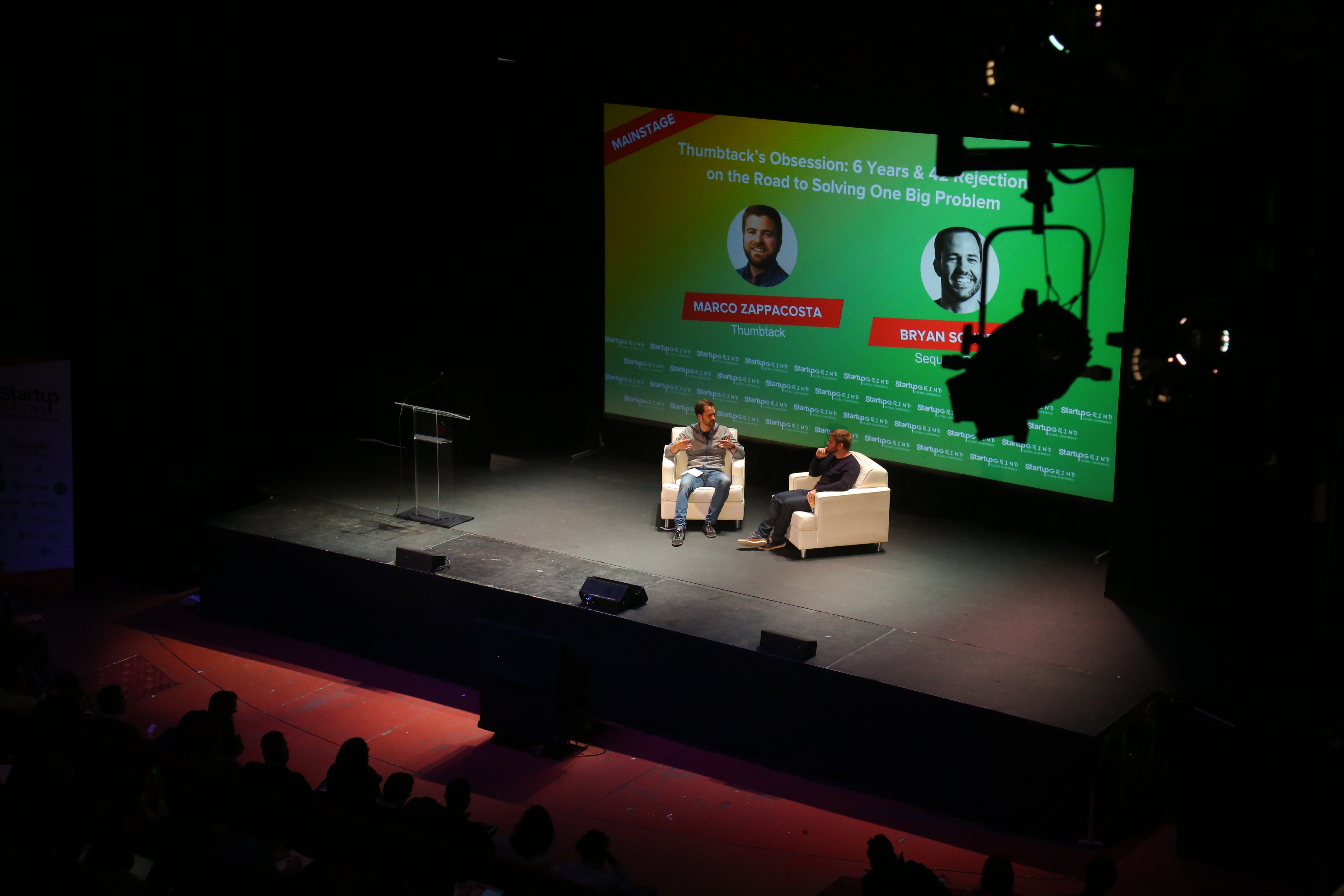
Fundraising supplied its own education. Zappacosta has described receiving 42 rejections while trying to raise the company’s Series A. The figure is memorable because rejection usually arrives individually, in an email or a meeting. Forty-two turns it into a routine. Believing in the company had become a task that had to be performed again tomorrow.
There were practical problems beneath the drama. Thumbtack needed to demonstrate that it could make money. It tried different ways of charging, including a subscription model. In the lean period, only three members of a ten-person team were earning a real salary. Zappacosta’s account of leadership during that stretch centers on telling people what was happening, including the parts he could not explain.
He later compared the fundraising climate to the weather. The point was to dress for the conditions and get on with serving customers. He also learned that the pitch which persuaded an angel investor would not necessarily satisfy the next round’s investors. Each audience was asking the business to prove something different.
One of his earliest hiring stories has rather less ceremony. He met the first hire on a rafting trip. The person was absorbed by the company’s mission and kept showing up. However carefully a business eventually writes its recruiting procedures, its beginnings can depend on a conversation far from an interview room.
When the working version became the problem
By early 2017, Thumbtack had a service people used, and a reason to worry about it. Customers submitted requests and waited for professionals to send quotes. Pros had to read and respond to those requests individually. The model carried useful information, but also delay and repeated effort. Growth had made the limitations more consequential.
Zappacosta backed a move toward automated matching. Professionals would specify their preferences and the system would do more of the introductory work. This asked them to trust software with decisions they had previously made themselves. A faster experience for the customer required a different relationship with the person paying for the introduction.
Looking back, he said the company should have been clearer internally about the size and uncertainty of the transition. That admission gives the story its friction. Persistence could not mean defending every existing method. He had to keep the original purpose in view while accepting that the product built to serve it needed changing.
The financial scale eventually changed too. In June 2021, Thumbtack announced a $275 million investment at a $3.2 billion valuation. Such numbers make a convenient stopping point for a startup story. They offered resources for the next stage of home management. They could not, by themselves, tell a homeowner which professional to invite through the door.
- 2008A company forms around finding local help.
- 2017A push to automate the matching process.
- 2026AI guidance starts with the homeowner’s problem.
A hiring company learns to hire
Zappacosta’s own job changed as Thumbtack grew. He had started the business straight out of college, without a previous full-time company role to use as a model. Recruiting experienced executives meant assessing people whose professional specialties he had never practiced. Confidence alone was a poor instrument for that work.
His response became quite specific. Define the few abilities the job really requires. Separate judgments about skill from judgments about fit. Ask people who have worked with the candidate what the person can actually do. An elaborate job description can promise a fictional employee; a focused one forces the hiring manager to choose what matters.
He has also spoken about sharing the board deck with employees. There is a consistent preference here for giving people enough information to form their own judgments. Asked which employee virtue was underrated, he chose independence of thought. A colleague who disagrees can be useful precisely because the founder would not have reached that conclusion alone.
For all the organizational machinery, his public anecdotes retain a modest scale. His favorite personal Thumbtack project was a Halloween party with a bartender, magician and photographer hired through the service. A marketplace can be discussed in terms of acquisition costs and matching systems. It can also be tested by whether the party has someone making drinks.
“Independence of thought.”
His choice for an underrated employee virtue
The question before the search
The 2026 version of the problem begins earlier. A homeowner may see a stain, hear a noise or notice a crack without knowing what kind of professional to hire. Search assumes that the person asking already possesses the right vocabulary. Houses are not obliged to explain themselves in useful keywords.
On April 30, Thumbtack announced nationwide testing of an AI-powered experience built around text, photos and voice. The proposed sequence was to understand the issue, clarify the project and explain which pros suited it. A week earlier, the company had announced an integration allowing U.S. Claude users to find, compare and hire local professionals within the assistant.
Zappacosta’s public argument about AI leaves considerable room for people. He sees an opportunity to support small businesses that are still struggling with basic digital marketing and administration. His long-standing interest is in the skilled professional doing varied work in the physical world. Better software could make that person easier to find and easier to do business with.
His desired destination is surprisingly grammatical. He wants Thumbtack to become a verb. He remembers hearing someone at a wedding recommend that a neighbor “Thumbtack it.” After years spent building a business, a casual phrase at dinner supplied its own measure of progress.
There is a useful severity to that ambition. A valuation is announced; a habit has to be earned. Every new homeowner arrives with a fresh uncertainty, and every professional has preferences the system must understand. Zappacosta has spent much of his adult life trying to shorten that distance. The successful shortcut would be the one people can recommend without giving it a second thought.