A brown stain appears on the ceiling. The homeowner knows this is bad, but not which flavor of bad. Is it a roofer’s problem, a plumber’s problem, an HVAC problem, or the lingering ghost of last week’s rain? Search engines are most useful after you know what to ask. Houses, with their pipes hidden in walls and moods tied to the weather, are not always so cooperative.
Thumbtack has spent more than fifteen years organizing the people who might answer that question. Founded in San Francisco in 2008, the company built a two-sided marketplace where customers describe a job and local professionals compete for the work. The old promise was practical: instead of calling names from a directory and leaving five voicemails, compare profiles, prices, reviews, availability, and messages in one place.
Now Thumbtack wants to move one step earlier. Its new AI-powered experience lets a homeowner begin with ordinary evidence - a sentence, a photo, or a voice note. The system asks follow-up questions, helps define the scope, identifies the right kind of specialist, explains why certain pros fit, and keeps conversations and project details together. In early testing, the company says 87 percent of customers found photo or voice input valuable. A wider rollout is planned during 2026.
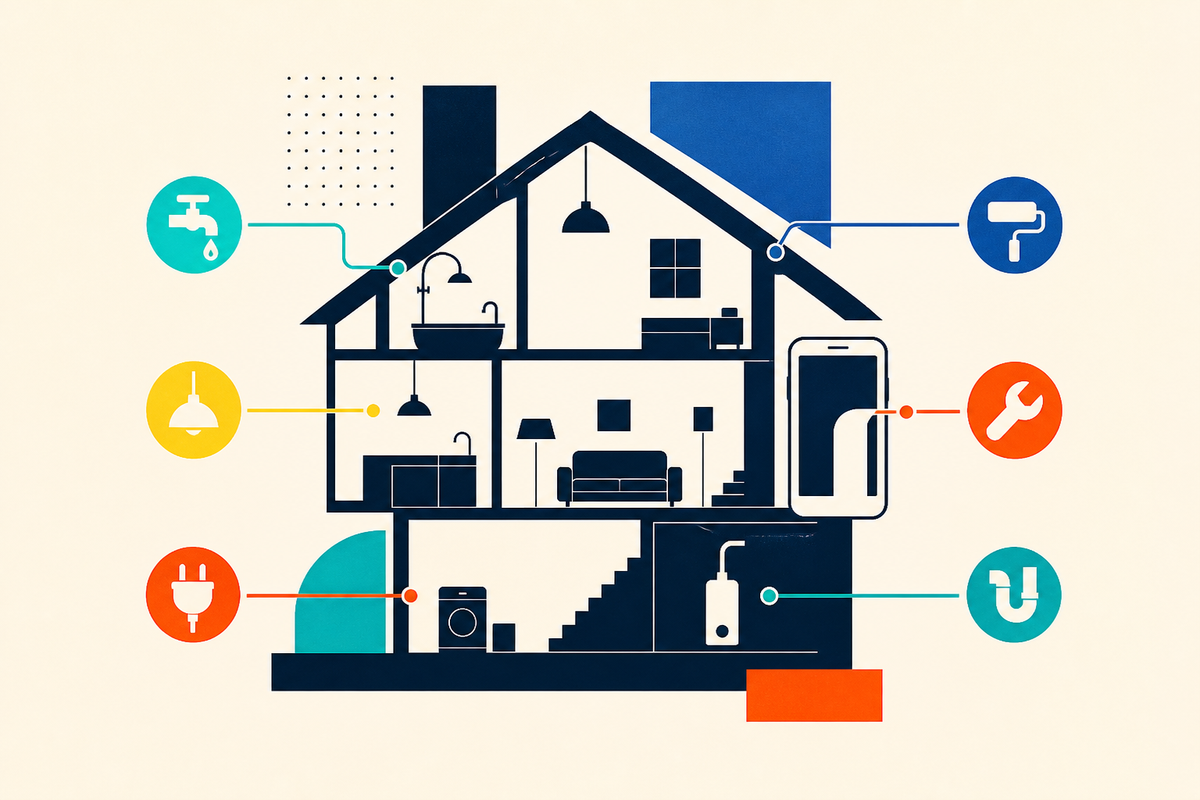
The marketplace behind the drywall
For homeowners, Thumbtack is a shopping and project-management layer for local services. A user can request house cleaning, electrical work, lawn care, moving help, appliance repair, painting, roofing, or hundreds of other jobs. The platform structures the request, surfaces suitable professionals, displays reviews and business details, supports messaging, and, in eligible categories, offers near-immediate booking.
The supply side is a population of independent operators and small service companies. Thumbtack says roughly 300,000 local service businesses participate and that its reach extends to every U.S. county. These professionals build profiles, set job and geographic preferences, manage inquiries, quote work, and track performance. Products such as Pro tools, software integrations, a partner marketplace, and the Front Desk concierge are meant to help a busy contractor respond while standing on a ladder rather than at a laptop.
That breadth matters because local services are not one market. A $90 cleaning and a five-figure roof replacement share a house but little else: different sales cycles, licenses, urgency, margins, and degrees of ambiguity. Thumbtack’s expertise is the translation layer. It turns a consumer’s messy description into structured demand, then ranks supply using location, specialty, schedule, price signals, reviews, and what it has learned from years of project requests.
The valuable query is not always “find a plumber.” Sometimes it is “why is the ceiling changing color?”
How the money changes hands
A homeowner can generally browse, compare, and contact pros without paying Thumbtack an upfront marketplace fee. The professional usually pays for the introduction. Lead prices vary with the kind of work, location, competition, and estimated value. That gives small businesses access to demand without committing to a large advertising campaign, and it lets Thumbtack earn revenue before every project’s final invoice is known.
It also creates the company’s central tension. A lead is not a job. Several professionals may pay for contact with the same customer; the customer may delay, disappear, change the scope, or hire someone else. For a well-run business, a flow of matched demand can become a reliable acquisition channel. For a pro with thin margins or weak conversion, the same flow can feel like a meter running during a rain delay.
The homeowner wants certainty
Clear scope, credible reviews, responsive pros, useful cost context, and a fast route from worry to booked work.
The pro wants return
Customers who are ready, reachable, correctly matched, and valuable enough to justify the price of the introduction.
Thumbtack’s product work can be read as an attempt to improve both sides of that equation. Better intake should produce a clearer job. Better matching should reduce wasted leads. Instant Book compresses the path to a confirmed project. A project hub keeps information from scattering across texts and voicemails. None of those features can make every customer serious or every estimate accurate, but they aim at the marketplace’s most expensive leak: mismatched intent.
From errand board to home habit
Early Thumbtack was delightfully indiscriminate. Its 2010 announcement mentioned plumbers, wedding officiants, dance teachers, and “glamour horse photography.” Later, the marketplace stretched across more than 1,000 categories. The current company is more focused. Its public language centers on fixing, maintaining, and improving the home, a market it sizes at roughly $600 billion in the United States.
The narrowing is strategic. Homeownership produces repeat demand: filters need changing, gutters fill, paint fades, appliances fail, and a minor drip acquires ambition. The 2020 acquisition of home-management startup Setter added maintenance planning. Thumbtack later introduced seasonal guides, project recommendations, cost information, membership features, and on-demand booking. In 2024 it said Instant Book covered more than 100 categories and that a major app update added 30 features.
The business in three layers
This changes the competitive map. Angi and HomeAdvisor pursue home-service demand; TaskRabbit is associated with shorter, task-like labor; Yelp and Google Local Services dominate broad discovery; Porch and Houzz live near home projects; and the oldest competitor remains a neighbor’s recommendation. Thumbtack’s distinction is not a single feature but a connected sequence: structured intake, real-time matching, professional availability, reviews, messaging, booking, and a growing memory of the home.
The moat is a better question
By 2017, Thumbtack said its matching work drew on roughly 25 million customer requests and years of information about what professionals were qualified, available, and interested in doing. That data is difficult to reproduce because it is local and conditional. The same repair can carry different prices, schedules, and supply in Phoenix and Philadelphia. A directory knows who exists. A marketplace tries to know who is ready for this job now.
Partnerships extend that engine beyond Thumbtack’s own app. Nextdoor placed pros into neighborhood discovery. Neighborly connected franchise locations to demand. GoSite brought Thumbtack inquiries into small-business software. MyMove and parent Red Ventures embedded access to pros during the chaotic weeks around an address change. Zillow and Thumbtack have repeatedly combined housing and project data to calculate the “hidden” costs of ownership - estimated at $15,979 annually in their 2025 analysis, including maintenance, insurance, and property taxes.
The company has capital for the experiment. Its 2021 round raised $275 million at a $3.2 billion valuation. In 2024, Thumbtack announced $75 million in debt financing from Silicon Valley Bank and Hercules Capital. It also disclosed that 2023 revenue had passed $300 million, EBITDA was profitable, home-segment revenue grew 30 percent, and gross margin exceeded 90 percent. As a private company, it offers less financial visibility than a public marketplace; the last confirmed valuation remains the 2021 figure.
- 01Own the uncertainty. The earlier Thumbtack can help define a problem, the less likely the customer is to leave for a generic search.
- 02Make the introduction worth buying. Better scope and intent improve the economics for the professional who funds the marketplace.
- 03Remember the asset. A history of the home can turn emergency discovery into recurring, preventive care.
Where the bet could break
Trust cannot be automated into existence. Reviews can be incomplete, licensing requirements differ by state and trade, and the person arriving at the door is still an independent business, not a Thumbtack employee. Homeowners must check credentials, insurance, written estimates, and project-specific requirements. Professionals, meanwhile, must watch acquisition cost and conversion rather than mistaking a crowded inbox for revenue.
AI adds another obligation: know when not to diagnose. A photograph can help route a project, but it cannot see behind drywall, test a circuit, smell gas, or certify structural safety. The strongest version of Thumbtack’s new product is not an oracle. It is a calm triage nurse for the house - gathering symptoms, recognizing urgency, and sending the case to someone qualified.
That is also why the strategy is interesting. The winner in home services may not be the company with the longest directory. It may be the one that asks the best first questions, earns enough trust to hold a homeowner’s history, and delivers jobs that local businesses are glad they paid to meet. A good result must work twice: the repair has to feel right to the owner, and the introduction has to make economic sense to the person carrying the toolbox. Thumbtack has the network and the data. Its next test is whether software can feel as reassuring as the name your neighbor writes on the back of an envelope.