Ben Rubenstein remembered the elevator. It was the summer of 2005, and Yodle was selling online advertising door to door. An average early customer spent about $200. Then a hair salon referred the company to a dentist, who agreed to pay $1,200 a month. Rubenstein recalled jumping up and down after the sale. Six ordinary accounts’ worth of spending had arrived in one conversation.
- The customer: local businesses that needed customers but had little time for digital marketing.
- The offer: websites, advertising and customer communication brought into a coordinated service.
- The catch: better advertising economics did not automatically produce better retention.
- The outcome: Web.com acquired Yodle in March 2016 after announcing a $342 million deal.
The dentist in the elevator
The anecdote offers a better introduction to Yodle than a list of features. The founders were learning which businesses could justify paying for help. A customer’s willingness to spend changes the economics of selling, supporting and maintaining an account. The dentist was a clue about where their effort might pay.
The original idea came from Nathaniel Stevens’s work on online marketing for his family’s Connecticut car dealership. Search advertising offered a route to consumers who were already looking. By 2005, Stevens and his collaborators were building a business around bringing that route to other local firms. Wharton professor Kartik Hosanagar joined to help turn labor-intensive service into a repeatable technology platform.
That was the central wager: local businesses would pay someone to translate the internet into work arriving at the door. An owner did not need to become fascinated by keyword auctions. The owner needed to know whether the spending was producing worthwhile inquiries.
A marketing department, sold by the month
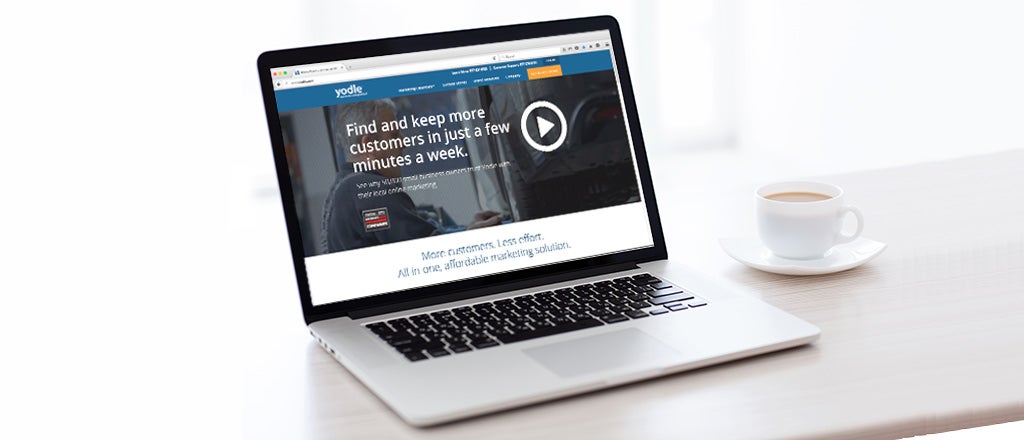
Yodle occupied the space between an advertising agency and a software subscription. Its customers bought access to tools and help getting marketing done. Financial disclosures describe recurring platform fees, managed media budgets, and revenue from setup and website design. The business also sold through resellers.
Marketing Essentials brought together a web presence, ways to turn interest into inquiries, and customer communications. The company’s historical product description included mobile and desktop websites, listings distribution, SEO, reviews, photos, social media management, offers and email marketing. Yodle Ads added managed paid search. The distinction matters: a software subscription and money spent buying advertising are different expenses.
The attraction was coordination. Consider the work implied by each separate tool: keeping the business name and address consistent, publishing a photograph, requesting feedback, preparing an email and checking what an ad produced. Even inexpensive software consumes someone’s attention. Yodle’s proposition was that these chores could share a system.
- 01Get foundWebsites, listings, search ads
- 02Earn an inquiryCalls and website responses
- 03Follow upEmail and appointment messages
- 04Bring people backOffers, reviews, repeat contact
Illustrative workflow, not a measured conversion funnel.
A do-it-yourself stack offered more choices. A local agency could provide bespoke work. Yodle offered a standardized bundle and managed execution. That made it a plausible fit for an owner who valued time saved, provided the service could show useful results. It was a less obvious fit for someone seeking complete creative control.
The review nobody remembered to ask for
Some of the most revealing features were decidedly unglamorous. In March 2014, Yodle introduced review management and photo syndication. Customers could request reviews, host them at RateABiz and publish positive feedback on their websites and Facebook pages. There were also tools for responding to negative reviews.
In the launch announcement, the company said its survey found that only 13% of small businesses asked customers for reviews. That is a company-reported survey finding, rather than a universal measurement. Still, it points to an intelligible problem: a good experience can remain invisible because nobody remembers to request a public account of it.
Automation can make that request routine. It cannot make a dissatisfied customer satisfied. For an owner, the useful distinction is between removing a forgotten task and repairing the underlying experience. A review system helps with the former. Service quality, honest responses and the work itself remain the business’s responsibility.
One brand, a hundred different neighborhoods
Yodle also served organizations whose problems were bigger than a single storefront. Centermark was designed for franchise networks, manufacturers and dealers, and companies operating multiple locations. It connected local marketing with shared reporting and oversight.
The difficulty is easy to recognize. A network wants a consistent brand, but its locations sell in different markets. Headquarters needs to see activity without personally running every campaign. Centermark’s role was to give the network a common way to coordinate and examine local work. The enterprise product grew from the same premise as the small-business offering: fewer disconnected systems.
Lighthouse addressed another kind of repetition. Its practice-automation tools included appointment reminders and patient communication. Here the software reached into the daily operation of a dental practice. A booked appointment has to survive the interval between booking and arrival. Marketing and office administration meet in that interval, however different their job titles sound.
The experiment that did not buy loyalty
The price deserves a date attached. Yodle’s 2014 IPO filing said Marketing Essentials was generally priced below $300 a month. That historical figure was for the platform; advertising required an agreed media budget. It is not a current quote.
The same filing disclosed a telling 2013 experiment. For new customers buying both platform and media, Yodle lowered the platform price and increased advertising budgets, hoping to improve returns and retention. The improvement in retention was insufficient to justify the approach over time. Platform prices went back up in the second half of 2013.
ChangeLower platform fees; more budget for media.
TestWould customers stay at an economically useful rate?
DecisionThe gain was insufficient; increase platform prices again.
For anyone selling a recurring service, the lesson is to specify the result that would justify continuing an experiment. More spending in one part of a bundle can improve the offer while worsening its economics. A friendly reception from customers is insufficient evidence.
The issue survived the acquisition. Web.com’s September 2016 quarterly filing described Yodle’s products as having higher churn than its large domain-subscriber base. Those products had different buying patterns, so the comparison needs that context. Nevertheless, a signed subscription was clearly still something the company had to earn again.
The humans behind the machinery
Automation was made and sold by people working through their own routines. In a 2013 interview, CIO Eric Raab described engineering teams of five to nine people, with weekly releases and demos. He also described a weekly process for reporting successes and obstacles.
“We have each team do a release every week, and they do a demo every week.”
Eric Raab, Yodle CIO, 2013
A designer’s account of a June 2014 hackathon reveals the other side. Sales demonstrations involved a 45-minute PowerPoint, a script in a binder, handwritten notes and objection-handling material taped to cubicle walls. Playing a video meant sending the prospect away from the screen share and guiding them back. The designer’s team built a prototype to bring the demonstration and supporting information together.
It is a wonderfully ordinary detail. A company reducing its customers’ marketing chores had its own coordination problem. Weekly demos and a hackathon prototype are specific evidence of how people tried to improve that work, rather than a reason to invent a sweeping claim about company culture.
What the $342 million bought
Web.com announced the acquisition in February 2016; it closed on March 9. The announced consideration was $342 million, including $300 million due at closing and two later payments. The acquisition announcement reported Yodle’s 2015 revenue at approximately $207.9 million.
$300m at closing + $20m after one year + $22m after two years
The buyer highlighted local marketing, franchise products and office automation. It was buying a route to businesses with recurring marketing needs and a broader portfolio to sell them. The acquisition price was a purchase of the company, not another venture funding round.
The enterprise line took another route. In April 2020, Enterprise Online, previously doing business as Web.com for Enterprise, announced the Enspire for Enterprise brand after its acquisition by Perseus Group, part of Constellation Software. Its announcement identified Centermark as a core platform. Today, Yodle.com redirects to Enspire, whose website still describes Centermark analytics for networks of locations.
Meanwhile, Newfold Digital announced Web.com’s integration into Network Solutions in June 2025. These are distinct developments: the enterprise operation’s rebrand and the later consolidation of the Web.com brand. Yodle’s old products and prices belong to their period.
What can a reader copy? Choose customers whose economics support the service. Connect the tasks that owners otherwise coordinate themselves. Set a financial test for a pricing experiment. For a local business buying help, trace an inquiry through to paid work and separate the platform bill from the advertising budget.
Those lessons have conditions. Advertising needs enough profitable work to cover its cost. Follow-up needs accurate information and someone able to handle the response. A busy business unable to serve another customer may need capacity before more demand. Yodle’s elevator celebration captured the thrill of a sale. The quieter question, every month afterward, was whether the customer had a reason to stay.
Keep exploring
Visit Yodle’s web address, now directing to Enspire, browse its LinkedIn profile, X account and Facebook page, or explore the Yodle video channel.
For a longer conversation, read the Rubenstein and Berkowitz interview and the founders’ Wharton retrospective. Read Enspire’s current services for the enterprise continuation; the Network Solutions blog explains the separate Web.com transition.