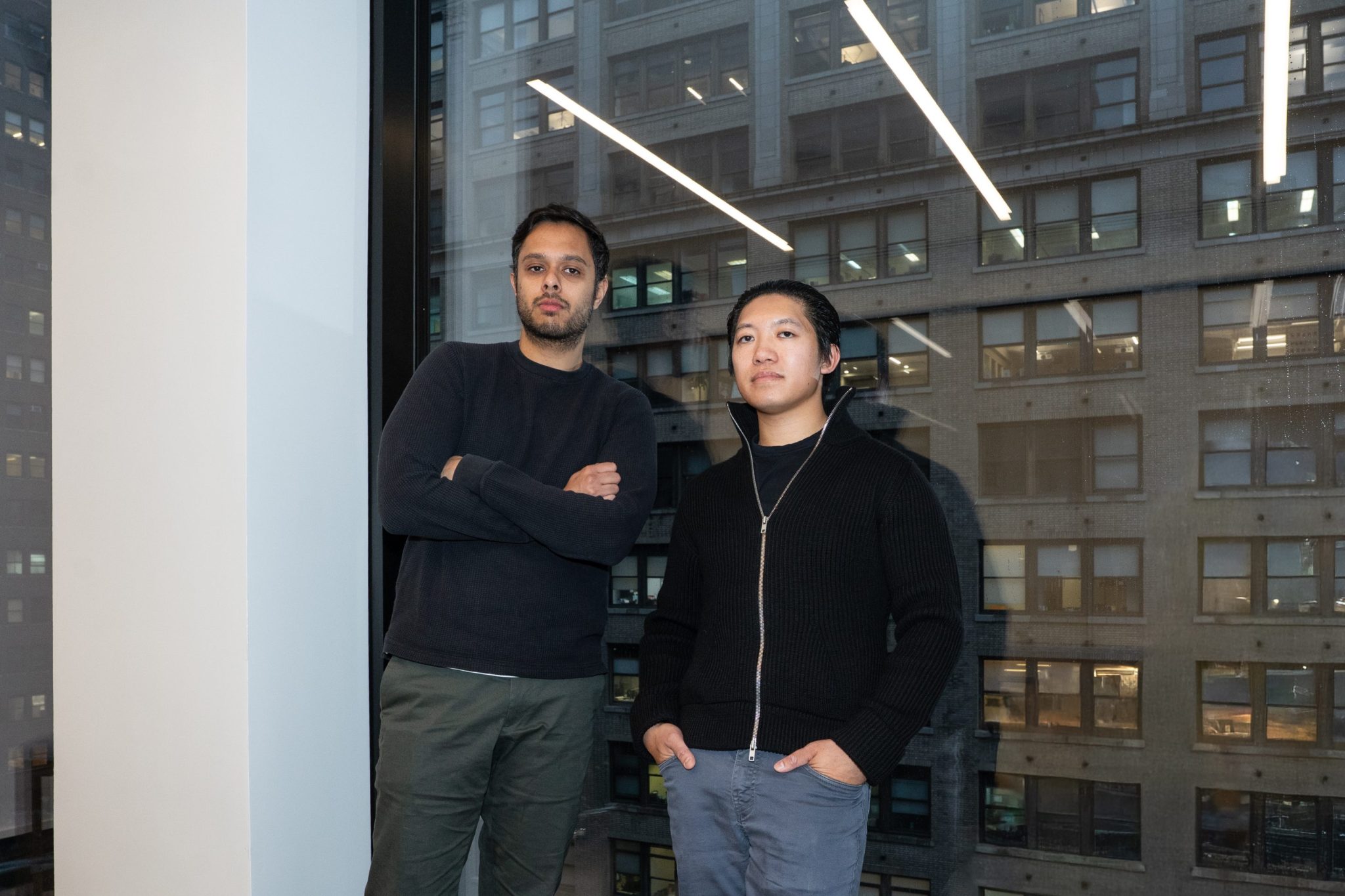
The engineer who decided insurance was a data problem
Anirban Gangopadhyay starts from an unusual premise: that health insurance, fundamentally, is a broken data system. Not a broken product. Not a broken experience. A broken data system - one that was never rebuilt after the fax machine era, one that still delivers 20-page PDF quotes to brokers who parse them by hand. His company, Angle Health, was built to close that gap.
The path to San Francisco's healthcare startup world ran through Washington D.C. - specifically through the U.S. Department of Defense, where Gangopadhyay served as a Stokes Scholar software engineer from 2015 to 2018. The Stokes program is the NSA's pipeline for computer science talent: full tuition funding, summer internships, and a post-graduation service commitment. It trains engineers who can operate at government scale - security-first, systems-first, no room for approximation.
He moved from government infrastructure to enterprise data at Palantir Technologies, where he spent two years as a machine learning engineer working on the kind of large-scale data problems that most engineers only read about. The combination - defense-grade rigor, enterprise ML - set up the founding thesis for Angle Health almost perfectly. What if you applied that same discipline to the administrative chaos of health insurance?
In August 2019, Gangopadhyay co-founded Angle Health with Ty Wang - another Palantir alumnus, who serves as CEO. The pairing is deliberate: Wang leads the market, Gangopadhyay builds the machine. Together they put the company through Y Combinator's Winter 2020 batch, raised a seed round, and began building out a full-stack health insurance carrier targeting the employers that legacy carriers had consistently under-served: startups and small businesses.
We don't believe that an insurance company is going to really solve healthcare. We think that the future of healthcare is a completely redesigned ecosystem that is using AI-first, tech-first products and workflows to really unlock the best care for members.
- Anirban Gangopadhyay, Fortune (Dec 2025)Gangopadhyay was not new to startups when he launched Angle Health. While still at the DoD, he co-founded Zircon Technologies - an AI-enabled clinical trial recruitment platform. Zircon was acquired, giving him an early exit and a first look at what it takes to turn machine learning from research paper into running product. That experience - brief, scrappy, successful - showed up later in Angle Health's technical architecture.
The scale Angle Health has reached since its January 2022 $58 million Series A is striking. By December 2025's $134 million Series B, the company covered 2,600+ small business employers across 44 states, with revenue up 26x from the Series A. The Dec 2025 round, led by Portage (which also led the Series A), included both equity and debt - a structure that signals Angle Health is operating enough like a real insurance carrier to access insurance-grade capital.
Gangopadhyay's technical fingerprints are on the platform's most concrete differentiators. Where a traditional carrier's quoting process involves brokers uploading PDFs, waiting days, and sorting through manually-compiled data - Angle Health quotes thousands of employer groups per week, fully automated. Underwriters and sales staff only touch the decisions that actually require human judgment. Everything else runs on the machine.
What he actually built
Angle Health is not a broker. Not a third-party administrator. It is a licensed insurance carrier - meaning Gangopadhyay's team built both the product and the regulatory infrastructure, from scratch, in a heavily regulated industry. That is an unusual technical challenge and an unusual career choice.
As CTO, Gangopadhyay architected the platform on a modern stack - Python, Django, React, TypeScript - supported by integrations across Cloudflare, Sendgrid, Zendesk, Webflow, HubSpot, and FullStory. The build-out included HRIS integrations, real-time quoting infrastructure, member onboarding flows, and benefits data connectivity layers. Essentially: the software infrastructure that a traditional insurer would have built over 40 years, in about five.
The AI layer is not cosmetic. Gangopadhyay has been explicit about where machine learning is applied: quote generation, underwriting automation, member onboarding optimization, and benefits personalization. The goal is to remove humans from every workflow where human judgment adds no value - and to keep humans only where it does. That sounds obvious. In insurance, it is radical.
Angle Health's platform now handles quoting for thousands of employer groups weekly, spans benefits customization, provider network management, and payroll integration. The addressable market Gangopadhyay is targeting is enormous: 62 million small and mid-sized business employees in the U.S. currently lack access to enterprise-grade health benefits. Angle Health's bet is that AI can close the cost gap that has kept carriers away from that market.
How Gangopadhyay talks about the work
We've been able to very effectively use AI in areas where a human should not be manually administering things that they otherwise would be.Fortune Interview, Dec 2025
We quote thousands of groups a week. In any other company, you're getting quoted these PDFs that are 12, 15, 20 pages long... We've fully automated and optimized that process where our underwriters and our sales people are only doing the pieces that we need a human to be doing.Fortune Interview, Dec 2025
We don't believe that an insurance company is going to really solve healthcare. We think that the future of healthcare is a completely redesigned ecosystem that is using AI-first, tech-first products and workflows to really unlock the best care for members.Fortune Interview, Dec 2025
From classified systems to carrier-level AI
The gap Angle Health is filling
The United States has approximately 62 million employees at small and mid-sized businesses - companies that cannot access the same health benefit plans available to large employers. The reasons are structural: large carriers have no incentive to build the quoting, underwriting, and administrative infrastructure required for smaller groups. The margins are thin, the complexity is high, and the technology investment has never been justified.
Angle Health's argument is that AI inverts this calculus. If quoting can be automated, if onboarding can be streamlined, if member advocacy can be AI-assisted rather than call-center-dependent - then the economics of small business coverage change completely. What was unprofitable at manual scale becomes viable at software scale.
Gangopadhyay has pushed this further than the economics story. His stated aspiration is not to build a better insurance company. It is to make the insurance company model irrelevant - to rebuild the healthcare ecosystem from scratch, with technology at the center rather than the periphery. In December 2025, with $134 million in new capital and 26x revenue growth behind him, the ambition is no longer theoretical.
For investors, Angle Health's position is notable: a Y Combinator-backed, fully licensed insurance carrier with both the technical architecture to scale and the regulatory foundation to operate across 44 states. That combination - venture speed, insurance-grade compliance - is genuinely rare. It reflects the particular resume of its CTO: someone trained to build at government scale and Palantir speed, simultaneously.