Jonathan Amir had an idea to explain and an investor to catch. While studying at the Technion, he approached a Sequoia Capital executive after a student event. The executive was running late and invited him to walk along. Amir began his pitch. They entered an elevator. The executive noticed what had happened and started filming: an elevator pitch, with an actual elevator supplying the deadline. The lobby arrived before Amir’s explanation was finished.
Some business lessons come with a certificate. This one came with opening doors. Amir remembered it as a lesson in brevity, which seems fair. A founder can spend months assembling an idea and still discover that the listener’s available time is measured in floors.
It is an appealing place to begin his story because it gives ambition a comic inconvenience. Here is a student willing to approach an investor, eager to describe what he wants to build, and caught by the literal dimensions of his opportunity. The grand plan has to fit inside an ordinary journey. Eventually, so does the product.
From the mat to the Technion
Before Diagnostic Robotics, there was taekwondo. Amir competed professionally and described training in martial arts from a young age. Sport belongs in his biography as an occupation in its own right, rather than decorative evidence that a founder likes winning. There is a difference between playing with the vocabulary of competition and having spent years competing.
At the Technion - Israel Institute of Technology, his academic path encompassed engineering, computing and economics. Those fields offer different questions to ask of the same undertaking. Can this be built? How does it work? What makes the effort sustainable? Placing them together gives a useful way to understand his subsequent career, without reducing it to a degree followed by a business card.
The university also supplied the connections that became a company. In 2017, Amir co-founded Diagnostic Robotics with Kira Radinsky and Professor Moshe Shoham. Radinsky brought an artificial-intelligence background and experience building SalesPredict, which eBay acquired. Shoham brought robotics expertise and the experience of founding Mazor Robotics. Amir arrived with his own combination of technical study, economics and competitive sport.
Read that founding lineup slowly. It contains expertise accumulated in different settings, at different speeds. A university can be a place to learn a subject; it can also become the place where people discover which parts of a problem they can tackle together. In Amir’s case, the later company makes that second function unusually visible.
The robot leaves the room
The name Diagnostic Robotics preserves an early ambition. The founders originally planned a product that combined software with a physical robot. Later, Amir and Radinsky explained that the physical component created unnecessary complexity. They could deliver their technology through devices that already existed, including phones and tablets.
So the hardware plan gave way to a software approach. The company retained its name, a small linguistic fossil of the first design. There is something pleasingly untidy about that. Business names often suggest that everything was obvious from the beginning. This one records a change of mind.
The decision invites a practical question about invention: which part of an idea deserves loyalty? A physical object is easy to picture and easy to describe. Software working through familiar devices may offer less theater. Yet the thing that first makes an idea vivid can also become the thing that complicates its delivery.
Amir’s team chose to revise the form. That matters more than the tidy word “pivot,” which can make a difficult decision sound like moving a chair. Removing hardware from a hardware-and-software plan changes what the team must build, what it must support and how its work reaches people. The founders themselves connected the change with a wider potential customer base.
There is no need to pretend the discarded concept was foolish. First designs give a team something concrete to examine. The revealing moment comes when people can discuss the design without treating every alteration as a personal defeat. A company has to retain enough conviction to proceed and enough freedom to reconsider its own instructions.
A founder has people to learn from
Amir’s account of starting companies includes conversations with Shai Wininger, co-founder of Fiverr and Lemonade. As a student, Amir met with him to discuss product development and the practical work of building a startup. It is a useful counterweight to the elevator story: some encounters demand compression; others give an idea room to be questioned.
Mentorship can sound vague until the subject becomes a product. Then it has somewhere to land. What should be built first? What makes the design convincing? Where does a user’s willingness to adopt it enter the discussion? These are ordinary questions, and their ordinariness is part of their value. An ambitious proposal still needs answers at this level.
The same is true of the founding partnership. Amir and Radinsky have described collaboration using the image of an orchestra. A conductor depends on other people to produce the sound. The comparison is familiar, but its placement in a founders’ account is telling: it leaves considerable room for the people whose work happens beyond the central figure.
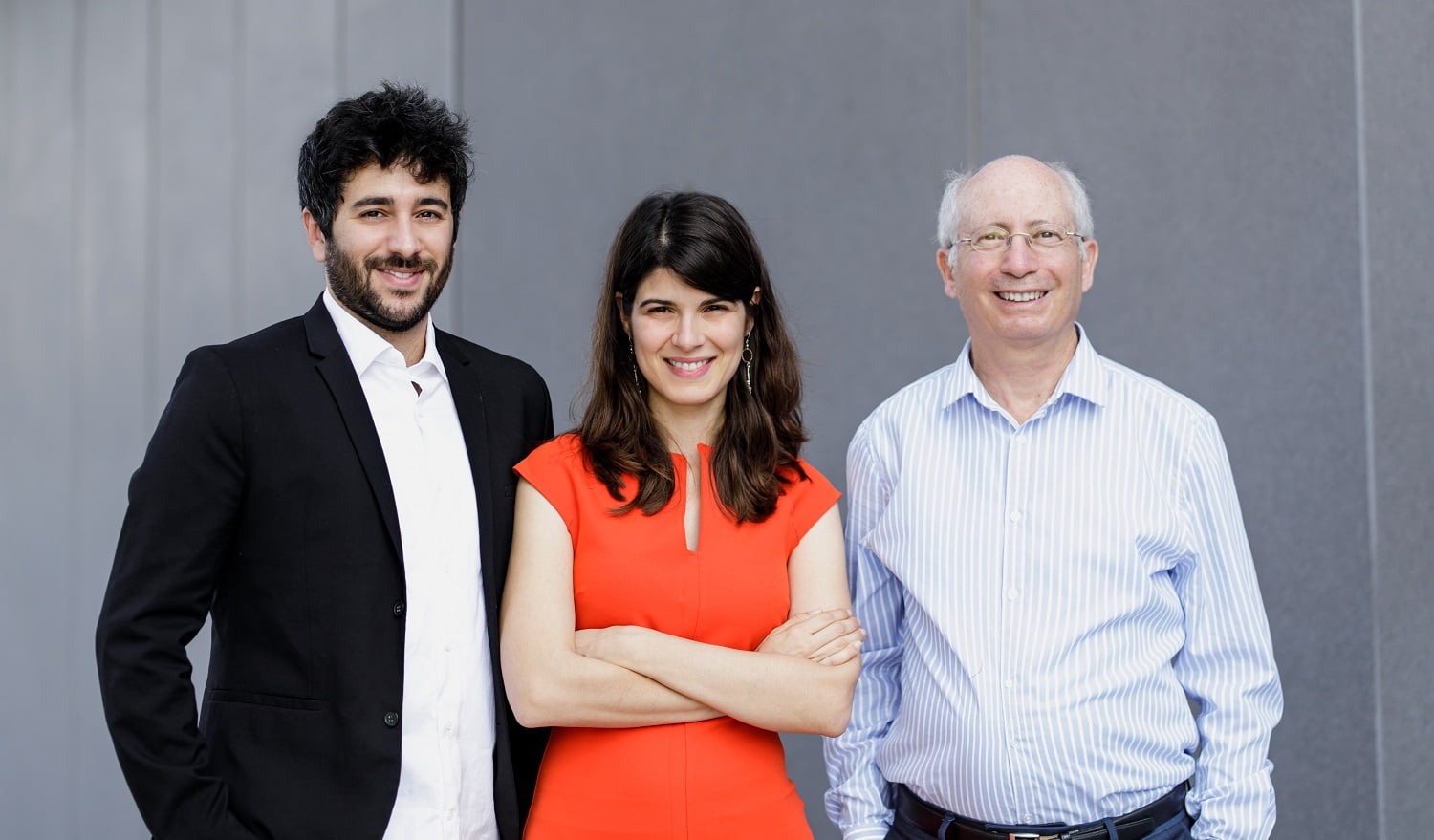
A personal profile naturally pulls attention toward one person. The photograph above resists that pull. Amir stands alongside two colleagues whose histories and expertise belong to the undertaking. A reader can follow his career while keeping the partnership in view. That makes the story more useful than a tale in which every decision somehow originates in a single head.
Nor should the athlete’s background encourage a solitary reading. Competitive sport provides a readily available language of individual effort. Company building introduces dependencies that make the language less sufficient. The work has to continue through other people, with other kinds of knowledge, after the founder has left the meeting.
A different glimpse of Amir came at a Forbes photoshoot on the 60th floor of Sarona Azrieli Tower in Tel Aviv. Wearing a tailored suit, he spoke with entrepreneur Omri Segev Moyal, whom he had met that day. The account describes a shy smile. It is a quieter image than the student pursuing an investor, but it shares the same basic activity: one entrepreneur explaining a company to another.
The setting supplies the height; the conversation supplies the scale. Between the formal photograph and the funding announcement, there are still introductions to make. A founder’s working life includes these exchanges, where a business has to become intelligible to someone who has just arrived.
The title changes; the work continues
In 2019, Amir appeared in Forbes Israel’s 30 Under 30 Tech list. The profile identified him as the company’s founder and CEO. Two years after the founding, his biography had acquired a public recognition and a company substantial enough to attract attention beyond the original circle of collaborators.
That November, Diagnostic Robotics announced $24 million in funding. Reporting at the time identified Amir as CEO and described a team working in Israel and New York. Investors included Accelmed, Maverick Ventures Israel and Alpha Capital, among others. The venture begun at the Technion now had the additional demands of financing and an international operation.
Another announcement arrived in July 2022: a $45 million Series B led by StageOne Ventures. The participating investors included Migdal Insurance, Clal Insurance and Bank Hapoalim. By then, Amir was identified as president, following a move from the CEO role. His public professional profile also uses founder and president.
- 2017Amir, Radinsky and Shoham co-found Diagnostic Robotics.
- 2019Forbes Israel recognition; a reported $24 million funding round.
- 2022A $45 million Series B; Amir is identified as president.
Funding figures describe separate announcements, rather than revenue or personal wealth.
A founding date stays fixed while the jobs around it change. That is one reason a title needs a date attached. “CEO” accurately describes Amir in the earlier reporting; “president” describes him in the later record. Reading them in sequence preserves the movement of the career.
The funding figures supply a different kind of sequence. They locate stages of the company’s development without telling us everything about the organization, much less about the person. A dollar amount is wonderfully compact. It cannot carry the conversations, revisions and decisions that made a company possible. For those, a biography needs smaller details.
A book for the next journey
One such detail appears in Amir’s November 2020 account of his travel plans. He wanted to go to Spain to visit his sister and family. He also looked forward to reading Ray Dalio’s Principles: Life & Work. Vacation offered time for books; management offered reasons to keep reading.
“a successful manager needs to constantly be learning”
Jonathan (Yonatan) Amir, November 2020
The planned reading is worth keeping at its human scale. A book on a future travel list is an intention, with a family visit alongside it. It gives a glimpse of what Amir wanted to make time for beyond the next company task. It also leaves learning open-ended: the person responsible for decisions can still seek ideas about making them.
His story contains several occasions on which the first answer required editing. The pitch needed fewer words. The product needed a different form. The founder’s title changed as the company developed. Taken together, these moments make revision a useful thread through the career.
The elevator remains the funniest example. Its doors did the editing automatically. In a company, the doors are less obliging. People must decide for themselves when an explanation has become too long, a design too cumbersome or a familiar approach too expensive to preserve. Amir’s biography earns its interest in those decisions, where ambition encounters something specific enough to change it.