Kira Radinsky was stuck in a computer game. She and her aunt had tried the riddle five or six times and still could not get to the next stage. Her aunt proposed a change of tactics: write a little program to solve it. They did. Radinsky later remembered that she liked computer science from that point on. The game had accidentally supplied a second game, with rather better prospects for employment.
It is a small origin story for someone whose work would concern large questions. There is no sudden flash of destiny in it. There is a child, a helpful adult and an obstacle that becomes an invitation to make something. The interesting action happens outside the rules the puzzle appeared to offer.
Radinsky grew up with her mother and aunt, women for whom mathematics and computing were familiar work. Her mother taught mathematics and had studied computer science; her aunt worked at Amdocs. In her recollection, even her school computer science class was overwhelmingly female. She encountered the idea of being a minority in technology later. At home, nobody had needed to explain that women could do this. They were doing it.
Three jobs behind the fast track
Born in Kyiv in 1986, Radinsky moved to Israel as a small child and grew up in Nesher, near Haifa. The compressed biography usually hurries from immigration to university. Her account slows it down: her mother worked three jobs to support the family as they rebuilt their lives. An accelerated education rested on some very unaccelerated work.
Radinsky began coding at eight. An after-school programme added physics, chemistry and literature; her other activities included piano, tennis and dance. She also practised karate and earned a black belt. The picture is of a busy child in a household that took learning seriously, rather than a young person who simply materialised with an impressive examination result.
One memory from the move has survived with particular clarity. The family could bring little with them, and she arrived with a toy truck. During the Gulf War, a neighbour and her daughter brought a box of toys to the door. Decades later, Radinsky remembered the marbles in that box. Beside the public story of algorithms sits this private scale of importance: a child, a new country, something to play with.
At 15 she began studying at the Technion. She has recalled being frightened by her age there. Her aunt treated being the youngest as a possible advantage. Encouragement, in this family, could arrive as a practical reinterpretation of the problem.
Teaching yesterday to speak about tomorrow
University did not proceed in one uninterrupted sprint. Radinsky served as a software engineer in Israel’s intelligence forces between 2004 and 2007, then continued her academic work. She earned her computer science doctorate at the Technion in 2012, supervised by Shaul Markovitch. Research at Microsoft brought collaborations with Eric Horvitz and Susan Dumais. There were people around the ideas, as there had been around the childhood computer.
Her subject was time. Web pages change, searches rise and fall, and the information people want today differs from what they wanted yesterday. A search engine has to account for those movements. Radinsky’s work extended the question: could the movements help estimate what would happen next?
Consider the archive as a collection of sequences. An event occurs. Reports describe it. Other events follow. Across many examples, a system can look for recurring relationships, then use knowledge about the world to generalise beyond the exact names and places in its training material. The difficult part is finding a pattern that survives its original setting.
The research came in distinct projects. A 2013 paper with Horvitz examined 22 years of New York Times reporting, spanning 1986 to 2008, alongside web resources. A separate paper with Sagie Davidovich and Markovitch described Pundit, a method drawing on 150 years of news articles to generate plausible consequences of a current event. Different archives, different experiments. The numbers belong to particular pieces of work.
Another project, PROFET, used patterns in search-query history to predict terms likely to appear prominently in forthcoming news, up to a week ahead. A query is an unusually immediate trace of curiosity. The work asked whether those traces, taken together, could provide advance clues about the news people would soon encounter.

A scientist walks into a sales meeting
SalesPredict was founded in 2012 by Radinsky and Yaron Zakai-Or. She became its chief technology officer. The setting changed from global events to the practical decisions of sales teams: which prospective customer to approach, where to spend effort, and which existing relationship might need attention.
In business, uncertainty has a calendar invitation and a quarterly target. A salesperson cannot investigate every possible lead equally. SalesPredict combined a company’s own information with outside data to help prioritise the work. Its approach made the forecast part of a routine decision rather than an interesting result left on a researcher’s desk.
Radinsky’s explanation of the move into entrepreneurship was direct. She wanted to see her ideas implemented in the real world and to take part in implementing them. Academic work and company building could share a purpose, even when their daily chores looked quite different. In a 2013 interview she compared that combination to an Indiana Jones adventure. The fedora was optional; putting the idea to use was central.
Recognition arrived while the company was young. MIT Technology Review included her among its 35 Innovators Under 35 in 2013. Forbes placed her on its 2015 enterprise technology list of 30 Under 30. Such lists make an appealing shorthand. They tell us much less about the ordinary task of persuading someone to change how they work.
The product had to earn that change. Radinsky emphasised explanations for its lead rankings and models that kept updating as conditions changed. A score alone could struggle against an experienced salesperson’s judgment. Showing the reasoning gave the customer something to examine. Software, like a promising colleague, benefits from being able to explain itself.
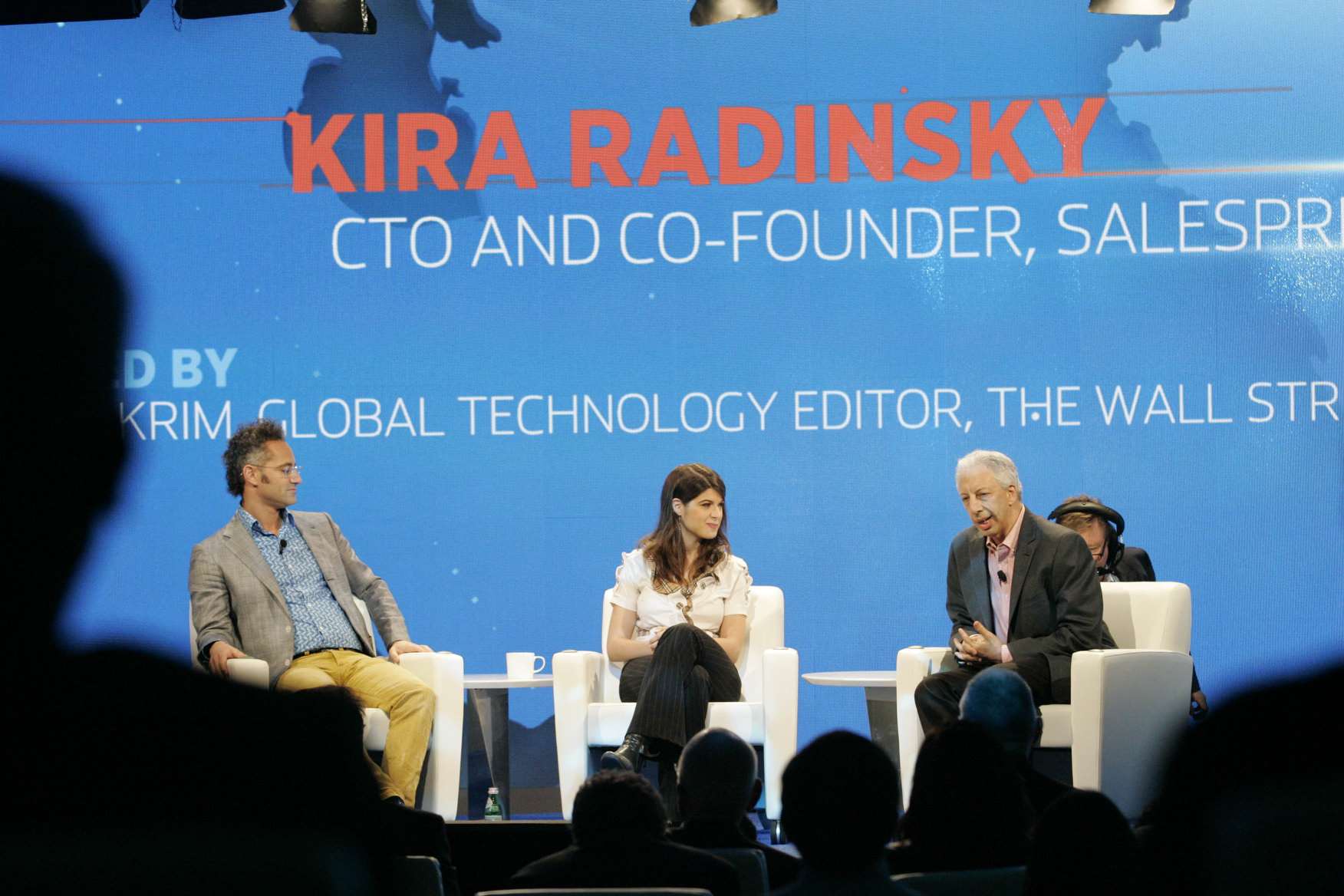
“I intend to be the Indiana Jones of Predictive Analytics.”
Kira Radinsky, 2013
The acquisition that enlarged the experiment
In July 2016, eBay announced its acquisition of SalesPredict. Radinsky became director of data science and chief scientist for eBay Israel. Zakai-Or took a product management role. The transaction brought the team into a marketplace with more than 900 million listings at the time of the announcement.
That inventory made the prediction problem tangible. What attributes affect an item’s price? How likely is a particular product to sell at a particular price over time? Sellers already make those judgments. The company wanted data and machine learning to give them more information for making them.
Radinsky described the deal in terms of scale. SalesPredict had been founded with an ambition to change economic decision-making; eBay offered a way to work across a much larger environment. An acquisition can be a full stop in a startup biography. Her account treated this one as a chance to continue the experiment with more room.
She stayed at eBay until 2019. The move also illustrates a recurring demand in her work: an idea has to travel. A pattern found in a dataset must become a system; a system must enter a workplace; somebody has to decide whether to use its output. Each step brings a new audience and another set of questions.
The list she finished, then questioned
Radinsky has described liking the fast pace of life. Her early schedule makes that an unusually modest statement. Yet speed did not settle every question. At 13, she wrote a list of goals to accomplish by 30. She later said she had completed it and realised that some of the goals were not the right ones.
The episode gives the neat chronology a welcome wrinkle. A doctorate by a chosen age is a measurable target. What that doctorate should let someone do is a longer conversation. Finishing a list can expose a question that checking its boxes allowed you to postpone.
There is humour in a prediction researcher revisiting her own plan, but no contradiction. Planning requires preferences as well as forecasts. A person can become better informed about both. Radinsky’s account of reconsidering her goals allows for that movement without pretending the achievements were wasted.
Her karate belongs in this portrait, too, without requiring a theory that every executive decision begins on a training mat. It is simply an enduring interest alongside the research and companies. A life that looks tidy in professional bullet points has other rhythms. The black belt and the computer science credentials have coexisted for years.
The question keeps its job
Radinsky is now co-founder and chief technology officer of Diagnostic Robotics. Her academic connection continues at the Technion. She also serves as an independent non-executive director of Nebius, whose board she joined in 2024. In August 2026, shareholders approved her reappointment. Research, operating work and governance now sit beside one another in her professional life.
The research trail has continued as well. A paper presented at WSDM 2022 and posted to arXiv in May 2024, co-authored with Dan Kalifa, Uriel Singer, Ido Guy and Guy D. Rosin, examined consumer demand during unusual events. It drew on 40 years of world-event records and eBay sales data to investigate whether outside context could improve forecasts when familiar patterns faltered.
The problem retains the old shape: yesterday’s data alone may be inadequate when today behaves differently. Bringing in a wider view gives the model more to work with. The authors tested that idea on an actual marketplace dataset, keeping the connection between a research question and a working environment.
Return to the childhood riddle and the family’s small program. The continuity is a habit of approach. Radinsky has repeatedly taken a difficult question, found collaborators and tried to build a tool around it. Her career offers several versions of that action, at very different scales.
The future remains an awkward customer. It changes the conditions, refuses tidy appointments and occasionally makes a finished list look incomplete. Radinsky’s work has been to find useful patterns within that uncertainty. The little girl who found another way through a game grew up to keep making things people could try.
Follow the questions
Talks, papers and conversations for the next rabbit hole.