The first recipe arrived with the confidence peculiar to a computer and the manners of a stranger. It proposed seeds and vegetable oil. It hoped to be mayonnaise. Karim Pichara, the computer scientist who had produced the formula, knew almost nothing about food. Still, the result was close enough to make the next experiment irresistible.
Pichara had spent his career on larger objects and colder data. At Pontificia Universidad Católica de Chile and later as a postdoctoral researcher at Harvard, he developed machine-learning methods for astronomy. Telescopes create vast catalogs of flickering objects; people cannot patiently inspect every light curve. Algorithms can classify variable stars, notice an anomaly and help decide where a human should look. Pichara's papers carry titles about missing data, quasars and massive astronomical catalogs. The poetry belonged to the sky. His work was to cope with the spreadsheet.
Then, in 2015, Matías Muchnick found him through a mutual connection and asked a question with no telescope in it: could artificial intelligence discover combinations of plants that behaved like animal-based foods? Pichara asked for time to think. The two began working, biochemist Pablo Zamora joined them, and NotCo emerged in Santiago. Muchnick supplied a dataset. Pichara supplied the code. The rough mayonnaise supplied permission to continue.
“He heard about me from a friend of his, because this country's not so big.”
Karim Pichara, recalling the introduction to Matías Muchnick
The astronomer enters the kitchen
Stars and mayonnaise make an absurd pair only until both are translated into variables. A food has texture, color, aroma, nutrition, price and behavior under heat. A plant ingredient has molecular and sensory properties. The search for a useful formula is a crowded puzzle: improve one quality and another can decline. Pichara had already worked in places where the observation is incomplete, the possible classes are numerous and a pattern must be found without pretending the noise has gone away.
The team called the system Giuseppe, after Giuseppe Arcimboldo, the Renaissance painter who assembled portraits from fruit, vegetables and flowers. The joke was unusually well engineered. Arcimboldo made a person from produce; Giuseppe would try to make familiar foods from the same botanical cast. Even the software modules borrowed names from the painter's life and work.
The machine never received a chef's hat and sole possession of the kitchen. Research chefs and food scientists made its proposals, tasted them, measured them and returned their findings. Early Giuseppe could get one dimension right while offending another. One often-told example involved milk with convincing taste and a thoroughly unconvincing pink color. A bad breakfast, perhaps, but excellent training data.
This distinction matters. Giuseppe did not taste. People tasted, and their judgments became part of a system that could make a more informed next suggestion. Pichara's technical contribution was not a magic answer machine. It was an organized way for models, experiments and several varieties of expert to keep correcting one another.
The product was also the proof
NotCo initially wanted to place its technology in the hands of large food companies. The market was not ready to buy that service. So the founders used the system to develop their own products and demonstrate that the method could survive contact with a supermarket. NotMayo reached shelves. Milk, burgers, chicken and ice cream followed across several countries. At a 2017 IndieBio demo day in San Francisco, NotCo arrived with something many science startups could only envy: a product already selling in 220 Chilean stores.
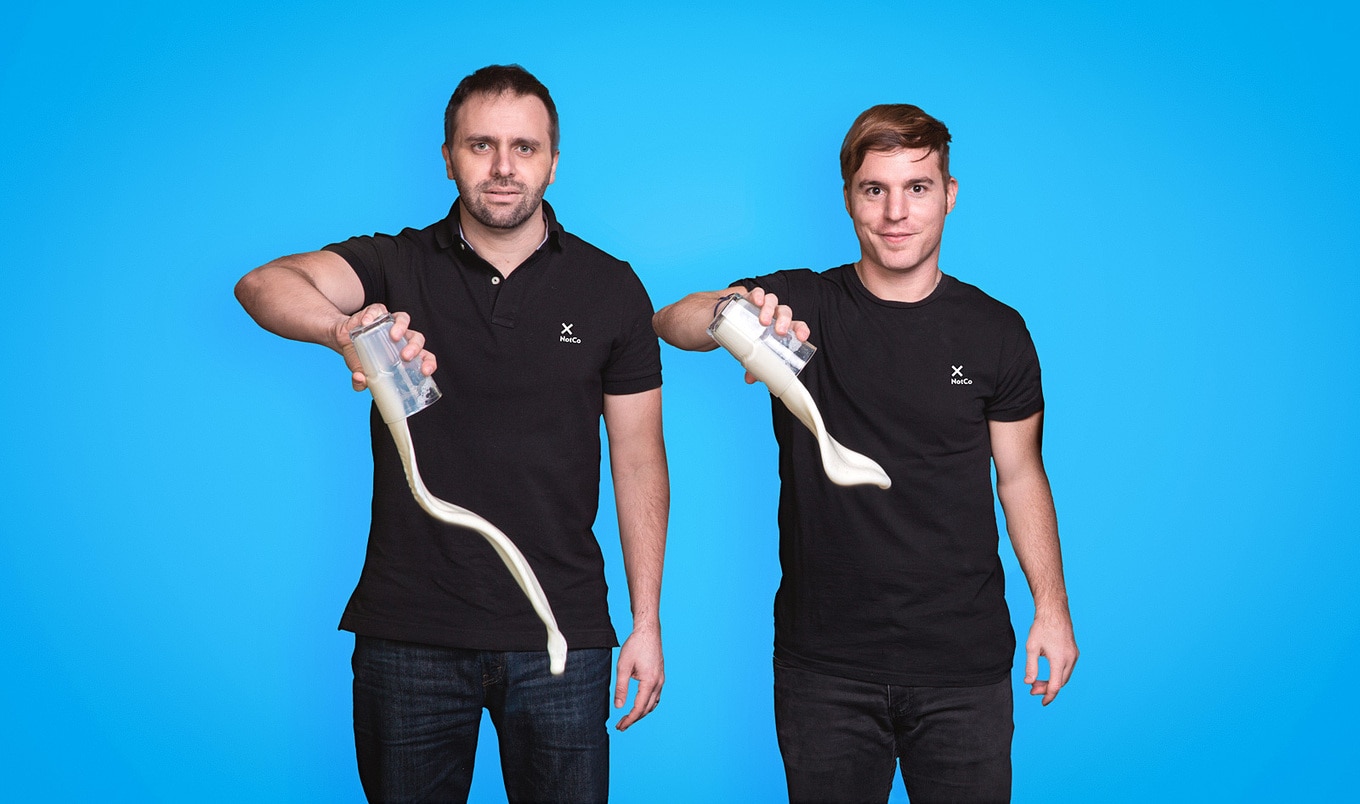
Selling food was more than a commercial detour. Every launch forced the system to confront manufacturing, regulation, supply, cost and the unfashionable fact that a formula must still please somebody's mouth. The company accumulated experimental data by doing the work. Failed trials were expensive, but they were also specific. A model trained on those outcomes could remember more than an organization that left them in notebooks and the recollections of departing staff.
The patent mattered to Pichara because he never considered NotCo merely a maker of branded cartons and jars. In 2021, while discussing the US approval, he described intellectual property as one of his priorities. He also said the technology would be made available to other companies. The dream, he added, was for NotCo to have more impact through technology than through products. At the time, generative AI had not yet become compulsory decoration for an investor presentation.
A method for being wrong
Pichara's public language about innovation is refreshingly short on incense. “Making mistakes is part of innovating,” he said in 2023. The point was not permission to be careless. In a laboratory, a mistake becomes valuable only when it is captured well enough to change the next trial. NotCo's advantage depended on producing that record deliberately.
People who have worked with Pichara have described him as serious and methodical. An interviewer found him pragmatic, slightly uncomfortable when challenged about the patent, and consistently cordial. These are not the usual ingredients of founder folklore, which prefers a garage, a revelation and a heroic dislike of sleep. They fit the actual task rather better. Coordinating software engineers, chefs and scientists requires someone willing to let different forms of evidence interrupt one another.
There is one more register. Pichara plays piano and violin. It would be too neat to claim that music explains his technical style, but formulation has the temper of an arrangement. Texture, flavor, cost and nutrition each want to be the soloist. The work is to make them coexist without allowing the loudest requirement to ruin the piece.
“We are a fusion of both.”
Pichara on the union of software and food
His academic identity did not vanish into the company. UC Chile continues to list him as an associate professor whose specialties include machine learning, data mining, astrostatistics and data science. In 2024, he traveled from the United States to speak with students at his old department about computer science, startups and AI. His research record also continued, including 2025 work on neural networks for classifying variable stars. The stars had not been replaced by snacks. The same researcher had simply acquired a second laboratory.
The second act was inside the first
By 2025, NotCo had formed NotCo AI as a distinct unit aimed at enterprise product development. Its pitch was broader than plant-based replicas. The platform would help consumer-goods companies navigate formulation problems in food, beverages and other physical products. In 2026, the company said it was running live programs with 20 leading consumer packaged goods businesses. Recent reporting named PepsiCo, Mondelēz and Mars among customers, while the company presented a larger roster of partners.
NotCo spent a decade making products, running laboratory trials and learning manufacturing limits before presenting that accumulated system as enterprise AI.
The chronology changes how the pivot looks. NotCo did not discover software after tiring of food. Its CTO had been describing the software as the larger ambition for years. The consumer business created proof and proprietary data when enterprise buyers were not yet asking for an AI formulation platform. The grocery shelf was a public demonstration and a demanding training environment.
There were diversions that revealed the system's range. In 2024, Pichara discussed experiments using natural-language prompts to generate fragrance formulas. Perfume is not mayonnaise, although both punish an insensitive nose. The move suggested that the underlying problem was not any single category. It was the computational search through ingredients, constraints and sensory goals.
Pichara has also imagined Giuseppe helping create foods without familiar precedents: new colors, properties and flavors rather than another imitation of something already on the table. This is the more difficult proposition. A substitute comes with a target. A genuinely new food asks a model to search while people decide whether the destination is desirable.
The distance between possible and edible
A machine can make a suggestion at extraordinary speed. It cannot make the suggestion matter. Someone must source the ingredients, prepare the batch, run the measurements, understand the factory and decide whether the result belongs in the world. Pichara's career has been less about removing those people than about giving their experiments a better memory.
That is the line connecting a variable star to a spoonful of mayonnaise. In both cases, the universe has supplied too many possibilities for unaided inspection. The useful system narrows the field, notices relationships and points toward the next observation. It does not abolish curiosity. It tells curiosity where to spend the afternoon.
The first Giuseppe recipe was wrong in several ways. It was right in the way that mattered most: it made another attempt rational. Companies are often built on grand convictions. This one also depended on a smaller and more scientific pleasure - the suspicion that the next result could be better, if only everyone remembered exactly what happened in the bowl.