The tea required a walk. In the early days of Metizsoft, Chetan Sheladiya and his colleagues worked in a tiny room with two desks and two developers. Getting a cup meant walking a few miles. When he returned to that memory during the company’s tenth anniversary celebration, the furniture and the tea made it into the story. Entrepreneurship has an extensive vocabulary for ambition. Two desks are rather more convincing.
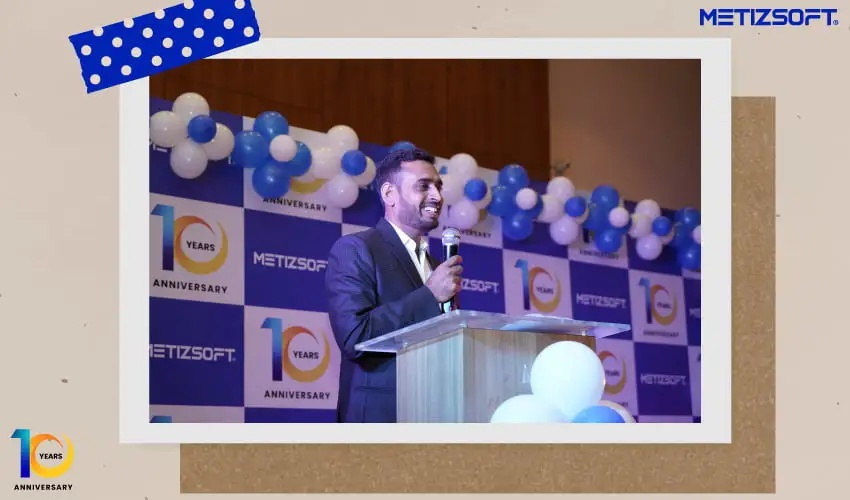
By April 2022, Sheladiya was telling the story from a stage, microphone in hand, with employees, relatives and guests gathered for the anniversary. He thanked the people around him and revisited the difficult beginnings. The photograph catches him smiling at the lectern. The tiny room had become something large enough to warrant a party, a programme and a succession of speeches. Even the tea had acquired a backstory.
Sheladiya’s career connects software delivery, online commerce and, more recently, artificial intelligence. The useful thread through these different technologies is a practical one: helping businesses do something their existing systems make difficult. His ventures have changed, and Metizsoft’s leadership has changed too. The question of usefulness keeps returning.
A company founded with a friend
Metizsoft began on April 1, 2012, in Ahmedabad. Sheladiya founded it with his friend Manthan Bhavsar. The company was self-financed, with support from friends and family. Before starting it, Sheladiya had studied computing and worked as a technical executive at other businesses. He credited that employment with giving him experience he could carry into ownership.
There is a pleasing lack of theatre in that sequence. Study a subject. Work at it. Start a business with somebody you know. Then discover whether the business can keep going. The founders’ anniversary accounts give their partnership a central place, alongside the employees who joined them. The origin has two names, and the company’s subsequent history continues to carry both.
By its eighth anniversary in 2020, Metizsoft described a team of more than 50 employees and clients around the world. Its twelfth anniversary account, in 2024, put the team above 100. These are company-reported snapshots from different years, rather than a claim about today’s headcount. Taken together, they show a small operation acquiring the people and organisation needed to serve a wider market.
The 2024 celebration took place at Grand Qaraar Banquets in Ahmedabad. Colleagues, friends and family were again part of the occasion. A business anniversary can become an exercise in congratulating the business. Here, the recurring guest list also brings the story back to the relationships that helped the founders begin.
The work between the promise and the product
In his CEO interview, Sheladiya described a role that included responsibility for operations and resources, shared senior management with Bhavsar, and guidance for employees. Asked about his biggest achievement, he pointed to the skilled team and the company’s reputation with clients. It is an answer rooted in the work of running a services business.
His account of client work was similarly concrete. Understand the business requirements, discuss the platform, divide development into phases, and agree on the budget. He said Metizsoft covered training costs for employees learning new skills. When asked about client satisfaction, he emphasised honesty, quality and open communication. The software business can supply a fashionable acronym for almost anything; those three requirements travel well without one.
Other parts of his professional record make the technical breadth visible. His LinkedIn projects include an RFID race-timing system from late 2013 and an ecommerce integration with Amazon web services beginning in May 2014. The latter concerned sending products to Amazon and synchronising inventory and orders. One project followed competitors through a race; the other followed merchandise through a selling system.
They are useful reminders that software often has a very physical assignment. A runner crosses a line. A product leaves a shelf. Someone needs an accurate result, and someone else needs an accurate stock count. These projects give substance to Sheladiya’s combination of technical and commercial interests without requiring an extravagant theory of innovation.
with Manthan Bhavsar
announced by Destinova
Bhavsar as CEO
A team is made of individual careers
The people around a founder can make the scale of a company easier to understand than a headcount does. In a retrospective on seven years at Metizsoft, business development manager Sweety Christian described the help she received from Sheladiya, Bhavsar and team leader Bhavin Raval. She recalled being encouraged to express her interests and put forward ideas.
Christian also remembered attending Shopify Pursuit in Bangalore in 2018 with her founder managers and team leader. That detail places the founders alongside colleagues in the work of learning a commercial ecosystem. It also makes mentorship less abstract. Encouragement, exposure to an industry gathering, and room to contribute are recognisable ingredients in a professional education.
Sheladiya’s own education includes management studies at Indira Gandhi National Open University between 2008 and 2011, described on LinkedIn as a master’s in business management. His earlier academic connection is to Sankalchand Patel College of Engineering in Visnagar. In an alumni recollection, he placed the beginning of his computer engineering studies there in 2002.
Returning to that campus for the December 27, 2025 alumni gathering, he reported receiving recognition as Best Computer Engineering Alumnus. He also described a growing commitment to student placement guidance, mentoring and support for startups through incubation centres. His account ties the return to more than nostalgia: the campus that helped him begin had become somewhere he could contribute experience.
That is a different measure of a founder’s reach. A client receives a product; a colleague develops a career; a student hears what running an IT business actually involves. Each relationship asks something different of the same person.
The catalogue gets a conversationalist
On September 3, 2025, Destinova AI Labs announced the launch of ReComAI, identifying Sheladiya as its founder. The product was presented as an AI recommendation engine for ecommerce, with product suggestions, search optimisation and personalisation. The launch described integrations with Shopify, WooCommerce and Magento. Its proposed audience was merchants looking for a more tailored shopping experience.
“Personalization is no longer optional,” Sheladiya said at the launch. That sentence expresses his commercial conviction, rather than a measured result. The venture’s ambition was to make AI tools accessible to ecommerce brands without adding complexity. Years spent building commerce systems had led him to a product aimed at helping shoppers decide what to buy.
On his founder page, he explains the problem as choice overload: digital platforms give people a great deal to inspect while leaving them to work out what is relevant. He wants discovery to feel more like a conversation with someone who understands the immediate task. The emphasis is on present intent, rather than simply repeating what a customer previously purchased.
The distinction gives his AI work a human-sized subject. A catalogue can be perfectly organised and still leave a visitor uncertain. A recommendation becomes useful when it connects a product to a need. Sheladiya’s stated aspiration is for that connection to feel intuitive. Whether a system delivers it is a matter for the customer using the system.
“To help businesses stop guessing and start listening.”
The mission stated on Sheladiya’s ReComAI founder page
His writing has moved alongside his ventures. An April 2024 AI guide under his name covered the technology’s types and applications. By April 2026, a development guide credited to him addressed agentic AI copilots for SaaS products. The subject had moved from explaining a field to discussing how to build with it.
The founder goes back to class
In May 2025, Sheladiya published an argument for testing a minimum viable product before investing in full development. He stressed evidence from users, market demand and measurable behaviour. The advice fits a recurring concern in his public work: a technical idea needs contact with the business problem it is supposed to solve.
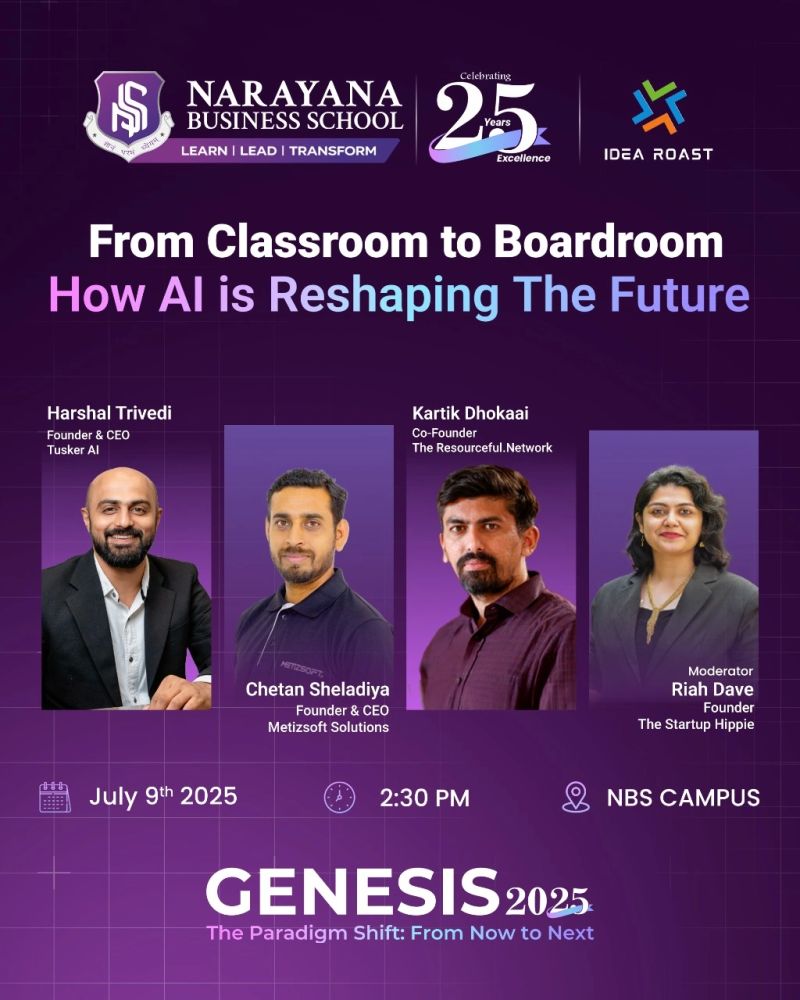
His conference appearances put that concern in conversation with other builders. The Genesis 2025 programme at Narayana Business School featured him on a July 9 panel about AI’s influence on the future, alongside Harshal Trivedi and Kartik Dhokai, with Riah Dave moderating. An event poster is a small artifact, but it shows the founder participating in a discussion that connects classrooms and business decisions.
Agile Ahmedabad listed him as a panelist in 2025. An account of Open Source Day at Silver Oak University also recorded his participation in a CXO discussion about innovation, collaboration and the usefulness of open source to organisations. These appearances broaden the setting of his work beyond his own companies.
He appears as a listener, too. In a post about Empresario 2026 at the Entrepreneurship Development Institute of India in Gandhinagar, he described attending a session with Aman Gupta. What stayed with him included ethical business practices, persistence through failure, family support and the possibility of a founder moving away from daily operations.
That last idea would soon have a concrete parallel in the company he helped establish. Learning remains an activity in his career, even when the invitation comes with a founder’s title attached.
Two founders, another chapter
On September 15, 2026, Metizsoft announced Manthan Bhavsar as its new CEO. The appointment updates a long period in which Sheladiya was publicly identified with that office. Their shared founding story remains; the current leadership title belongs to Bhavsar. Sheladiya’s founder role at Destinova AI Labs provides another continuing strand of his work.
Metizsoft’s announcement described a direction combining its ecommerce engineering background with AI, emerging technologies and long-term client relationships. The company’s history and its next plans therefore sit together. For Sheladiya, the career now includes the organisation built with a friend, a newer AI venture, and the teaching and mentoring that accompany both.
The two desks remain a useful place to begin. They give the later products and programmes a scale a reader can picture. A room becomes a company. A developer becomes an employer and mentor. A commerce problem becomes the subject of another venture. And a cup of tea, once inconvenient to obtain, becomes something worth remembering.
Follow the work & read further