Before Raj De Datta persuaded investors to back Bloomreach, he handed a different investment back. He had raised $500,000 for a cloud infrastructure business while working as an entrepreneur-in-residence. Then the financial crisis of 2008 changed the calculation. The venture would need considerable capital; he no longer thought it made sense. So he returned the money. It is an unusual opening for a Silicon Valley career story. The cheque travels in the wrong direction.
The episode matters because De Datta would later face a harder version of the same question: when should a founder stop believing in a business? Bloomreach, which he co-founded with Ashutosh Garg in 2009, would give him ample opportunity to consider it. Years later, he could talk about an AI personalization company with hundreds of millions of dollars in recurring revenue. Getting there required distinguishing an idea he still believed in from a product whose prospects had changed.
A résumé with several passports
De Datta grew up between India and the Philippines, attending school in the Philippines for eight months of the year. His education took him to Princeton, where he studied electrical engineering and also earned a certificate in public policy and international affairs. Later came an MBA with distinction from Harvard Business School. The combination suggests the range of subjects his career would require: how systems work, how institutions make decisions, and how a promising piece of technology becomes a business someone will pay for.
His working life crossed those borders too. He worked in technology investment banking at Lazard Frères and joined the founding team of the telecommunications company FirstMark Communications. That business reached an $80 million revenue run rate. These were useful experiences for someone who would eventually sell software to large organizations. Technical elegance gets a product into the conversation; budgets, distribution and the customer's priorities determine whether it stays there.
He attended Harvard from 2001 to 2003, already convinced that entrepreneurship was his direction. His explanation for going to business school was refreshingly practical. After years of extremely long working days, Harvard looked like an easier option. There was also an expiring GMAT score to consider. Even a career that sounds inevitable in retrospect can contain a decision partly motivated by avoiding another exam.
A paper he was writing with Clayton Christensen about disrupting networking reached Cisco. De Datta had been planning an independent company around its ideas; Cisco invited him to bring the effort inside. He worked on Application Oriented Networking and served as director of product marketing. After leaving, he explored roughly ten possible ventures over two years. The right idea and the right team refused to arrive together on demand.
The search engine on the other side of the counter
Garg had worked on search at Google. An introduction through Justin Caldbeck brought the two future founders together after De Datta's abandoned infrastructure venture. Each approached the internet from a different angle: Garg had experience with the machinery of search; De Datta had spent years around the commercial decisions that determine what gets built. Their shared opportunity lay with businesses that lacked the resources of the large internet platforms.
At the time, the sophisticated machine learning associated with Google and Facebook was closely tied to advertising. De Datta saw another use for it: improving the experience once a person reached a website. Finding someone online and helping them accomplish something online are separate jobs. Bloomreach set out to bring more of that intelligence to the second one.
The first product launched publicly in 2012. Its early work helped businesses get their content discovered through search. The company then expanded into tools for commerce. In 2016 it acquired Hippo, a content management business. In 2021 it acquired Exponea, bringing customer data and marketing automation into the company. Those moves widened the territory from finding a page to understanding the person moving through it.
De Datta and Garg start Bloomreach.
Hippo acquisition expands the platform.
Exponea adds customer data and marketing automation.
Loomi Connect brings search intelligence into conversational channels.
The product shrank. The question survived.
De Datta's account of the company's middle years is considerably less polished than the usual founder biography. He has described early momentum, a difficult intervening stretch, and renewed growth. He remembered walks with his wife and colleagues spent wondering whether the business would work. He also recalled warning investors that he could lose their money. The candour gives the later milestones some weight. There were people attached to the numbers.
Guidewire co-founder Marcus Ryu joined as an independent board member and shared his own experience of getting a company through a dangerous period. De Datta had a team, customers and a technical foundation that would be expensive to recreate elsewhere. The question was whether those assets could support a different business. Persistence alone could not settle it. He needed a reason to believe that keeping the company alive would serve a purpose.
In a later conversation, he described the original search optimization business reaching roughly $25 million to $30 million in revenue, then falling to about $1 million. The broader personalization business grew in the opposite direction. These are his retrospective figures for parts of the business, rather than a continuous series of audited company accounts. They explain the choice he made: keep working with the underlying technology, customers and many of the same people, while rebuilding what the company sold.
The distinction is useful. A founding ambition can outlast its first commercial expression. For De Datta, returning to the ambition meant a personalization system spanning more of the customer experience. He had once returned a cheque when a venture no longer made sense. Here, he chose to stay. The interesting part of his story is that both decisions required judgment.
The shopper who came for plywood
In June 2021, De Datta published The Digital Seeker: A Guide for Digital Teams to Build Winning Experiences. Writing a book had been a personal goal. The result took the question behind Bloomreach and gave it a vocabulary that did not require a software demonstration. A customer is visible in a purchase. The intention that brought the customer there can be harder to see.
“Before you are a customer, you are a human being with a want or need.”
Raj De Datta, on The Digital Seeker
Consider his example of buying plywood to build a deck. A retailer can make the plywood easy to locate, compare and order. Yet the buyer still has to work out everything else the project requires. De Datta asks businesses to take that larger purpose seriously. The product is part of a task, and the task is part of someone's life. A highly efficient checkout can leave a surprisingly large amount of homework.
Product → project → purpose. An illustration of his seeker idea, not a measured customer journey.
His examples extend to clothing and travel. Stitch Fix helps people express a style, rather than leaving them to assemble it from a catalogue. The book considers businesses including Rent the Runway, HotelTonight and Bayern Munich. The variety is part of the argument: people arrive with goals that rarely fit the categories a company has used to organize itself.
De Datta said he conducted about a hundred executive interviews while developing the book. That makes the author another kind of seeker, asking what successful digital organizations had learned. His thesis asks teams to inspect their assumptions before buying technology. A bigger catalogue is of limited comfort to someone who does not yet know what belongs in the basket.
A tennis court is a useful place to think
Outside work, De Datta is an avid tennis player and fan. He has supported player development at the United States Tennis Association, and his LinkedIn profile records service on its Council of Champions from 2018 through 2024. In discussing that work, he has described how video analysis can help players and coaches spot patterns across a match.
A machine can identify passages worth reviewing and compare outcomes across different situations. A coach can take those observations further. Tennis makes the division of labour easy to picture: the analysis has to become a useful decision for a person trying to improve. A stack of statistics cannot walk onto court and practise the next shot.
The sporting interest also gives texture to his view of AI at work. In 2023, discussing the responsibilities of brands using artificial intelligence, he put it in terms of moving from player to coach. The company still has to guide what the system does. Delegating a task creates a new responsibility for whoever once performed it. The tools change; somebody still has to know what a good result looks like.
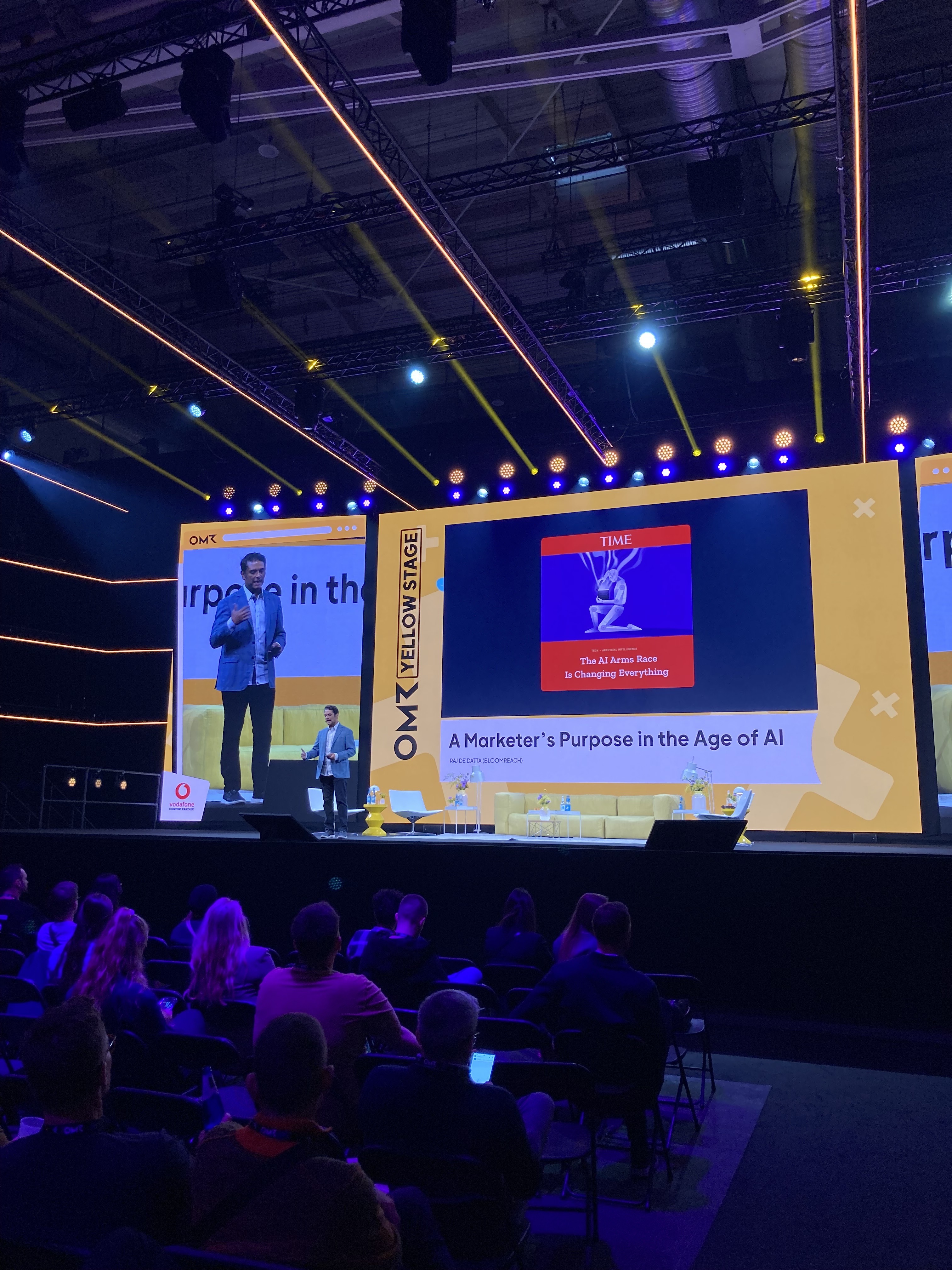
The founder has to learn a second job
De Datta has spoken about the difference between founding a company and learning to run it at scale. His early leadership team was small and flat. As Bloomreach grew, it needed functional leaders and then executives with experience of larger software businesses. Having the original idea did not automatically confer every skill the company would need next.
He says he wrote Bloomreach's culture document before its business plan. That ordering puts the working environment among the things a founder can actually shape. His stated principles include transparency, ownership and a preference for teams over star performers. They also offer a way to read his investment activity: alongside running Bloomreach, he is a Founder Partner at Founder Collective and has invested individually in more than twenty startups.
He has held a board role at RepresentUs, which works on democracy reform. Engineering, company building, tennis and civic involvement make for a wider set of interests than a product pitch usually reveals. They need no invented connection to be interesting. De Datta has made room for more than one arena in which systems, institutions and people have to work together.
The next shop window might be a conversation
Bloomreach announced a $175 million investment in February 2022 at a $2.2 billion valuation. By the end of that year, it reported more than $150 million in annual recurring revenue. Its February 2026 announcement put 2025 ARR above $260 million and reported positive free cash flow. These are company milestones, distinct from De Datta's personal finances. The rebuilt business had acquired a scale that the earlier crisis gave him reason to doubt.
Thresholds reported by Bloomreach. Bars compare the stated milestones; they do not imply a smooth path between years.
In January 2026, Bloomreach introduced Loomi Connect to bring retailers' product discovery intelligence into ChatGPT and other conversational AI channels. In June it expanded its conversational agent, including tools to surface shoppers' recurring questions and gaps in a catalogue. The commercial setting is changing again. De Datta's old interest in what people are trying to accomplish now meets an interface where they can explain it in ordinary language.
His September 2026 writing returned to the importance of the moment in a customer experience. In October, Bloomreach announced further recognition in Gartner's assessment of multichannel marketing hubs. There will be more announcements and more debates about how shopping should work. The durable question in De Datta's career remains easier to state than to answer: what did this person come here hoping to do? Somewhere behind an order for plywood, friends are waiting for a barbecue.
Keep the conversation going
- Bloomreach Company website
- Raj on LinkedIn Posts and articles
- Raj on Twitter / X Public profile
- About Raj Personal profile
- The Digital Seeker Book and its central idea
- Watch: winning experiences and brand responsibility YouTube · CEO.com
- Listen: tennis, AI and the digital seeker InfoQ conversation
- Listen: the difficult middle years Founder interview
- Read: Bloomreach’s 2025 results February 2026 announcement
- Read: Loomi Connect January 2026 announcement
- Read: October 2026 marketing assessment Latest company announcement