The useful thing about an old mistake is that time can make it look like prophecy. In 1995, while studying electrical engineering at Princeton, Raj De Datta spent a summer at Bell Labs working on a problem: dial-up internet calls were confusing the telephone equipment. The project was canceled. Internet traffic, the thinking went, was too small to matter. Netscape went public that same summer.
De Datta has carried that anecdote for three decades because it contains the plot of his working life in miniature. A signal appears at the edge. Established systems classify it as noise. Someone curious asks what happens if the signal becomes the system. His company, Bloomreach, has spent sixteen years asking a commerce version of the same question: what if the stray clues people leave in search boxes, clicks, pauses, and purchases could tell a business what they actually came to do?
He calls that person a seeker. The term has the faint air of a novel, which is useful. A customer belongs in a spreadsheet. A seeker is moving through a story. She may type “black dress,” but she could be looking for confidence at a wedding, a uniform for a new job, or something that arrives by Friday. Inventory knows what is available. Intent explains what matters.
search · clicks · context
what is this visit for?
the useful next step
An education in noticing the edge
De Datta grew up between India and the Philippines. His father was an agricultural scientist working on rice research during the Green Revolution, and the family spent much of each year in the Philippines before returning to India. De Datta has described his childhood home as hundreds of miles outside Manila. Silicon Valley was not the neighborhood expectation.
He came to the United States for college at seventeen. Two details survived the landing: Detroit was cold, and an American meal arrived on the largest plate of food he had ever seen. The scale of the place announced itself before the curriculum did. At Princeton, he paired electrical engineering with public policy and international affairs, a combination that suited a mind interested in both machinery and consequence.
“My ticket was education. The only way I could get on the map was through education.”Raj De Datta
After graduating in 1996, he worked in technology investment banking at Lazard Frères. Then came the accidental draft that altered his career. He joined the founding team of FirstMark Communications in Europe at 23, entering entrepreneurship before “founder” had hardened into a profession with its own podcasts and uniforms. FirstMark grew to 600 employees and an $80 million revenue run rate. The experience was clarifying. De Datta had found the work he wanted to keep doing.
An MBA at Harvard Business School followed, then product marketing at Cisco, including work on a venture inside the company. He became an entrepreneur-in-residence at Mohr Davidow Ventures. By the time he met the problem that became Bloomreach, he could approach it as an engineer, operator, marketer, banker, and investor. A less tidy résumé might have been a better instrument.
The first product was not the final idea
Bloomreach began in Mountain View in 2009 with De Datta as CEO and Ashutosh Garg as co-founder. The early product helped large retailers improve organic search performance by using machine learning to make their pages more relevant. It was practical software with an unfashionably large premise behind it: every web experience could adapt to the person arriving.
The practical software took off. The company’s SEO business grew to roughly $25 million to $30 million in revenue, De Datta later recalled. Success created its own trap. A company can become very good at the narrow thing the market first rewards, even while its founders continue to see the larger thing it might become.
Bloomreach chose the larger thing. It moved beyond acquisition into site search and merchandising, added content management through the acquisition of Hippo CMS, and eventually combined product intelligence with customer data and marketing automation. Acquisitions, including Exponea in 2021 and conversational AI company Radiance Commerce in 2024, widened the toolkit. The nouns kept changing. The underlying question held.
The widening surface of the original idea
This is the part of company building that press releases compress into a verb: pivoted. In reality, an established company does not pirouette. It renovates while the tenants are home. Customers still expect yesterday’s product to work. Employees need to understand why their expertise remains valuable. A new category must be sold before it feels inevitable.
De Datta has spoken candidly about this “messy middle.” Bloomreach returned to its original vision while keeping much of the same technology stack, customers, culture, and team. The old business declined as the broader personalization business grew. Continuity came not from protecting every product decision, but from protecting the problem worth solving.
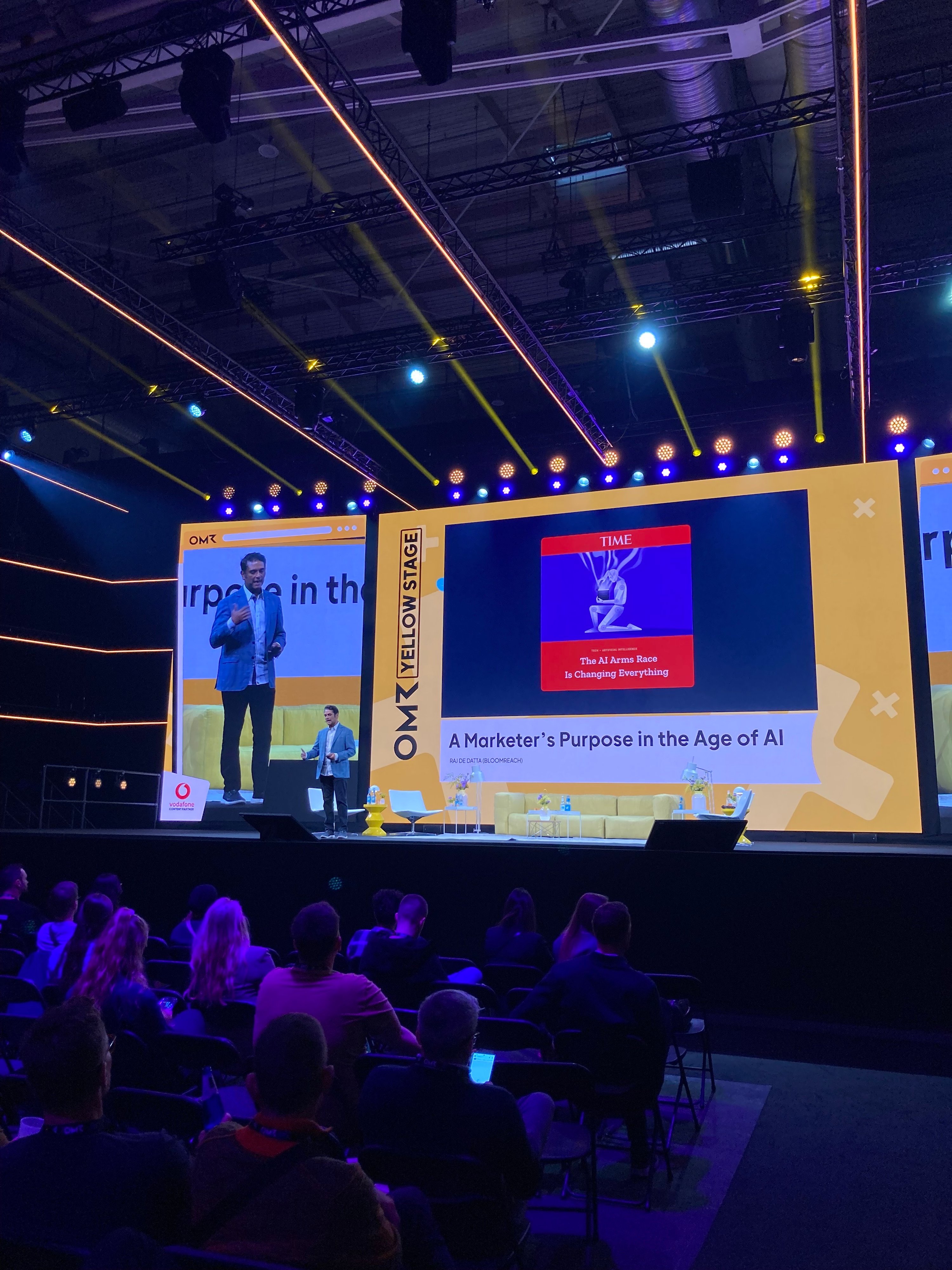
A search bar with ambitions
The current Bloomreach platform is organized around Loomi, an AI layer meant to connect product knowledge, customer context, and marketing action. Its conversational agent can help a shopper describe a need in ordinary language. Its marketing tools aim to help teams plan and execute campaigns. Loomi Connect extends the company’s commerce intelligence into outside conversational environments.
The vocabulary is contemporary, but De Datta’s test remains stubbornly human. Does the software get someone closer to what they came for? He has argued that people go online for experiences, not advertisements. This puts a useful constraint on AI. More generated material is not automatically more useful. An agent that can speak at length still fails if it misunderstands the errand.
“The great digital experiences, the winning ones, are actually built for the seeker, not the customer.”Raj De Datta
That philosophy became his 2021 book, The Digital Seeker. De Datta conducted about 100 interviews, drew on Bloomreach customers and seed investments, and tried to explain why some digital teams produce experiences people choose while others merely digitize a catalog. The answer combined organizational design with three technological forces: ambient devices that sense, artificial intelligence that interprets, and APIs that let builders assemble the result.
There is an appealing modesty in treating technology as a set of means. The experience is the point. Even the search box, one of the web’s plainest rectangles, can become less like a slot machine for keywords and more like the beginning of a conversation. The ambition is large; the interface can remain quiet.
The operator outside the office
De Datta has also spent years on the other side of the founder table. Founder Collective named him a Founder Partner in 2014 after more than a decade of knowing him and co-investing in companies including Hunch, Yub, and TrialPay. Bloomreach’s biography says he has invested individually in more than 20 startups. Operating and investing can pull attention in opposite directions, but they also create a feedback loop: the CEO sees patterns across young companies, and the investor remembers how advice sounds when payroll is real.
Tennis supplies another lens. De Datta is an avid player and fan who served on a U.S. Tennis Association advisory group supporting player development. Tennis is a game of intent disguised as motion. The ball tells you where it has been; posture, spin, and position suggest where it will go. Prediction helps, but reading without action wins nothing.
His public interests have also included democracy reform through board service at RepresentUs. It fits the public-policy half of his Princeton education and his stated hope that digital technology can open possibilities to people for whom older options were uneconomic. The thread is access: to education, to a better digital experience, to a system more responsive to the person using it.
In February 2026, Bloomreach said it had passed $260 million in annual recurring revenue for 2025, achieved positive free cash flow, and recorded its strongest quarter. The company attributed the momentum to Loomi. De Datta’s comment was brief: “We were built for this moment.”
Built for it, yes, but not recently. The moment rests on years of catalog data, search language, marketing workflows, acquisitions, integrations, and arguments about relevance. AI arrived as a dramatic new interface for a problem Bloomreach had already been working from several angles. Good timing sometimes looks like a long period of being early without becoming bored.
In the summer of 2026, De Datta was writing about the platform behind agents, inviting customers to a Loomi Connect hackathon, and arguing for value before volume. The emphasis matters. The market can count agents because agents are nouns. Value is harder. It appears when a shopper finds the right thing, a marketer avoids a repetitive task, or a company notices an intention before it becomes an abandoned cart.
The canceled Bell Labs project is funny now because the error is so legible. Internet traffic mattered. Yet every technological wave produces its own version of the small signal: a behavior dismissed, a user misread, an awkward interface accepted as permanent. De Datta’s career offers a practical habit for those moments. Pay attention to what the system calls noise. Then ask what the person on the other side is seeking.