Leah Pope has made a career out of the part of marketing nobody puts on a Cannes postcard: cleaning up the mess. The mess has changed names over the years. It was social chatter at Synthesio, scattered campaign reports at Datorama, customer records at ActionIQ and now the thicket of proprietary data and artificial intelligence at Zeta Global. But the practical complaint underneath has stayed intact. Information arrives in pieces, people spend their week assembling it, and by the time the answer appears the moment to act has quietly left the building.
On August 3, 2026, Pope became Zeta Global’s Chief Marketing Officer. Her portfolio covers brand, product marketing, demand generation, customer marketing and events. It is a wide remit, though not an unfamiliar one. She has spent more than two decades in enterprise software, often at the moment when a technical product needs a category, a market story and a reason for a nontechnical buyer to lean forward.
Her appointment also gives the industry a neat résumé-as-history lesson. Business-process software became social intelligence. Social intelligence gave way to marketing intelligence. Marketing intelligence widened into customer data platforms. Now all of it is being pulled into enterprise AI. The nouns keep arriving in expensive suits. Pope’s argument is more modest: tools should help people see the whole picture, decide sooner and return their attention to the customer.
“The evolution of technology and data is allowing us marketers to come back to what we’re good at.”Leah Pope, speaking at Cannes in 2019
The résumé is a map of software’s moving center
Pope studied psychology, marketing and history at Boston University. It is an unusually apt trio for a career built on behavior, persuasion and the habit of watching one technological era replace another. Her early software roles included FatWire and Inquisite. In 2006 she moved into global marketing at Lombardi Software, a business-process-management company. IBM completed its acquisition of Lombardi in 2010, and Pope continued in worldwide marketing leadership at IBM.
That was the first of three acquisitions running through her career. The pattern matters because acquisition turns marketing into translation under pressure. A specialist company has a vocabulary its customers understand. A platform company has a larger vocabulary, a larger sales force and a real risk of sanding the interesting edges off the thing it bought. Someone has to explain what survives, what expands and why the combination is useful.
At Synthesio, where she became CMO, Pope dealt with a world briefly intoxicated by likes, follows and retweets. Her response was to ask the slightly impolite question: what did any of it do for the business? She called social media a vast focus group, but insisted that its data leave the social team’s silo and reach decision-makers in a clean, understandable form. A cheerful vanity metric, in her telling, was still vanity wearing office clothes.
Her writing from that period was often playful in subject and rigorous in method. She used social data to examine Wimbledon sponsorship, the London Marathon, Valentine’s Day conversation, the television sets of CES and even the internet’s annual outbreak of April Fools’ pranks. The point was not that every cultural moment required a dashboard. It was that a dashboard needed a point.
At Datorama, the spreadsheet became the antagonist
Pope joined Datorama as CMO in 2016. The company promised a single view of marketing performance, automating the dull labor of pulling data from channels, agencies and regions into something that could be analyzed. Salesforce completed its acquisition of Datorama in August 2018 for consideration valued at roughly $766 million. Pope stayed, eventually leading marketing across Salesforce Marketing Cloud, Pardot, ExactTarget and other products while retaining the Datorama CMO role.
Her public argument became sharper. Marketers, she observed, were spending most of their bandwidth preparing data rather than understanding it. Often they analyzed only fragments because there were not enough hours in the week to gather the rest. Reporting might be accurate yet uselessly late. A retrospective delivered after a campaign is a post-mortem with nicer typography.
The destination, however, was never the immaculate spreadsheet. At a 2019 Cannes discussion, Pope said technology could let marketers “double-down” on caring about customers and how they engage with a brand. It is the most revealing line in her work because it places the machinery in a supporting role. Data does the laundry. The marketer gets to think.
She also described the emerging growth CMO as equal parts marketer, finance expert and data geek. That hybrid now feels less like a prediction than a job description. Brand spending must connect to return. Customer experience stretches across departments. Product architecture shapes what marketing can promise. The CMO has not abandoned storytelling; the CMO has acquired a calculator and several awkward meetings.
ActionIQ put the customer inside the data story
In late 2020, Pope left Salesforce to become CMO of ActionIQ. The company had doubled annual recurring revenue and was selling an enterprise customer data platform to brands whose information lived across old systems, new clouds and departmental borders. Her job was positioning, messaging and communications, but the deeper task was category education: explaining why stored customer data was not the same as usable customer understanding.
ActionIQ pushed the conversation from campaign measurement to orchestration. A marketing team should be able to recognize a customer, understand context and shape an experience across channels without waiting in a queue for a specialist to wrangle the data. Pope’s earlier complaint about social information trapped inside one team had grown into an enterprise architecture question.
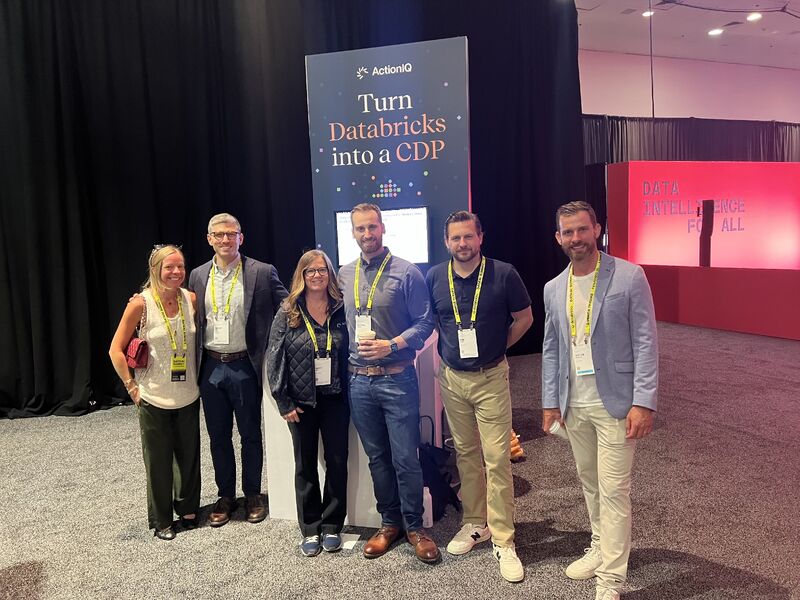
Uniphore announced its agreement to acquire ActionIQ in December 2024, combining the CDP with a broader enterprise AI platform. Pope had now worked inside a third company that became part of a larger technology story. Her résumé began to look less like a collection of employers than a sequence of specialist ideas being absorbed into the center of enterprise software.
She also kept returning to culture. In a 2021 discussion about customer experience, Pope joined leaders from e.l.f. Beauty and Google Cloud to address a problem no connector can solve by itself: external channels and internal teams both form silos. Customer centricity is an operating model, not a software setting. The tool may create the view, but people still have to agree on what to do with it.
This is where Pope’s psychology training feels more than biographical decoration. Her public work rarely treats behavior as a clean output of technology. A useful signal still needs an audience. A shared dashboard still needs a shared definition of success. A recommendation still needs somebody willing to change a plan. Enterprise software loves to promise a single source of truth; enterprises, being gatherings of humans, are exceptionally talented at maintaining several truths and a spreadsheet for each. Pope’s version of data-driven marketing leaves room for that friction. The aim is not to remove people from the system. It is to give them less clerical work and a better argument.
“Marketing leaders are now in a unique position to shape business strategy and drive growth through better decisions.”Leah Pope, August 2026
Zeta’s challenge is category-sized
Zeta Global hired Pope at a moment when the company was presenting itself as intelligent AI infrastructure rather than a conventional marketing cloud. Its pitch combines proprietary data, intelligence and activation. That is a great many abstract nouns to fit through one doorway. Pope’s stated aim is to make the combination tangible, build the category and help enterprises turn intelligence into measurable outcomes.
The assignment fits the pattern. Zeta does not merely need awareness; it needs comprehension. Enterprise buyers must understand what the platform changes about a decision, a customer relationship or a growth plan. Pope will work with CEO David Steinberg and Chief Communications Officer Candace Dean, whose promotion was announced alongside Pope’s appointment, to sharpen both the commercial story and the corporate one.
There is an appealing tension in Pope’s career. She markets increasingly sophisticated technology while repeatedly arguing for less time spent on technology’s chores. She writes about data but ends at judgment. She discusses AI but brings the conversation back to accountability. She has spent years near companies selling a “single view,” while knowing that a view is only worthwhile if someone can act from it.
Her latest role will test that philosophy at a larger scale. AI can produce copy, find patterns, recommend audiences and optimize campaigns. It can also manufacture activity at magnificent speed. Pope’s body of work suggests a stern test for all of it: Did the system clarify the customer, improve the decision and connect the result to growth? If not, the machine may be busy, but the desk is still a mess.