A video has traditionally been a rather stubborn object. Once finished, it says the same thing in the same order to everyone. It does not notice who pressed play. It cannot shorten its explanation for an expert, change a number when an account changes or choose a scene because one viewer cares about travel while another cares about price. It is polished, expensive and magnificently indifferent.
Yotam Ben Ami has spent the past decade selling a different proposition. At Idomoo, where he has led marketing since 2016, video is treated less like a sealed reel and more like software. Data can alter the words, pictures, sequence and call to action. A single creative system can render individual versions at large scale. The frame still moves; now the message can move with it.
The idea suits a career built at the intersection of strategy and execution. Ben Ami studied law at Tel Aviv University and worked as an attorney. He spent three years in Israeli Military Intelligence, then moved through Cellcom and McKinsey, where his focus included telecommunications and ecommerce. He earned an MBA in international business from UCLA Anderson, graduating as a Carter Fellow in the top five percent of his class. It is a résumé full of institutions that admire a framework. Its more interesting feature is how often he ended up testing one in the wild.
First, make the market behave
At Warner Bros., Ben Ami joined corporate business development and strategy in 2002. By 2005, he was vice president for Worldwide Anti-Piracy Operations in North America, overseeing regional operations and strategic projects. The assignment sounded like enforcement. One memorable experiment looked more like product strategy.
When The Sisterhood of the Traveling Pants opened in American cinemas that June, Warner released a legitimate DVD in China on the same day. Pirated discs were quick and cheap; the studio tried competing on the same terrain with speed, local production and a price nearer the informal market. Mandarin subtitles that could not be switched off reduced the disc's usefulness to exporters. The movie was a modest test case, but the logic was ambitious: do not merely scold a market for existing. Build an offer capable of changing its incentives.
“I tend to be very numbers-driven, and therefore I will (almost) always go with the data over my personal opinion.”Yotam Ben Ami on creative decisions
That sentence could make a creative director spill an espresso. Ben Ami's full thought is less severe. He acknowledges the pull of a creative direction, then gives performance the deciding vote. In an era of generative video, he argues, the choice becomes less tragic: marketers can make numerous variations, test them and optimize. Taste gets to propose. Evidence gets to reply.
One career, five operating rooms
The open phone years
Telefónica gave him a larger, faster laboratory. In 2012, he took charge of Open Web Devices, the unit working to bring Firefox OS phones to market. The open-source operating system was an attempt to loosen the grip of Apple and Google, especially in places where many buyers were approaching their first smartphone. Telefónica's bet required handset makers, carriers, local apps, sensible prices and enough customers to make the whole coalition breathe.
The first ZTE Open arrived in Spain in July 2013 at roughly $90, data included. Launches followed across Latin America and Europe. Ben Ami's team stretched between California and Madrid and worked on the unglamorous details that decide whether an elegant platform becomes a product: the right device for the right market, local content, manufacturer commitments and a price a new customer could accept. Firefox OS did not ultimately break the mobile duopoly. It did put Ben Ami in the middle of a global attempt to turn open technology into shelf-ready hardware.
By 2014, another itch had appeared. Ben Ami later described wanting a more agile environment, one trying to disrupt media from outside. He joined Idomoo as general manager for the Americas, then became chief marketing officer two years later. The company was already working on a peculiar technical problem: how to render personalized, cinematic video without allowing production cost to rise with every viewer.
A million audiences of one
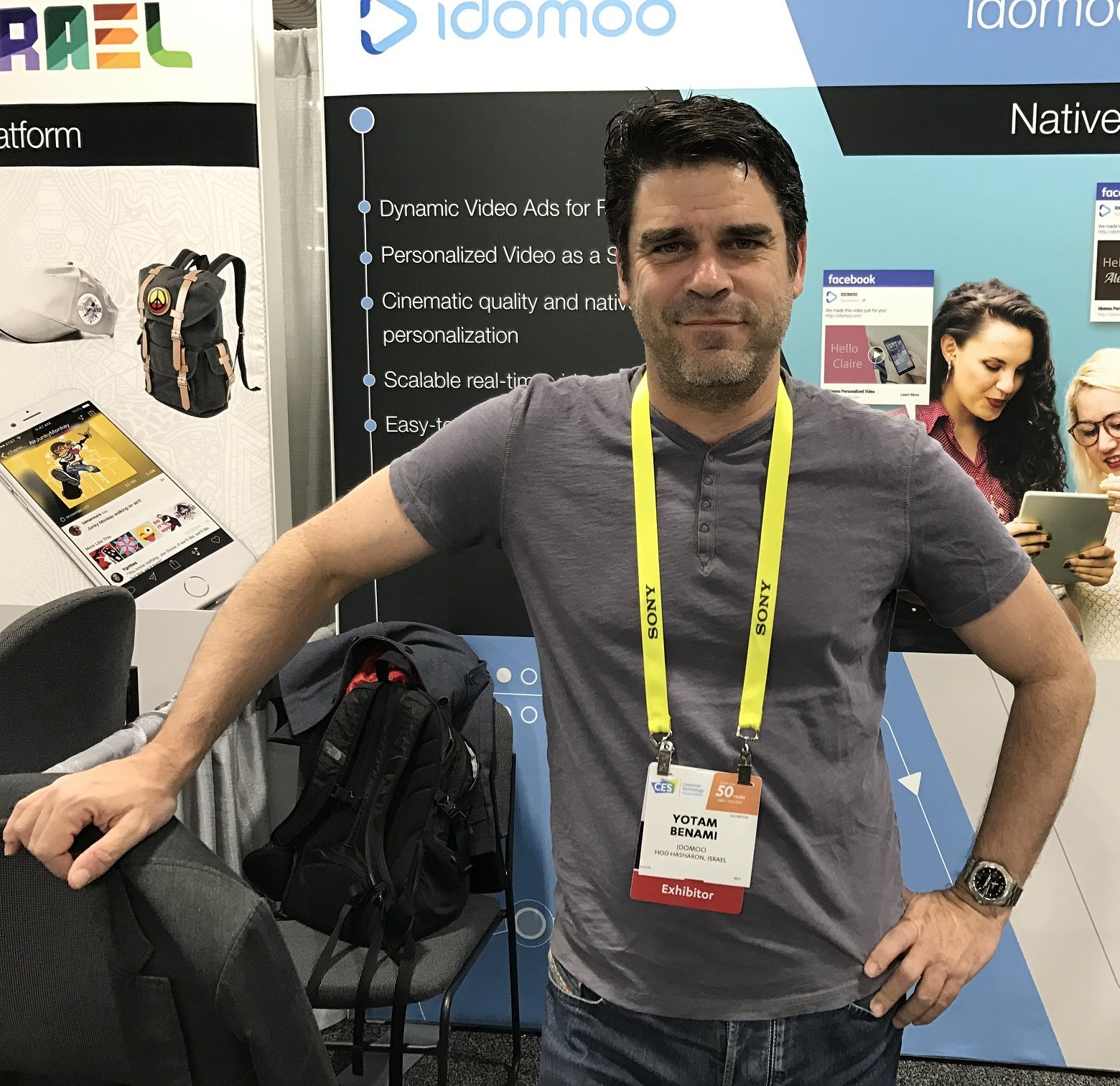
At CES in 2017, Ben Ami stood before an Idomoo display and explained the distinction plainly. Traditional production made one video for everyone; personalized systems could create different videos for different people in real time. The nearby bullet points promised dynamic ads, scalable rendering and cinematic quality. There was no friendly AI agent yet, no universal prompt box inviting a marketer to become a director before lunch. The difficult machinery sat behind the claim.
Generative AI changed the front of the machine. Ben Ami says creation that once took weeks or months and cost tens of thousands of dollars can now take minutes and cost dollars. Idomoo's Lucas product turns prompts and existing material into video; the older personalization and rendering stack can then produce variants for large audiences. His favorite formulation is that “the magic happens at the intersection of AI and personalization.” AI attacks the cost of making the thing. Personalization attacks the risk that nobody cares.
That distinction matters because abundance has poor manners. Give every department the ability to make video and soon every dashboard wants a documentary. Product catalogs become promos. Training documents acquire narration. Blogs learn to pan and zoom. The production bottleneck disappears, followed rapidly by the audience's patience.
“The reality is that whether a video is an AI video or not isn't a binary answer.”On how automation enters the creative process
Ben Ami's view of automation is more graduated than the loudest promises around it. AI may help research, brainstorm or write. It may generate images, animate them, synthesize footage or assemble the result. Customers still edit and approve what the system makes. He expects more work to travel through entirely automated paths as quality becomes consistent and behavior predictable, but he keeps returning to human judgment. In a medium capable of manufacturing synthetic confidence by the minute, approval is not an antique ritual.
Cheaper creation expands the number of ideas. Personalization increases the chance that one idea fits the viewer. Human review keeps somebody responsible for the result.
Champagne, with analytics
The clearest glimpse of his personality may be a phrase he borrows from the software trade. Idomoo, he says, believes in “drinking our own champagne.” Its production studio was once occupied with customer campaigns, leaving the company's marketers oddly short of video for their own website and mailers. With Lucas, the marketing team can produce those assets in minutes. A platform pitch becomes more convincing once the CMO has had to live inside it.
His advice to marketers begins with a joke - call Idomoo - and lands somewhere usefully unfashionable: start with the pain point. Is a blog failing to hold attention? Is ad production swallowing millions? Are new employees baffled by training material? The question is not where an AI video might be inserted. It is where communication is already expensive, slow or ignored.
This is the thread through Ben Ami's apparently zigzagging résumé. A lawyer learns to frame an argument. A consultant learns to decompose a market. A studio executive tests whether lawful distribution can outrun a bootleg. A telecom operator coordinates an open platform across makers and countries. A CMO tries to give video the responsiveness of software. Each job begins with a system and ends with the inconvenient presence of a person who must decide whether to buy, watch, trust or act.
Video that knows who is watching sounds faintly ominous until the proposition is stated from the other side of the screen. The viewer would like the bill explained, the tutorial shortened, the offer made relevant and the tedious parts omitted. Done well, personalization is more than a name dropped into the opening frame like a waiter hoping for a tip. It is respect for context.
Ben Ami's numbers-first temperament provides a necessary brake on the romance. A personalized video must still perform. An AI-generated scene must still be worth its seconds. Quality and creativity, he argues, will keep winning even as the volume of video grows exponentially. Tools can streamline execution; they do not repeal taste, accountability or the small democratic verdict delivered by a viewer who closes the tab.
The fixed video was easy to understand: one message, polished until deadline, then sent into the world. The living version is messier. It listens to data, rearranges itself, submits to testing and asks for human approval. It is never quite finished. For a strategist who prefers reality's answer to his own opinion, that may be precisely the appeal.