In one of Michael Hopkins’ old enterprise-software webinars, the questions did not arrive on cue. He waited. The silence expanded. Then Hopkins declared it “sufficiently awkward” and prepared to sign off. A question finally appeared, and he went straight back into databases, workflows and system architecture. It is a small scene, almost nothing, but it catches the particular combination that has carried him through a restless Kansas City career: comfort with complicated machinery, plus a human awareness of the room.
Today the room is larger. Hopkins is chief marketing officer at VINCUE, the Kansas City automotive technology company whose software follows dealership inventory from planning and acquisition through management and sale. He hosts the company’s Cue the Next Leader podcast. He helps stage product launches and gatherings where dealers meet the people building their tools. His remit is marketing, but the more accurate subject is the handoff between a promise and an experience.
That subject suits him because Hopkins has worked on both sides of it. He has implemented enterprise systems and explained process automation. He has marketed cars, salons and software. For a while, he helped turn rye, bourbon and a little oloroso sherry into a Kansas City brand with a top-hatted mascot. The categories wander. The work remains oddly consistent: take a system crowded with specialist knowledge and give people a way into it.
01 / The machinery beneath the message
Before the brand voice, there was the workflow
Hopkins studied organizational communication at Creighton University from 2003 to 2007. His first recorded job after college was at Cerner, where he worked as a solution delivery consultant. From there he moved deeper into enterprise content management at Perceptive Software, serving in consulting, project management and solution architecture roles. These were jobs concerned with the unglamorous parts of institutional life: where a document goes, how a process moves, which application speaks to another, and what breaks when it does not.
At RPI Consultants, he began appearing in public as both technical translator and marketing lead. In webinars on barcode indexing and the future of enterprise content management, Hopkins could discuss capture systems, license costs and integration choices without pretending every organization had the same answer. His recurring point was sober: architecture depends on the investment already in place, the requirements in front of you and the future you are actually planning for.
An RPI presentation introduced Hopkins as a “Proud Kansas Citian and Midtown Snob.” Even in a technical slide deck, place and personality had to get a line.
That work is useful preparation for marketing, though it rarely appears in a CMO fantasy. A campaign can be polished while the data is dirty. A customer journey can look handsome on a whiteboard while the CRM, onboarding process and support queue are quarrelling underneath it. Hopkins had seen the pipes before he was asked to paint the house.
02 / A useful detour underground
The whiskey had to be good. The room had to be kind.
In the West Bottoms, Kansas City keeps some of its history in brick, timber and old industrial tunnels. Alex Lindsey found one of those spaces on Craigslist and imagined a distillery there. He recruited three partners to get it open, including Hopkins as marketing director. The brand became West Bottoms Whiskey Co., and its mascot, Murdock, arrived dressed like an industrious Victorian who knew where the better bottle was hidden.
The planned opening met 2020. Public access narrowed just as the tasting room was meant to come alive. The partners adjusted, putting more energy into distribution while reservations and limited hours constrained the in-person business. Hopkins noticed the odd advantage: people stuck at home were experimenting with their home bars. A launch designed around hospitality learned to travel by bottle.
Yet Hopkins’ description of the hoped-for tasting room is more revealing than the distribution pivot. He wanted it to welcome seasoned whiskey drinkers and people who arrived saying they did not like whiskey. Nobody should need a working knowledge of grain or distillation before walking through the door. The team would teach without making the guest feel examined.
“We’re excited to teach people and we’re excited to let them take these different things and find something they like.”Michael Hopkins on the West Bottoms tasting experience
This is customer experience in its friendliest clothes. Expertise can impress people, or it can invite them in. Hopkins favored the invitation. He also rejected the usual local-business anxiety that another distillery must be an enemy. “There’s room for everyone,” he said, arguing that a cluster of makers could help Kansas City earn wider recognition as a whiskey town. Competition, in that telling, could enlarge the category.
03 / Back to VINCUE
The customer journey became the org chart
Hopkins first joined VINCUE in 2021 as chief marketing officer. After a brief hiatus, he returned in 2022 as chief experience officer. The title put him in the seam between what VINCUE told dealers and what dealers encountered after the contract was signed. He worked alongside CMO Angela Rizzo to extend the company’s brand identity, message and mission into relationships with customers and partners.
His visible project in that period was VINCUE: UNLEASHED, an annual gathering for the company’s dealers and partners. It mixed software announcements with workshops, panels, product feedback and time with the people behind the platform. The company reported that the event nearly doubled in size each year. More important than the growth was the feedback loop: dealers could describe what they needed in front of product teams empowered to build it.
In February 2025, VINCUE announced Rizzo’s retirement and Hopkins’ return to the CMO role. Dealer experience and marketing would merge. The organizational change made his long-running thesis explicit. If marketing owns the promise while another team owns what happens next, the distance between them becomes a risk. Put the functions together and the distance becomes a responsibility.
The numbers above came from VINCUE’s virtual Catalyst launch, produced with More Than Cars Creative. They show Hopkins’ version of brand theater in measurable form: hundreds of dealership rooftops represented, followed by conversations and deals. The production aspired to the polish of a technology keynote, but its value depended on what happened after the stream ended.
04 / Passing the microphone around
A host who would rather widen the conversation
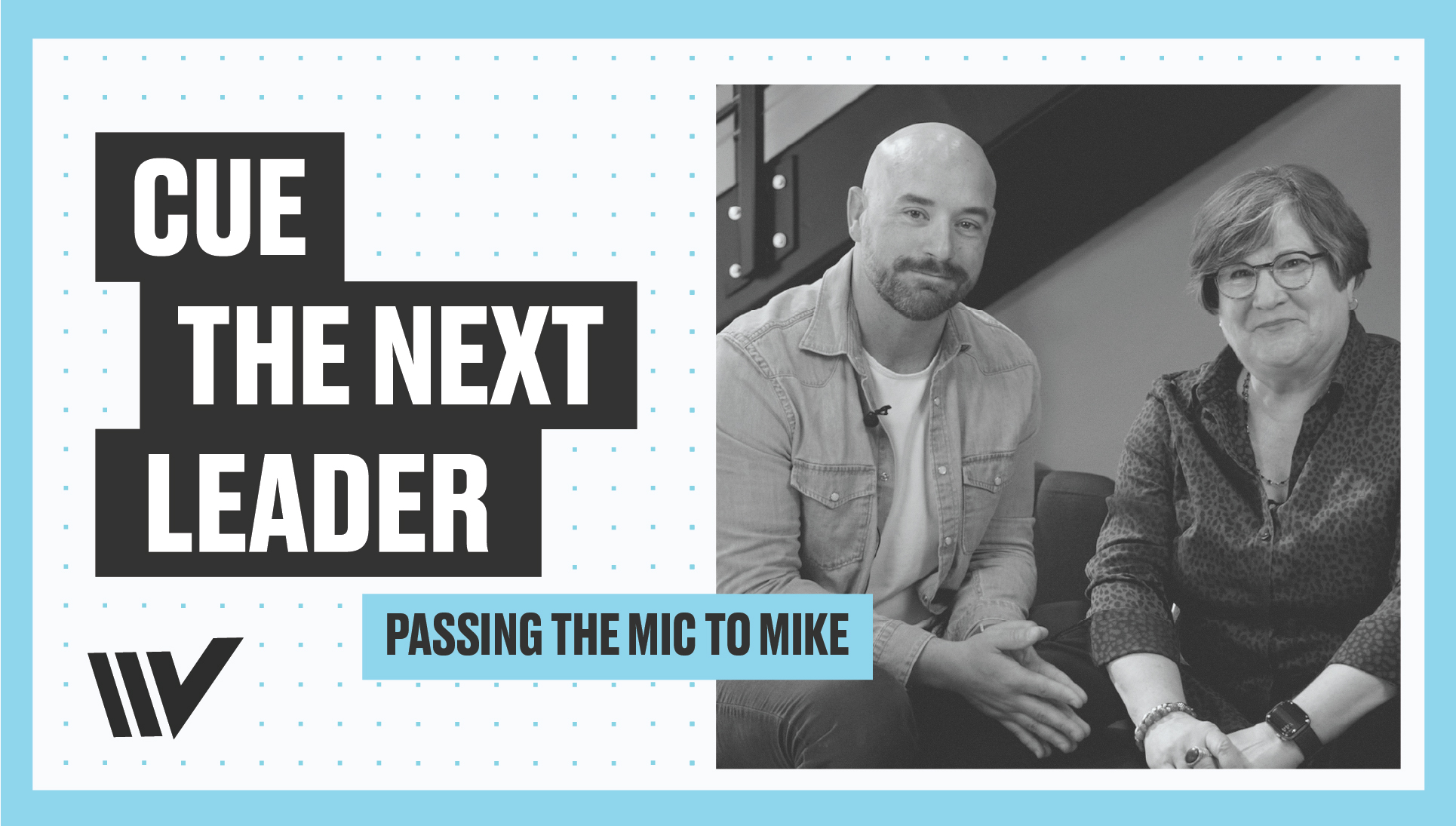
The CMO transition came with a prop. Rizzo had created and hosted Cue the Next Leader, building a library of 58 conversations. In her final episode, she handed the microphone to Hopkins. Their rapport predated VINCUE by roughly a decade, formed through volunteer projects in Kansas City. Rizzo had served as a mentor in the Metzler Mentor Program Hopkins started. The on-camera exchange therefore felt less like corporate succession and more like one friend trusting another with a room she had carefully built.
Hopkins said he wanted to invite more VINCUE employees to share the mic, along with dealers, partners and other automotive operators. That instinct matters. Corporate podcasts often reduce conversation to a brochure with breathing. A rotating cast gives the company less control, but it offers the audience more texture. The salesperson, operator, product builder and customer do not experience the same business. Letting them speak is a way of admitting the company is larger than its official voice.
His guests have since included multi-store dealers, logistics specialists and longtime operators discussing inventory sourcing, transport costs, team design and the limits of legacy tools. Hopkins is present, but the useful material belongs to the person doing the work. The old software translator has simply changed industries and added a microphone.
The same idea appears in Automotive Masterclass, which Hopkins co-founded as a series of dealers teaching dealers. In August 2026, VINCUE removed its customer gate and made the full episodes available free to automotive professionals through RockEd. Hopkins’ explanation was plain: the useful lessons come from people already living them, and keeping that knowledge fenced off worked against the point of collecting it.
The marketer’s generous wager: let usefulness arrive before the pitch.
05 / The generalist’s advantage
A career that only looks scattered from far away
Hopkins’ path can read like several résumés stapled together. There is the enterprise consultant. The marketing and communications manager. The dealership marketer. The local retail hand. The whiskey partner with the knowingly absurd title of chief propaganda officer. The CXO. The CMO. The podcast host. Search for a single industry and the route looks untidy. Search for the recurring problem and it straightens.
Each role sits between expert systems and ordinary decisions. An enterprise administrator needed to understand a content architecture. A dealership manager needs to know which vehicle to buy and how to price it. A new whiskey drinker needs permission to be curious without pretending to be a connoisseur. A podcast guest needs enough space to say something that did not begin in the talking points.
Colleagues describe Hopkins as a strategist willing to enter the weeds, whether that means implementing a CRM or building a website. The compliment fits the evidence of his career better than any polished executive adjective. He has repeatedly moved from diagram to room, from architecture to encounter. It is difficult to remain romantic about a customer journey after you have configured parts of the system carrying it.
His stated ambition at VINCUE is to use the momentum and structures already in place to scale sales, marketing and onboarding, while bringing more voices into the company’s media. Scale is where brand promises are usually tested. A small team can repair a broken handoff with memory and goodwill. A growing one needs processes that preserve the same care without turning it into a script.
Hopkins has been preparing for that problem since his first implementation job. Systems make behavior repeatable. Stories make purpose legible. Hospitality makes the whole arrangement feel as if it was designed for a person. His career has supplied him with all three, plus the good sense to notice when the room has gone quiet.